
Joseph Smith’s 1844 Presidential Campaign
In the late Nauvoo period (1843–1844), Joseph Smith and the Latter-day Saints increasingly felt politically isolated. They had been expelled from Missouri under the 1838 Extermination Order, had lost property worth hundreds of thousands of dollars, and had received no legal or governmental redress from Missouri, the federal courts, Congress, or the President of the United States.
Political Context of the 1844 Presidential Election
Breakdown of National Parties
The election of 1844 was unusual. President John Tyler, who had become president after the death of William Henry Harrison, was rejected by his own party (the Whigs) and was unwelcome among the Democrats. Tyler’s presidency was marked by conflict with both parties.
William Henry Harrison, a Whig war hero, had been elected in 1840. His campaign strategy came from the Whigs’ desire to counter earlier Democratic successes under Andrew Jackson. Harrison died a month after his inauguration, resulting in John Tyler’s presidency. Tyler had previously been a Democrat but broke with the Democratic Party and joined the Whigs. Once president, he vetoed Whig legislation, creating hostility between himself and both major parties.
Candidates in 1844
Among the main Democratic contenders were:
- Martin Van Buren, former president.
- John C. Calhoun, a pro-slavery leader, former vice president.
- Richard Mentor Johnson, former vice president.
- Lewis Cass, former governor of Michigan Territory and Secretary of War under Andrew Jackson.
The Whig Party was unified behind:
- Henry Clay, long-time statesman and leading national political figure.
Democrats were deeply divided. Ultimately, after multiple convention ballots, James K. Polk was chosen as the Democratic nominee, though Joseph had already sent letters to earlier leading candidates.
Joseph Smith’s Growing Political Disillusionment
Joseph Smith’s early belief that the American political system would rectify injustices deteriorated after the failure of all branches of government to address the violence and expulsion from Missouri. Despite years of petitions to state courts, federal courts, Congress, and President Martin Van Buren, no restitution was given and no perpetrators were prosecuted.
By 1843, Joseph Smith viewed national politics as essential to the survival of the Saints. Many Latter-day Saints were Democrats, partly due to local conditions, evangelical hostility within Whig constituencies, and immigration attitudes of the parties. However, the national Democratic Party had not protected them in Missouri or in subsequent appeals.
In mid-1843 Joseph publicly expressed support for Henry Clay, in part because leading Democratic contenders had shown unwillingness to intervene for the Latter-day Saints.
Joseph Smith’s Letters to Presidential Candidates
In late 1843, Joseph Smith wrote identical letters to the major presidential candidates, asking specifically what they would do to secure redress for the Latter-day Saints if elected. The letter summarized the Saints’ losses in Missouri, failures of legal recourse, and the refusal of Congress to act. It requested a direct answer about how each candidate would treat the issue.
John C. Calhoun’s Reply
Dated December 2, 1843, Calhoun replied that if elected president, he would administer the government strictly according to the Constitution and federal laws, which made “no distinction between citizens of different religious creeds.” He stated that the Missouri case did not fall within federal jurisdiction and repeated what he had told Joseph in their earlier meeting in Washington, D.C.—that the federal government could not intervene.
Calhoun reaffirmed that the federal government was one of “limited and specific powers,” and that Missouri’s actions against the Saints did not justify federal action.
Impact of the Candidates’ Responses
Calhoun’s refusal to intervene confirmed to Joseph that neither party nor the federal government intended to provide relief. The lack of protection from state and federal powers reinforced Joseph’s belief that American democracy had failed the Latter-day Saints.
Joseph Smith’s Response and Strategic Decisions
After receiving dismissive or negative replies from leading presidential candidates, Joseph Smith concluded:
- American institutions would not protect Latter-day Saints.
- The Saints might need to leave the United States.
Joseph authorized exploration of settlement options in:
- The Republic of Texas
- Mexican territory
- British territory in the West
Joseph Smith also concluded that he would run for President.
He decided to stand as an independent candidate in the 1844 election, forming a national political platform and sending out election agents across the United States.
Joseph Smith’s Presidential Campaign (Part 2)
After writing to multiple presidential candidates in late 1843, Joseph Smith began receiving their replies. These letters became central to his political thinking in early 1844.
In the previous episode, Joseph had sent nearly identical letters to leading Democratic and Whig contenders, asking what each would do to help the Latter-day Saints reclaim the property they had lost in Missouri and obtain redress for the violence committed against them.
Martin Van Buren
Joseph wrote to former president Martin Van Buren with additional criticism, reminding him that Joseph had personally met him in Washington in 1839–1840, where Van Buren had responded:
“Your cause is just, but I can do nothing for you.”
Joseph’s new letter included a postscript asking whether Van Buren’s views had changed since the time he “treated [the Saints’ plea] with coldness, indifference, neglect bordering on contempt.” Van Buren did not reply.
Lewis Cass’s Response
Lewis Cass sent one of the longest replies. He stated:
- The Constitution guarantees equal protection for all religious communities.
- He had vague knowledge of the Missouri events.
- If Missouri’s authorities and Congress had rejected the Saints’ petitions, he saw no power for presidential intervention.
John C. Calhoun’s Response (Summary)
Calhoun reiterated that Missouri’s actions did not fall within federal jurisdiction and reminded Joseph that he had previously explained this position in person.
Henry Clay’s Response
Clay replied that:
- He could make no promises to any particular group.
- He sympathized with the Saints’ suffering.
- He could offer no commitments beyond general constitutional principles.
Joseph Smith’s Replies to the Candidates
Joseph drafted sharp responses to the candidates.
Reply to John C. Calhoun
Joseph argued that Calhoun’s position allowed states to expel or kill citizens with impunity while the federal government claimed no authority to intervene.
Reply to Lewis Cass
Joseph pointed out that the federal government had exercised significant power during Indian Removal and therefore possessed authority to protect citizens’ rights.
Reply to Henry Clay
Joseph expressed disappointment that Clay offered sympathy without action and argued that constitutional protection meant nothing if unenforced.
Significance of the Candidates’ Rejections
By early 1844:
- No major candidate supported federal intervention.
- Both parties treated Missouri’s actions as a “state matter.”
Joseph concluded:
- Neither party would protect the Saints.
- The federal government would not intervene.
- Remaining in the United States might be untenable.
Joseph Smith’s Presidential Platform (Part 3)
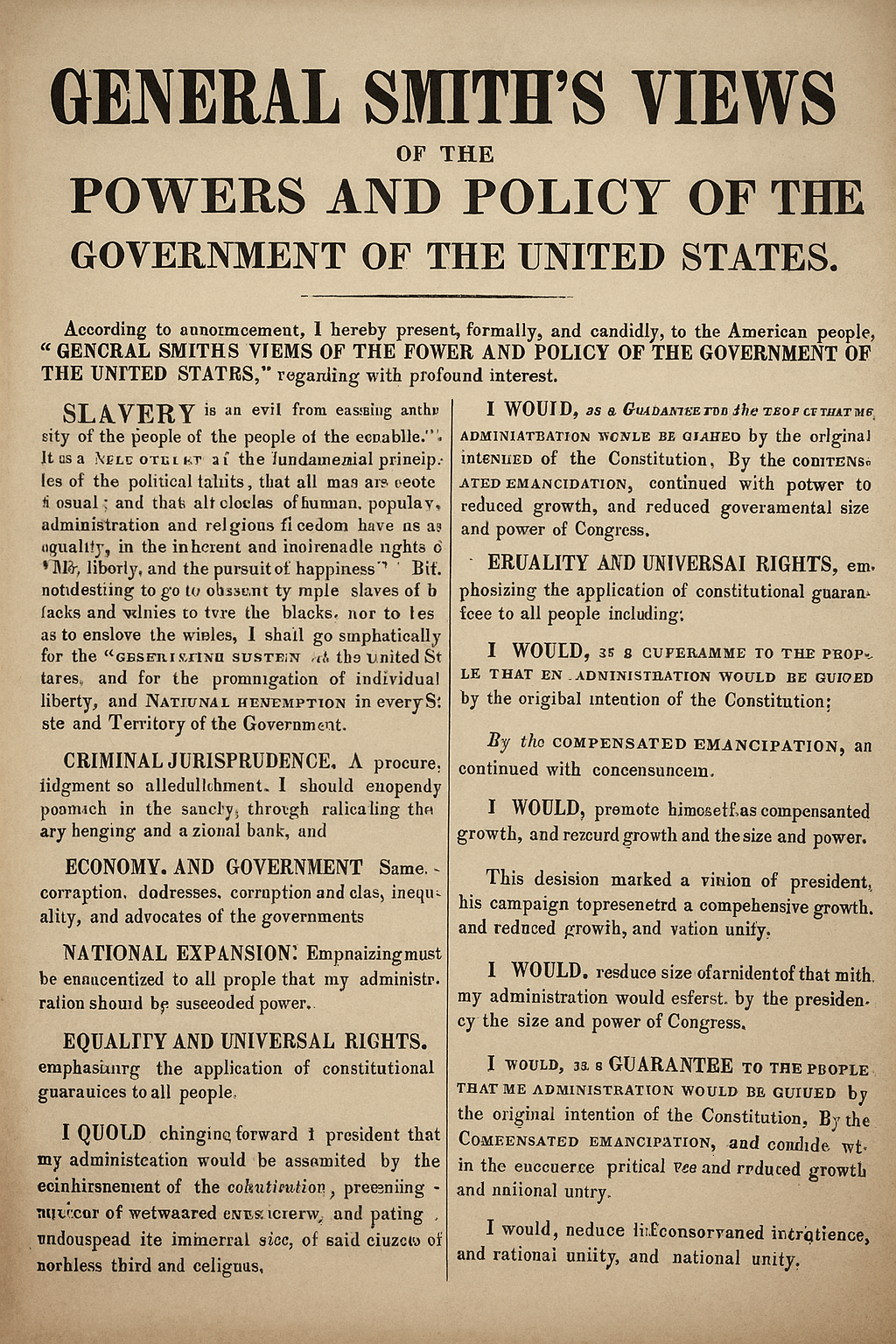
Joseph turned to outlining his own presidential platform, published as “General Smith’s Views of the Powers and Policy of the Government of the United States.”
Condemnation of Slavery
Joseph proposed:
- Abolishing slavery by 1850.
- Compensated emancipation through public land sales and salary reductions.
Criminal Justice Reform
Joseph proposed:
- Pardoning most convicts except murderers.
- Transforming prisons into educational institutions.
- Ending imprisonment for debt.
Economic and Governmental Reforms
Joseph proposed:
- Reducing the size of Congress.
- Reducing government salaries.
- Creating a national bank.
National Expansion
Joseph supported peaceful expansion with consent.
Equality and Universal Rights
Joseph emphasized equal civil and religious rights for all.
Joseph Smith’s Closing Vision
If elected, Joseph pledged to promote liberty, justice, peace, and national reform.
Aftermath
Though Joseph did not expect victory, his campaign represented:
- A formal defense of Saints’ rights
- A national critique of corruption
- One of the most radical platforms of the era
Joseph Smith became the first U.S. presidential candidate assassinated, killed at Carthage Jail on June 27, 1844.