Formation of the New Testament: How Early Christian Debates Shaped the Biblical Canon
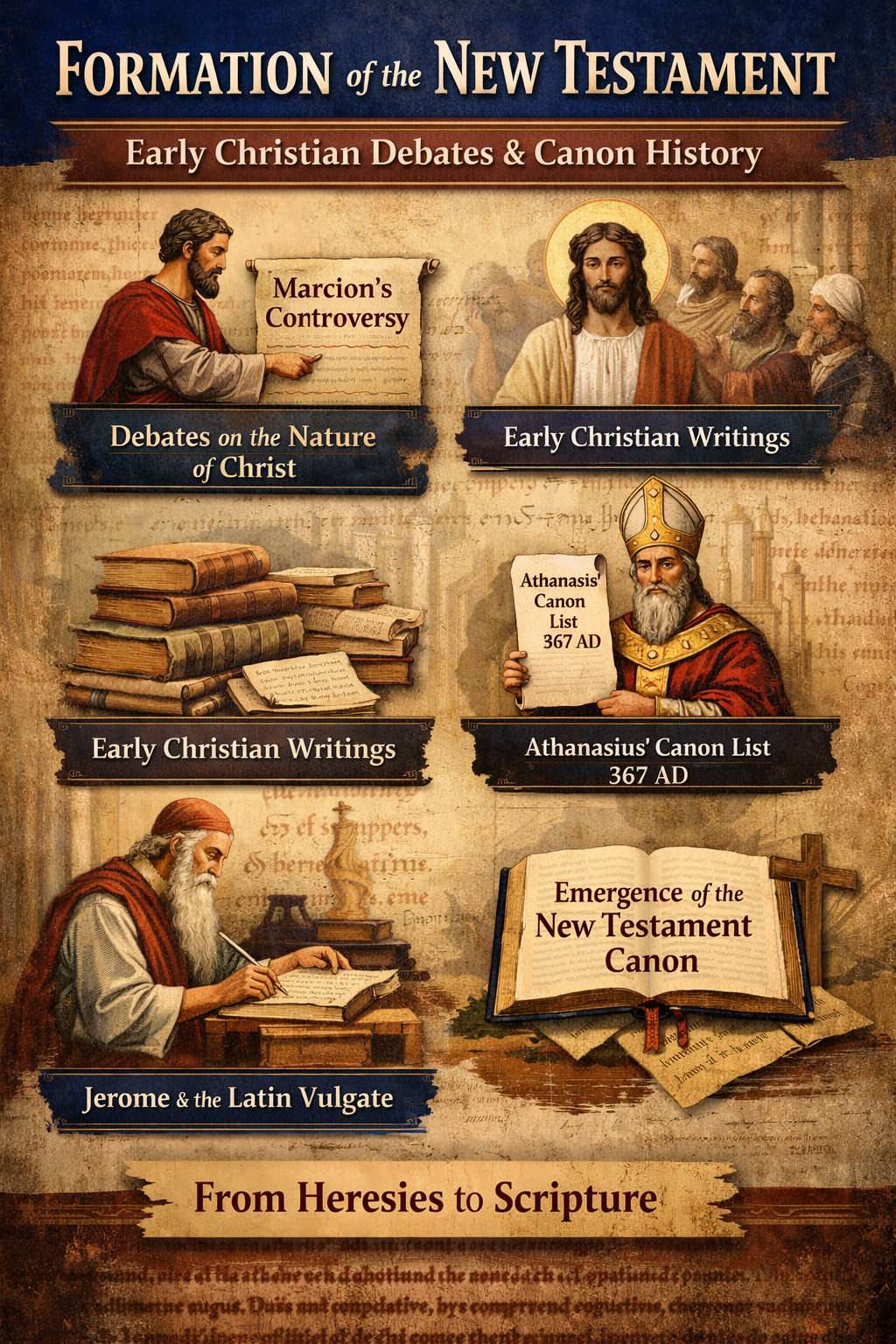
The early centuries of Christianity were marked by intense theological debates and uncertainty about which writings carried true apostolic authority. As Christian communities expanded, so did the diversity of beliefs and texts—many of them claiming apostolic origin. This environment produced a long and complex process that eventually led to the formation of the New Testament.
In this article, we will explore:
- Early Christian debates about the nature of Christ
- Marcion and his controversial canon proposal
- The absence of a closed canon in the early centuries
- Athanasius and the first complete list of New Testament books
- Jerome and the Latin Vulgate
- How the biblical canon formed over time
Early Christian Debates About the Nature of Christ
One of the greatest theological challenges of early Christianity was explaining how Jesus could be both fully divine and fully human. Competing interpretations generated intense disputes and gave rise to diverse Christian movements. Some of these views were later labeled heresies, but they played a significant role in shaping what became orthodox Christian doctrine.
During this period, numerous writings circulated among Christian communities—some authentic, others falsely attributed to apostles. Different regions used different texts, and no universally recognized New Testament canon yet existed.
Marcion and Early Canon Controversies
Marcion of Rome (2nd century) became one of the most influential—and controversial—figures in early discussions about Christian scripture. Troubled by what he saw as a contradiction between the violent God of the Old Testament and the message of Jesus, Marcion proposed a radical theological solution.
Marcion concluded that:
- The God of the Old Testament was a lesser creator deity
- Jesus revealed a higher, previously unknown God of love and salvation
- The Old Testament should be rejected entirely
- Only certain Pauline letters and an edited version of Luke should be accepted as scripture
Although Marcion was condemned as a heretic, his teachings forced Church leaders to respond by clarifying which writings were authoritative. In this way, his challenge accelerated the development of the New Testament canon.
Absence of a Closed Canon in the Early Church
Between the 1st and 3rd centuries:
- There was no fixed New Testament
- Texts circulated widely, often without confirmed authorship
- Different Christian communities relied on different collections of writings
- Some texts later labeled heretical were destroyed, limiting what survives today
Early Christian authors such as Justin Martyr referred to “the memoirs of the apostles,” indicating that scripture collections were fluid rather than standardized.
Athanasius and the First Complete New Testament List (367 AD)
The earliest known list matching the modern 27-book New Testament appears in Athanasius’s Festal Letter of 367 AD. Writing as Bishop of Alexandria, Athanasius warned believers against apocryphal works and identified the following books as canonical:
- Four Gospels: Matthew, Mark, Luke, John
- Acts of the Apostles
- Seven General Epistles: James; 1–2 Peter; 1–3 John; Jude
- Fourteen Pauline Epistles, including Hebrews
- Revelation
Athanasius also mentioned non-canonical but spiritually beneficial writings, such as Wisdom of Solomon, Tobit, Judith, and The Shepherd of Hermas.
Although influential, this list was not immediately accepted everywhere.
Jerome and the Latin Vulgate
In the late 4th and early 5th centuries, Jerome was commissioned to produce a standard Latin translation of Christian scripture. His work, known as the Latin Vulgate, became the dominant Bible in Western Christianity for over a millennium.
The Vulgate included:
- The Old Testament
- The New Testament
- Apocryphal books such as Tobit, Judith, and 1–2 Maccabees
These additional books had long been part of the Septuagint, the Greek translation of the Hebrew scriptures widely used by early Christians.
How the Biblical Canon Formed Over Time
The formation of the Christian biblical canon was:
- Gradual — unfolding over several centuries
- Non-uniform — with different communities using different scriptures
- Shaped by debate — especially disputes over Christology and heresy
- Influenced by key leaders — such as Athanasius and Jerome
- Not apostolic-era fixed — the canon was not finalized in the first century
Historical evidence shows that:
- Christianity had no universal Bible for nearly 400 years
- Many early believers read and revered texts not included in today’s canon
- The New Testament emerged through a process of debate, circulation, and ecclesiastical decision-making rather than a single authoritative moment
This history highlights that the biblical canon is the product of lived religious conflict, theological reflection, and institutional development across centuries—not a closed collection handed down intact from the apostolic age.
Listen to the Full Podcast
Season 5, Episode 25 — Formation of the New Testament
(formerly premium content from JSR)
Season 5, Episode 47 – Dead and in Hell Part 5 – YouTube