The Latter-day Saint Exodus and Fear of Federal Intervention (1846)
As the Latter-day Saints moved west in early 1846, they did so believing federal intervention was imminent. Members had repeatedly been warned that an army was coming to stop their migration. Many viewed the United States government as hostile because it had failed to protect them in Missouri and Illinois and because anti-Latter-day Saint violence continued without consequence.
Understanding the Problem With Punctuation in Historical Context
The Saints left Nauvoo in winter because they believed they were fleeing approaching federal forces. Their departure was rushed and impoverished, and severe weather, limited supplies, and disease made the Iowa crossing deadly.
Political Information and Rumors in Washington, D.C.
Samuel Brannan, presiding over the Eastern States Mission, gathered political reports in Washington, D.C. He informed Church leaders that high-ranking officials supposedly intended to prevent the Saints from reaching California or Oregon and might even attempt to destroy them. Whether accurate or not, these warnings intensified fears among the Saints.
Other sources in Washington circulated misinformation that added to the uncertainty. Although President James K. Polk later expressed public respect for the Saints, members traveling west remained unsure of federal intentions.
National Tensions in 1845–1846
During this period, the United States faced significant boundary disputes with both Great Britain and Mexico. War with Mexico appeared likely following the annexation of Texas in 1845. The Saints’ potential destinations—Oregon Territory or northern Mexico—were regions tied directly to these conflicts.
Oregon Territory
Oregon Territory (modern Oregon, Washington, Idaho, parts of Montana and British Columbia) had fewer than 5,000 settlers. The arrival of tens of thousands of Latter-day Saints could significantly influence U.S. demographic claims.
Northern Mexico
Northern Mexico—Upper California, including modern California, Nevada, Utah, Arizona, and parts of Colorado and New Mexico—was also sparsely populated. A large Latter-day Saint migration could similarly affect future American claims against Mexico.
Jesse C. Little and President Polk
Jesse C. Little replaced Brannan in Washington and sought federal assistance for impoverished Saints. President Polk met with him, asserting that he held no prejudice against the Saints and considered them loyal Americans. Polk asked whether they would raise a battalion for the Mexican-American War.
However, Polk’s private journal reveals a different motive. He recorded that the battalion was not requested because of trust but because he feared the Saints might become hostile after settling in California. He intended the battalion to serve as a means of conciliation and surveillance. He instructed military leadership to ensure Latter-day Saint volunteers made up no more than a quarter of the forces in case of rebellion.
The Battalion Request Reaches Iowa
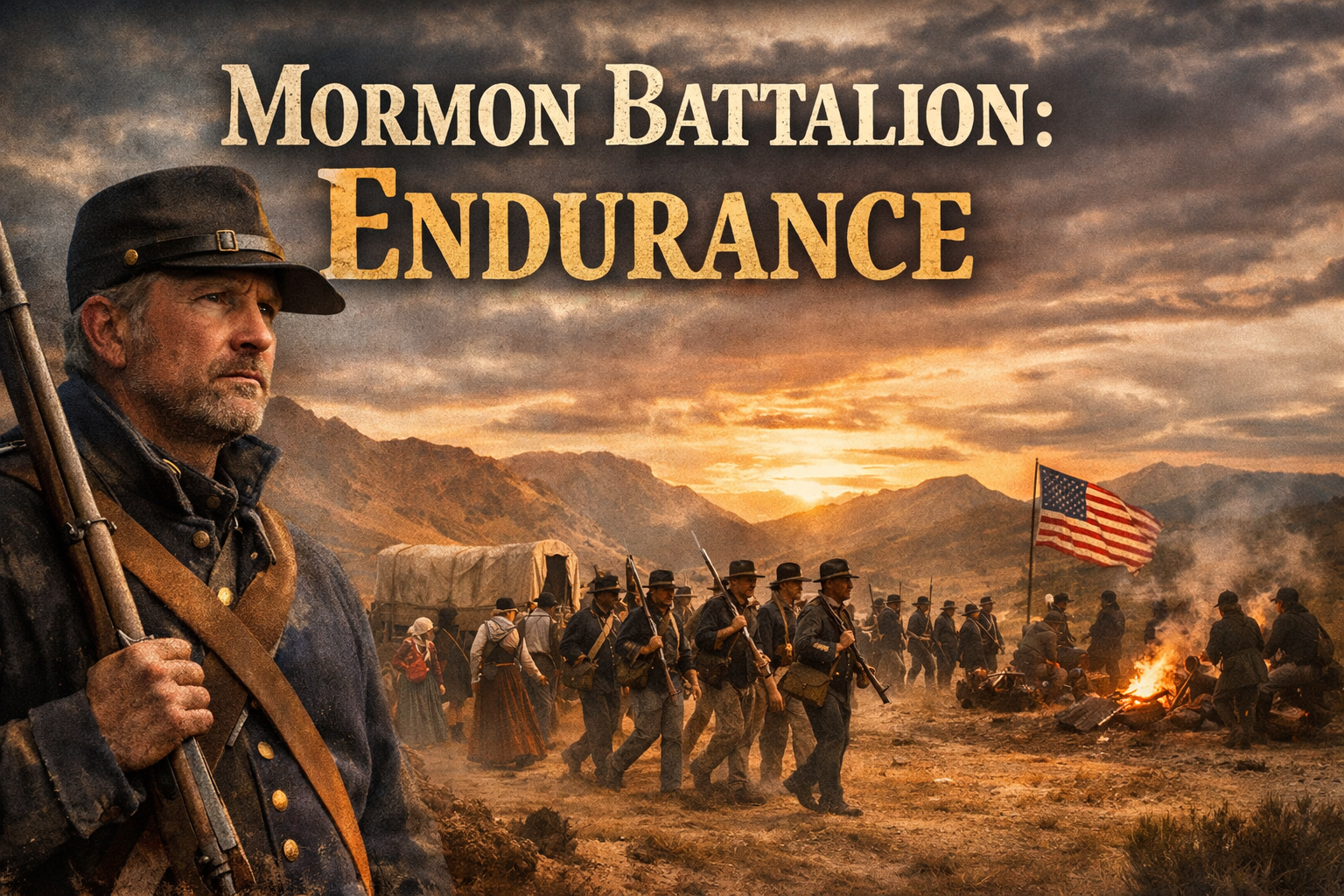
While these negotiations occurred, the Saints were suffering severely in Iowa. On June 26, 1846, U.S. dragoons approached Mount Pisgah, causing panic. Many believed the long-feared federal army had arrived to destroy them. Only after meeting the officer did they learn he had been sent to request 500 volunteers for the war.
Brigham Young had not yet received Little’s letter explaining Polk’s statements. Some Saints viewed the proposal as a potential trap. Despite limited information, Young determined that the Saints would raise the battalion.
More than 500 men volunteered, along with women serving as laundresses. Their wages were donated to support impoverished Saints, providing critical resources for the migration.
Mixed Reactions Among the Saints
Some Saints feared the request was part of a plot to destroy them. Others believed that refusing would give the government justification to treat them as enemies. Enlistment left many families without their strongest providers during a dangerous moment of the exodus.
The battalion ultimately saw no combat, though disease claimed several lives. Their march—one of the longest infantry marches in U.S. history—brought them to California at a critical stage of U.S. occupation, helping stabilize the region and discourage rebellion.
Aftermath and Brigham Young’s Assessment
By 1847, Brigham Young understood that Polk’s assurances had not been sincere. He later stated that the battalion call ultimately saved the Saints temporally by providing funds needed for migration and granting them a legitimate pretext to remain on Indian lands in Iowa. Young also believed that refusing the call would have resulted in federal interference with their westward movement.
Throughout the winter of 1846–1847, the Saints suffered severely at Winter Quarters. Disease, exposure, hunger, and death were widespread. Brigham Young rebuked murmuring and called for repentance, unity, and obedience to prophetic direction.
The Battalion as a Demonstration of Obedience
The service of the Mormon Battalion demonstrated obedience during severe hardship. Their sacrifice enabled the migration and survival of thousands of Latter-day Saints and contributed directly to the settlement of the Great Basin.
Wilford Woodruff, the Founding Fathers, and Temple Work
Temple Work in St. George (1877)
A historical question concerns whether Abraham Lincoln appeared to Wilford Woodruff in the St. George Temple. Woodruff’s journal entry from August 21, 1877, records that he was baptized in the temple for 100 deceased individuals, including almost all the signers of the Declaration of Independence (except John Hancock). He also recorded ordinances for notable figures such as Daniel Webster, Washington Irving, Henry Clay, Napoleon Bonaparte, John C. Calhoun, John Wesley, Amerigo Vespucci, Christopher Columbus, and others. Women—including Martha Washington—also had work performed.
He recorded that George Washington and John Wesley were ordained high priests. He stated that all U.S. presidents up to that time had work performed except Martin Van Buren, James Buchanan, and Ulysses S. Grant; Grant was still alive.
Woodruff’s 1898 Testimony About the Signers
In April 1898 general conference, Woodruff stated that the signers of the Declaration of Independence appeared to him and requested their temple work. He described them as inspired men raised up by God to establish the United States government. He instructed that their temple work be completed.
He reiterated that these noble spirits had personally appealed to him in the temple.
No Mention of Abraham Lincoln
Woodruff’s journal and his public testimony identify:
the Signers of the Declaration of Independence
George Washington
other prominent early American figures
Lincoln is not listed among those who appeared or for whom an appearance was claimed.
Wilford Woodruff’s Witness of Joseph Smith
Woodruff’s 1898 sermon also recounts:
An 1838 Kirtland event where men argued Joseph had apostatized; Woodruff rejected the claim.
Joseph Smith’s final address to the Twelve, in which Joseph declared that every key, ordinance, and principle of the dispensation had been conferred upon them.
Conclusion
Historical documentation confirms Wilford Woodruff performed temple ordinances for many prominent American figures. His recorded vision refers only to the signers of the Declaration of Independence, not Abraham Lincoln.
Listen to the full podcast here:
https://www.youtube.com/@standardoftruthpodcastllc