
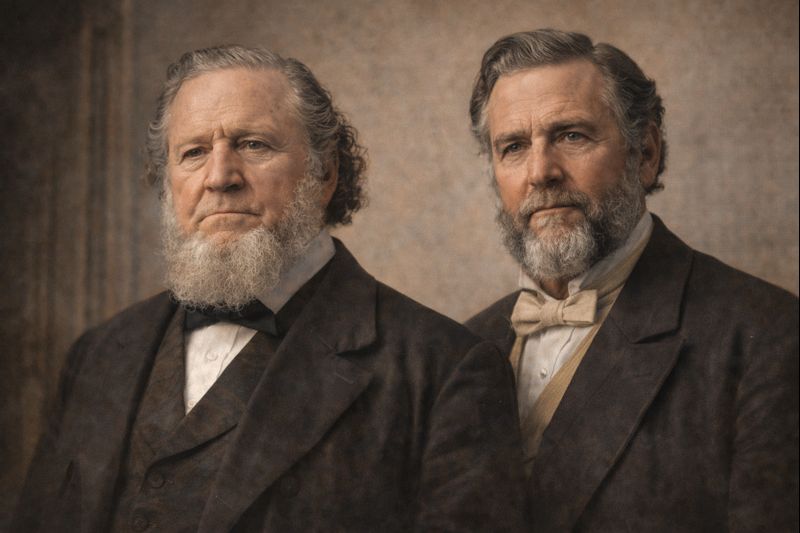
The “Never Friends” Story and Its Origin
A later family-based tradition claims that Brigham Young and John Taylor were essentially “never friends.”
One version, printed in an appendix titled “Never Friends: Brigham Young and John Taylor” in The John Taylor Papers (by Samuel W. Taylor and Raymond W. Taylor, descendants of John Taylor), relates the following:
An unnamed informant said he was in Brigham Young’s office when John Taylor walked past.
Brigham supposedly made a sarcastic remark about Taylor’s fine clothing, using the phrase “Little Bo Brummel.”
Taylor is said to have entered, declared that he sustained Brigham Young as prophet but “despised” him as a man, and then left.
This anecdote is used in that appendix as part of the argument that Brigham Young and John Taylor were personally hostile to each other.
Leonard Arrington’s Version of the Same Anecdote
In Brigham Young: American Moses, historian Leonard Arrington records a similar but notably milder story, based on an interview dated 21 August 1947 with William R. Wallace:
Wallace recalled, as an adult, being in Brigham Young’s office as a boy.
The door was partly open, and a group passed by, including John Taylor, then president of the Quorum of the Twelve. Taylor was described as tall, well-dressed, and dignified.
Brigham Young reportedly remarked, “Well, if there isn’t Prince John.”
Taylor overheard and entered, replying in substance:
“As a person, Brigham Young, you can be very small, but I still respect you as a great leader.”
In this account:
The nickname is “Prince John”, not “Little Bo Brummel.”
Taylor does not say “I despise you as a human being.”
There is no reference to Brigham in a stained or unkempt condition.
Arrington explicitly identifies his source as an interview with Wallace.
Problems of Memory and Time Gap
Key chronological and methodological issues
William R. Wallace’s age:
Born in 1865.
Brigham Young died in 1877.
Wallace could only have been a child—at most about 12 years old—during any such encounter.
Time elapsed before the interview:
Arrington’s interview: 1947 → roughly 70 years after Young’s death.
Samuel W. Taylor’s informant (interviewed in 1935) was also recalling events more than half a century later.
Given a childhood memory being retold many decades afterward, historians treat the precise wording and strong emotional color with caution. The core memory (a teasing comment and a sharp reply) may be genuine, but exact phrases and tone are less secure.
Divergences Between the Two Tellings
Comparing the two printed versions:
Nickname:
Arrington: “Prince John.”
Taylor appendix: “Little Bo Brummel.”
Taylor’s reply:
Arrington: Criticizes Brigham’s smallness “as a person” but affirms respect as a leader.
Taylor appendix: Uses the much stronger phrase, “I despise you as a human being.”
Details:
The Taylor version adds more pointed and theatrical description (e.g., clothing, contrast, and repeated morning ritual).
The differences indicate that later retellings, especially in the Taylor appendix, likely embellished the anecdote for effect. The core event may reflect real tension or teasing, but it cannot safely bear the weight of a broad thesis such as “never friends.”
The St. George Confrontation and the New York Times
The same appendix also references a dramatic episode:
Brigham Young and John Taylor allegedly clash publicly in front of the St. George Temple.
A crowd of approximately 2,000 reportedly witnesses Brigham using a vulgar curse including the phrase “God-damned…,” with the language supposedly reflected in a New York Times report.
Historical concerns
The 19th-century New York Times often printed hostile and sensational material about the Saints.
The alleged wording does not match Brigham Young’s known speech patterns, even when he was blunt or sharp.
There is no clear corroboration in contemporary Latter-day Saint diaries, letters, or minutes for such a major public outburst.
LDS historian Ronald K. Esplin, in a 1982 Sunstone session specifically responding to the “Never Friends” appendix, examined these claims and concluded that the evidence does not support the picture of a sustained, venomous personal feud.
Brigham Young’s 1875 Reorganization of the Quorum of the Twelve
A major concrete piece of evidence concerning their relationship is Brigham Young’s reordering of apostolic seniority in 1875.
Background
Orson Hyde:
Original member of the Twelve.
Left the Church during the Missouri conflicts and signed an affidavit against Joseph Smith.
Later reconciled, was rebaptized, and rejoined the Twelve.
For many years, he served as president of the Quorum of the Twelve during Young’s presidency.
Orson Pratt:
Also experienced excommunication and later rebaptism in 1842.
His seniority in the Twelve was affected by this interruption in service.
The 1875 policy decision
Brigham Young ruled that apostolic seniority would be based on continuous service in the Quorum.
Apostles who had left the Quorum through excommunication or apostasy and then returned would have their seniority dated from their reinstatement, not from their original ordination.
Immediate result
Orson Hyde, who had presided over the Quorum for roughly 28 years, lost that position.
John Taylor was advanced in seniority and became the new president of the Quorum of the Twelve Apostles.
This change established the line of succession that eventually brought John Taylor to the presidency of the Church after Brigham Young’s death.
Brigham made this decision two years before his death, without any definite knowledge of the exact timing of his passing. It was a structural move, not a last-minute maneuver.
If Brigham Young had considered John Taylor untrustworthy or “despised,” this deliberate elevation of Taylor’s seniority—and thus his likely succession—would be difficult to explain.
Evidence from Daily Leadership and Cooperation
Surviving documents—letters, discourses, council minutes, institutional decisions—show:
Brigham Young and John Taylor working together for decades on major issues:
Governing the Utah Territory.
Defending plural marriage.
Responding to federal pressure and legal actions.
Administering temple work and missionary efforts.
John Taylor consistently sustained Brigham Young in public and in official church contexts.
Brigham repeatedly entrusted Taylor with important assignments and responsibilities.
Disagreements did occur among senior leaders (for example, recorded debates between Brigham Young and Orson Pratt), but these did not necessarily equate to permanent personal hostility.
No continuous, well-documented pattern emerges of Taylor undermining Brigham, nor of Brigham attempting to marginalize Taylor.
Cautionary Lessons About Sources
This case illustrates several key principles of historical method:
Late oral recollections:
A memory reported 50–70 years after the event, especially from childhood, is inherently fragile.
Divergent versions of the same story further reduce confidence in exact wording.
Family traditions:
Descendants often preserve strong impressions (“they always clashed,” “they never got along”).
Such impressions may reflect later feelings or selective memories rather than complete historical reality.
Hostile or sensational sources:
Newspapers and outsiders may exaggerate or distort events.
Claims from such outlets must be checked against internal records before being treated as reliable.
Insufficient evidence for sweeping claims:
A small number of shaky anecdotes cannot justify broad characterizations like “never friends.”
Analogies: D&C 87 and Emma Smith
Doctrine and Covenants 87 (Civil War prophecy)
Not included in the 1835 or 1844 Doctrine and Covenants.
Published in the 1851 Pearl of Great Price and later in the 1876 D&C.
Without early manuscript evidence, a historian might wrongly conclude it was written after the Civil War.
Early copies show it dates from 1832, demonstrating that a “logical” scholarly reconstruction can be wrong when key documents are missing.
Emma Smith and plural marriage
Few contemporary statements from Emma herself about specific plural marriages survive.
Later in life, she denied that Joseph practiced plural marriage at all—a claim contradicted by multiple independent sources.
Most details about her reactions come from others’ recollections, not from Emma’s own surviving writings.
These examples underscore the need for caution with late and partial evidence—just as in the case of Brigham Young and John Taylor.
Historical Conclusion on Their Relationship
Based on the best available evidence:
Brigham Young and John Taylor sometimes experienced tension, as strong leaders often do.
They collaborated closely in governing the Church.
Brigham’s 1875 reorganization explicitly advanced John Taylor, placing him in line for prophetic succession.
The sources do not support the claim that they were lifelong personal enemies or that they “never” had a respectful working relationship.
The most historically responsible conclusion is that:
They were committed colleagues in the Restoration.
They likely had moments of friction.
Their long-term relationship was marked by cooperation and mutual responsibility rather than ongoing, irreconcilable personal hatred.