Introduction
This episode addresses a listener’s question regarding the burial location of Seymour Brunson and provides historical background explaining why Seymour Brunson is significant in Latter-day Saint history—particularly connected to the first public teaching of baptism for the dead by Joseph Smith.
Who Was Seymour Brunson?
A respected Latter-day Saint in Nauvoo
Member of the Nauvoo High Council
Lieutenant colonel in the Nauvoo Legion
Strong supporter of Joseph Smith
Died in 1840 at a young age
His funeral was notably large, with reports of a procession a mile long
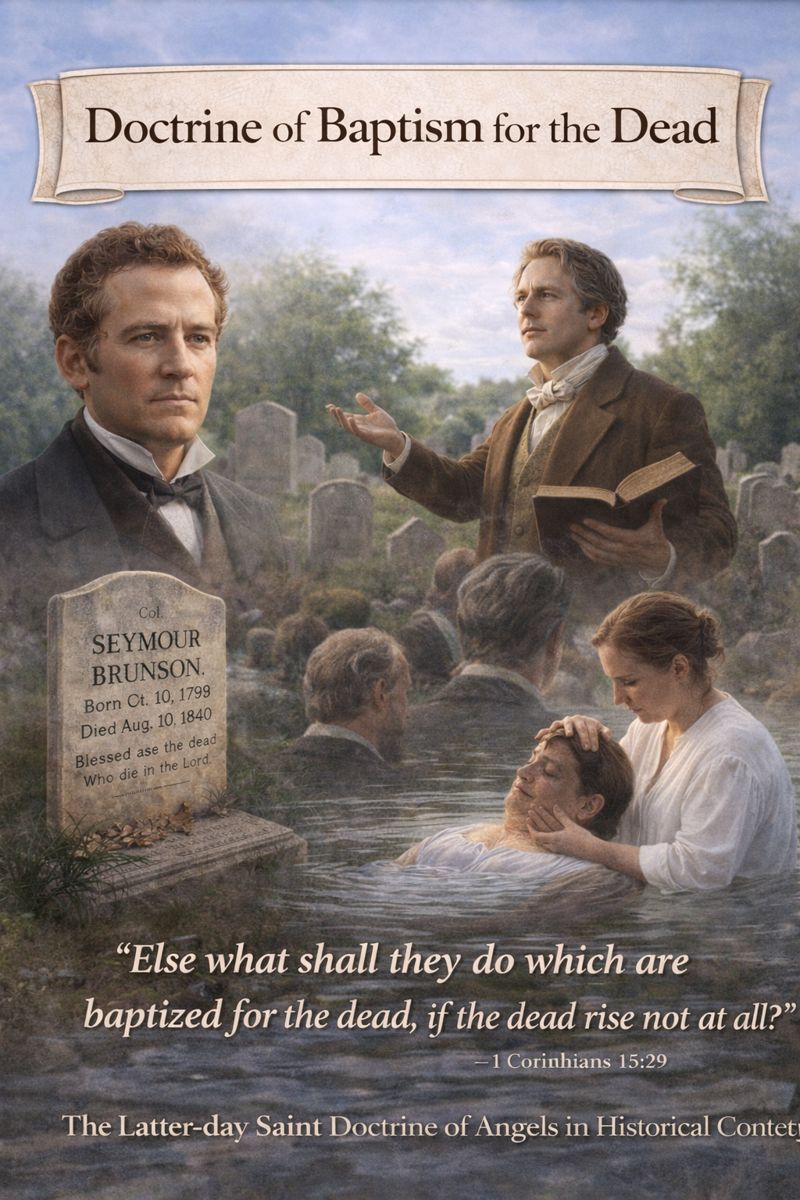
Seymour Brunson is primarily remembered because Joseph Smith introduced the doctrine of baptism for the dead publicly for the first time at Brunson’s funeral.
Why Brunson’s Funeral Matters: Baptism for the Dead
First Public Mention of the Doctrine
Although no complete contemporary transcript of Joseph Smith’s sermon survives, several later accounts summarize the content:
Account by Simon Baker
Joseph Smith read from 1 Corinthians 15.
He referenced a widow whose son had died without baptism.
He taught that baptism for the dead was an ancient Christian practice.
He explained that people could act on behalf of deceased relatives who would have accepted the gospel.
Account by James Nyman
James Nyman recorded that Joseph introduced baptism for the dead during Brunson’s funeral sermon.
Nyman’s mother immediately went and was baptized for her deceased son.
Joseph confirmed the ordinance was performed correctly.
These accounts show that Joseph publicly taught the doctrine for the first time at this funeral.
Doctrinal Background Leading to This Reveal
Before 1840, early Saints faced a doctrinal contradiction:
Baptism was required for entrance into the Celestial Kingdom (D&C 76; Book of Mormon).
Many worthy people died unbaptized, including Joseph’s own brother Alvin.
Joseph’s 1836 vision in the Kirtland Temple showed Alvin in the Celestial Kingdom.
God revealed that:
Individuals who would have accepted the gospel if given the chance could inherit the celestial kingdom.
But how this would occur remained unexplained until 1840.
Thus, baptism for the dead filled an essential doctrinal gap.
Joseph’s Letter to the Twelve (1840)
Joseph explained:
He could not reveal everything in writing.
Baptism for the dead had ancient precedent.
Saints could now be baptized for deceased relatives who would have accepted the gospel.
The ordinance was to be performed in Nauvoo.
This marks a foundational moment in Restoration theology.
1 Corinthians 15 and Baptism for the Dead
Paul appeals to the Corinthians:
“Else what shall they do which are baptized for the dead, if the dead rise not at all?”
Context of Paul’s Argument
Some Corinthian Christians denied a physical resurrection.
Paul uses baptism for the dead as evidence that physical resurrection must be real.
His argument relies on the existence of this practice.
Most New Testament scholars acknowledge Paul is referencing a real ritual.
Modern Attempts to Explain Away the Verse
Some non–Latter-day Saint commentaries attempt to reinterpret the passage by claiming:
Paul was referencing a misguided ritual by “others.”
Paul did not endorse it.
However:
Paul uses it as a supporting argument, not a criticism.
There is no biblical evidence that it was a heretical practice.
The straightforward reading is that early Christians practiced proxy baptism.
Where Is Seymour Brunson Buried?
This was the listener’s main question.
The issue is complicated because there were three Nauvoo burial locations relevant to Latter-day Saint history:
The Original Commerce Burial Ground (1839–1842)
Located near present-day Durphy Street.
Operated before the Saints created the “Old Nauvoo Burial Ground.”
Brunson died in 1840, so he was definitely buried here originally.
The “Old Nauvoo Burial Ground” (also called the Pioneer Cemetery)
Established in 1842, after Brunson’s death.
Some earlier burials (e.g., Edward Partridge) were exhumed and moved here.
There is no confirmed record that Seymour Brunson’s remains were moved.
Nauvoo City Cemetery
Established after the Saints left Nauvoo.
A modern headstone for Brunson is placed here.
This placement does not prove his body is here.
Summary of Burial Evidence
Originally: Brunson was buried in the Commerce (Durphy Street) burial area.
Possibly: His remains were moved in 1842 to the Pioneer Cemetery—but no surviving record confirms this.
Unlikely: That he is physically buried in the Nauvoo City Cemetery under the modern headstone.
Thus:
Conclusion
There is no definitive documentary proof of where his body currently lies.
The most responsible historical answer is:
Seymour Brunson was originally buried in the Commerce burial ground.
It is unknown whether his remains were later moved to the Pioneer Cemetery.
The modern headstone in the Nauvoo City Cemetery does not necessarily indicate his physical burial location.
Final Doctrinal Takeaway
Regardless of his burial location, Seymour Brunson is significant because:
His funeral sermon marks the public introduction of baptism for the dead,
One of the most distinctive and far-reaching doctrines of the Restoration.
This doctrine resolves centuries-old Christian theological contradictions,
And reveals God’s plan for the salvation of all His children, living and dead.