Introduction
The episode presents questions sent in by listeners and discusses historical and doctrinal topics related to early Latter-day Saint history. Among the subjects examined are the temple ordinances of Lilburn Boggs, the practice of rebaptism in the nineteenth century, and especially the central theme: the moment when Joseph Smith conferred the keys of the Kingdom upon the Twelve Apostles, known as the “Last Charge” or “Final Charge.”
Lilburn Boggs and Temple Work
A listener inquires about the temple ordinances of Lilburn W. Boggs and finds messages on FamilySearch indicating they are “not available—please contact FamilySearch Support.” This likely means the ordinances are locked due to multiple duplicate submissions and conflicting records from independent attempts to perform them. FamilySearch often locks access for famous historical figures to prevent repeated ordinance work. Only direct descendants can obtain more detailed information through official support.
Rebaptism in Early Church History
The episode briefly mentions that rebaptism was widely practiced by the Saints in the nineteenth century. It was used as a symbol of spiritual renewal, healing, or a reaffirmation of covenant, especially when Saints moved to new colonies or began new communal efforts. Brigham Young asked all the Saints in the Salt Lake Valley to be rebaptized as a sign of renewed commitment. The practice declined and was officially discontinued later in the nineteenth century.
Joseph Smith’s “Last Charge” to the Twelve
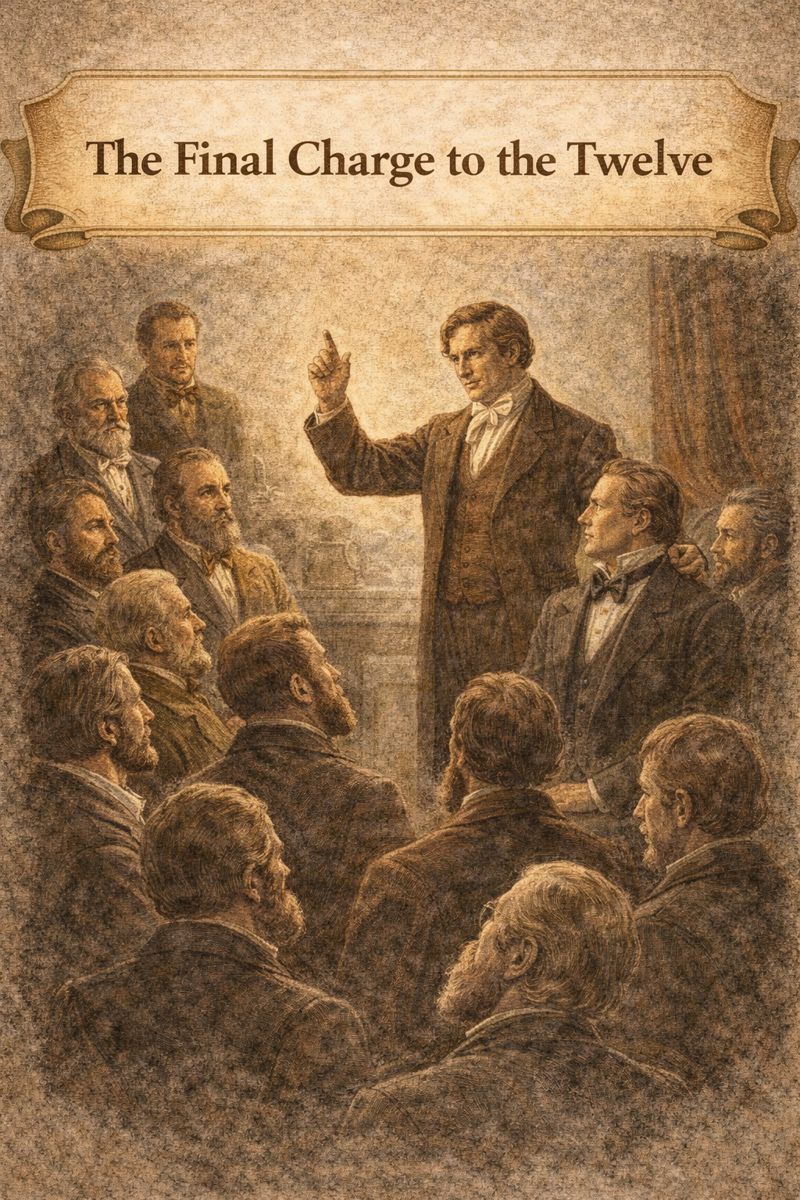
The main question concerns when and how Joseph Smith conferred the keys of the Kingdom upon the Twelve Apostles. After Joseph’s death, several figures claimed authority to lead the Church, including Sidney Rigdon and James Strang. The central historical question is why the Saints accepted the authority of the Twelve. The foundation of that acceptance is the Last Charge, a moment when Joseph, perceiving that his death was imminent, formally transferred all priesthood authority and keys to the Twelve Apostles.
Timing of the Last Charge
The event most likely occurred in March 1844. We do not possess a fully literal, contemporaneous transcript of the meeting; however, there are retrospective accounts, later testimonies, and references in the Council of Fifty records that confirm its essential content. One entry in the Council of Fifty journal dated March 26, 1844 states that Joseph “continued his instructions on heavenly things and many other important subjects,” a phrase that may be referring exactly to the same meeting described by the apostles later.
The 1845 Testimony of the Apostles
In March 1845, less than a year after Joseph’s death, the Twelve prepared an official document describing the event. They state that they were present at a council in late March 1844, together with many high priests and most of the apostles: Brigham Young, Heber C. Kimball, Orson Hyde, Parley P. Pratt, Orson Pratt, John Taylor, Amasa Lyman, Willard Richards, and Wilford Woodruff.
Joseph explained that the Lord required haste and could not wait for the temple’s completion. He indicated an “important event” was near and that his enemies might kill him. If he died before conferring the keys, they would be lost. Therefore, he needed to place them on the Twelve, who would bear future leadership responsibilities, as enemies could not kill all Twelve at once. After anointing them, Joseph declared: “I take the responsibility of leading this Church from off my shoulders and place it upon yours… I feel as light as a cork… I thank God for this deliverance.”
Wilford Woodruff’s Testimony
Wilford Woodruff, the last surviving apostle among those present, recorded several detailed accounts throughout his life. He described how Joseph spent many days instructing the Twelve, conferring upon them their endowment, and teaching them elevated doctrines. In one of these meetings, Joseph spoke for nearly three hours about the final dispensation. Woodruff wrote that the room was “filled as with consuming fire” and that Joseph’s face shone as he delivered his final words about the priesthood keys.
Joseph warned that he feared dying without passing the keys to others. He affirmed that he had received from God all the keys necessary to organize and build up the Church, and that he had now conferred them upon the Twelve. He declared that he was “removing” from himself the work and burden of the Church and placing it upon them, and that if the Twelve did not carry the Kingdom forward they would be condemned. Woodruff concluded by affirming that Joseph did not appoint anyone else besides the Twelve to lead the Church.
Wilford Woodruff’s Audio Recording (1897)
Shortly before his death, Woodruff recorded his final testimony on a wax cylinder. In that recording, the earliest known audio of a prophet, he once again confirms the Last Charge and bears witness that the Twelve received and retained the keys directly from Joseph Smith.
Succession and Continuity
Joseph prepared the Twelve to assume full leadership. Records of the Council of Fifty show that Joseph repeatedly expressed the sense that his death was approaching. Brigham Young later stated that Joseph seemed hurried by the Lord in his final year. The Twelve carefully preserved the endowment, temple ordinances, plural marriage, and the doctrine of exaltation—all that Joseph had revealed—even when those doctrines were unpopular or difficult. That ongoing preservation is presented as historical and doctrinal evidence of the legitimacy of their succession.
Doctrinal Meaning
The doctrinal teaching emphasized by the episode is that the Twelve received all the keys before Joseph’s death; that Joseph explicitly transferred to them the responsibility of leading the Church; that the early Saints recognized that authority; and that all modern temple worship and Church authority rest upon this fundamental act of key transmission.
Listen to the full podcast here:
https://www.youtube.com/@standardoftruthpodcastllc