
Introduction
This episode examines the historical foundations behind two of the most influential early anti-Mormon theories: the Solomon Spalding hypothesis and the later Sidney Rigdon collaboration theory. These claims were introduced in the nineteenth century as attempts to explain away the origins of the Book of Mormon without acknowledging the possibility of divine revelation. Using established historical methodology, this episode evaluates why neither theory holds up under scrutiny and how developments in documentary evidence eventually caused critics themselves to abandon the Spalding hypothesis. The discussion begins with a reference to premium content exploring early visions experienced by Joseph Smith Sr. and Lucy Mack Smith—visions which, like scriptural dreams, shared thematic features with material later appearing in the Book of Mormon. Critics have long used these parallels to argue for plagiarism, but the episode emphasizes the need to distinguish between thematic resonance and literary derivation, particularly when spiritual visions rather than written texts are involved.
Joseph Smith Sr.’s Visions and the Book of Mormon
Several of Joseph Smith Sr.’s recorded visions contain symbolic imagery reminiscent of scriptural narratives, including features resembling Lehi’s dream. These visions were preserved through Lucy Mack Smith’s writings and appear to reflect the family’s rich religious environment. Critics later seized upon these similarities as evidence that Joseph Smith borrowed or plagiarized thematic elements while producing the Book of Mormon. However, such claims overlook the fact that symbolic dreams are a common feature of Christian devotional life, that the Smith family was deeply engaged with the Bible, and that parallel imagery does not constitute proof of textual borrowing. The historical question, therefore, is not whether Joseph Smith Sr.’s visions share thematic motifs with the Book of Mormon but whether any evidence supports the notion that they served as sources for fabrication. Historians find no such evidence.
A Listener Question and the Role of Professional Historians
A listener asked how professional historians evaluate claims that Joseph Smith or Sidney Rigdon might have intentionally erased evidence of collaboration. This question directly confronts a common argument advanced by critics: that a lack of evidence supporting a conspiracy proves only that the conspirators successfully destroyed it. Historians reject such reasoning. Historical scholarship depends upon documented events—letters, journals, newspapers, legal records, travel logs, and contemporary testimonies. Claiming that evidence once existed but was later suppressed is not a historical argument; it is a hypothetical assertion that cannot be tested or verified. Historians therefore proceed with what the documentary record actually contains, not with what critics imagine might have been destroyed.
The Rigdon Collaboration Theory
Among the twentieth century’s critics, a popular hypothesis arose claiming that Sidney Rigdon helped Joseph Smith write the Book of Mormon in secret during 1828–1829. This theory asserts that Rigdon met Joseph Smith privately, provided doctrinal sophistication, and assisted in composing the manuscript. Yet this claim is entirely absent from early anti-Mormon writings. For example, Eber D. Howe’s influential 1834 volume Mormonism Unvailed—the foundational text of nineteenth-century anti-Mormonism—does not accuse Rigdon of participating in the Book of Mormon’s creation. Instead, Howe argues that Rigdon only joined Joseph Smith afterward and helped him explain the doctrinal content already present in the published text.
Contemporaries who knew Rigdon in Ohio made no suggestion that he traveled to Palmyra during the translation period, and his documented whereabouts contradict any such possibility. No neighbor of the Smiths, no early Church member, and no known associate of Rigdon recorded claims of collaboration. The earliest mention of the theory does not appear until long after the Book of Mormon was published and after the collapse of the Spalding hypothesis. In short, historians find the Rigdon collaboration theory untenable because it has no contemporary foundation, contradicts known timelines, and relies on unsupported conjecture.
The Solomon Spalding Hypothesis
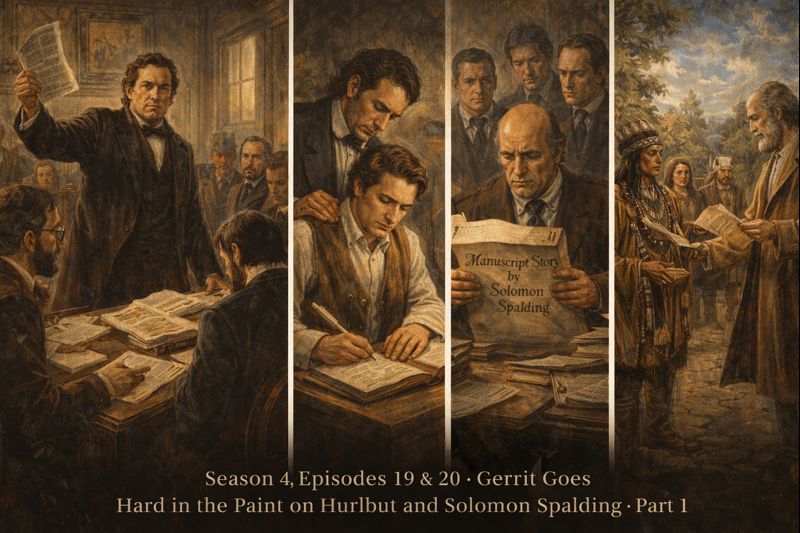
From 1834 until the early twentieth century, most critics adhered to the Solomon Spalding hypothesis. This argument claimed that the Book of Mormon derived from a lost manuscript by Solomon Spalding, a former minister who wrote fictional tales about ancient Americans. Critics argued that Spalding wrote an “ancient” romance titled Manuscript Found, that Sidney Rigdon somehow acquired it while associated with a Pittsburgh print shop, and that Joseph Smith used it—possibly with Rigdon’s help—as the foundation of the Book of Mormon narrative. This explanation dominated for nearly seventy years and was considered the primary naturalistic explanation for the Book of Mormon’s origins.
The Collapse of the Spalding Theory
The Spalding hypothesis suffered a decisive blow in the late 1880s when an actual Spalding manuscript was discovered. Published in the early 1900s as Manuscript Story, it bore no resemblance to the Book of Mormon. Its characters, narrative structure, themes, and names differ entirely from those in the Book of Mormon. Scholars quickly noted that not a single distinctive pattern or storyline matched. While some critics attempted to argue that a second, lost Spalding manuscript must have existed, such an argument required the same speculative reasoning that historians cannot accept—namely, that evidence once existed but was conveniently destroyed. The discovery and publication of the Spalding manuscript effectively ended the dominance of the theory. Only after its collapse did critics transition toward the newer Rigdon collaboration theory.
Historical Methodology and the Problem of Speculation
Throughout the episode, Gerrit emphasizes that professional historians avoid speculation such as: “Perhaps Joseph Smith destroyed all evidence of Rigdon’s involvement,” or, “Maybe the true Spalding manuscript was lost.” Such claims rely on imagined possibilities rather than historical documentation and cannot be tested or verified. Historians instead evaluate the available record, including the known chronology of Joseph Smith’s life, Rigdon’s documented travels and ministry in Ohio, testimonies from early Saints and neighbors, and early anti-Mormon writings. Based on this evidence, historians unanimously reject conspiracy theories alleging collaboration during the translation of the Book of Mormon.
Summary
Joseph Smith Sr.’s early visions reflect a deeply religious family environment and share general symbolic elements with scriptural dreams, but they do not suggest literary borrowing. The most influential early critic, Eber D. Howe, advanced the Spalding theory—not the Rigdon collaboration hypothesis. When the real Spalding manuscript resurfaced and proved irrelevant to the Book of Mormon, critics shifted to new theories. Professional historians rely on contemporary documents and therefore dismiss claims that depend solely on speculation or hypothetical destroyed evidence. Ultimately, both the Spalding hypothesis and the Rigdon collaboration theory emerged not from evidence but from the need of critics to explain the Book of Mormon without acknowledging revelation.
Gerrit Goes Hard in the Paint on Hurlbut and Solomon Spalding, Part 2
Doctor Philastus Hurlbut
Doctor Philastus Hurlbut occupies a central role in the earliest anti-Mormon efforts to undermine Joseph Smith’s prophetic calling. Hurlbut had been a member of the Church before being excommunicated for adultery committed while on a mission. After briefly expressing remorse and being reinstated, he again fell into misconduct and was excommunicated a second time. It was after this final separation from the Church that he began publicly attacking Joseph Smith, presenting himself as an insider with special knowledge of the movement.
Hurlbut embarked on a speaking tour designed to discredit Joseph Smith and the Book of Mormon. During this period, he was hired by Eber D. Howe, editor of the Painesville Telegraph, to gather negative statements from New York and Pennsylvania residents. These affidavits, despite their biases and internal contradictions, would later form the backbone of Howe’s influential book Mormonism Unvailed. Hurlbut’s hostility toward the Church escalated to such a degree that he was later found guilty in an Ohio court of making threats to kill Joseph Smith. His subsequent inability to carry out those threats does not diminish the clear danger he presented, nor the animus that motivated his actions.
Eber D. Howe and Mormonism Unvailed (1834)
Eber D. Howe’s 1834 publication Mormonism Unvailed became the first full-length anti-Mormon book and shaped critical discourse for decades. Howe relied heavily on Hurlbut’s affidavits, many of which made sweeping claims about Joseph Smith’s character as well as the origins of the Book of Mormon. The most influential component of the book was Howe’s presentation of the Spalding–Rigdon theory, which attempted to explain the Book of Mormon as a reworked fictional manuscript written years earlier by Solomon Spalding.
According to the story Howe promoted, Spalding had written an old-world narrative about ancient American settlers. Sidney Rigdon, supposedly connected with a Pittsburgh print shop, was alleged to have acquired this manuscript and later used it—together with Joseph Smith—to produce the Book of Mormon. This theory appealed to critics because it offered a naturalistic explanation for the Book of Mormon’s complexity at a time when many outsiders doubted Joseph Smith’s ability to produce such a text.
The Spalding Affidavits
The affidavits collected by Hurlbut and published by Howe included statements from individuals such as John and Martha Spalding, Henry Lake, Oliver Smith, and Aaron Wright. These witnesses claimed that Spalding’s manuscript contained stories of migrations from Jerusalem, characters with biblical names resembling Lehi and Nephi, and wars between two ancient peoples. Some asserted confidently that the Book of Mormon’s narrative structure matched Spalding’s earlier fictional creation. Given the fervor of opposition to Mormonism in the 1830s, these affidavits spread rapidly and were accepted by many as factual.
However, the affidavits shared a troubling common feature: none of the individuals quoting Spalding’s manuscript could produce the manuscript itself. Their recollections, offered more than twenty years after Spalding wrote his story, varied widely, conflicted with one another, and often contained descriptions that sounded suspiciously like they were drawn from the already-published Book of Mormon rather than from independent memory.
The Discovery of the Actual Spalding Manuscript
The debate over the Spalding theory changed forever in 1884, when the long-lost manuscript—titled Manuscript Story—was discovered among historical papers associated with the Painesville Telegraph office. James H. Fairchild, president of Oberlin College, examined the manuscript closely. His conclusion was unequivocal: the text bore no resemblance to the Book of Mormon. There were no shared names, no overlapping plotlines, no migrations from Jerusalem, and none of the biblical narrative style claimed by affidavit writers. Fairchild went so far as to state that critics would need to find “some other explanation” for the Book of Mormon, because the Spalding manuscript could not account for it.
The manuscript’s publication in 1885 confirmed Fairchild’s assessment. Readers could compare Spalding’s actual writing to the Book of Mormon for themselves. The result was devastating for the theory: every major claim made in the affidavits collapsed when confronted with the real text.
The Persistence and Decline of the Spalding Theory
Despite lacking a factual foundation, the Spalding theory became the dominant anti-Mormon explanation throughout the mid- and late nineteenth century. Newspapers repeated it, preachers used it in sermons, and politicians even invoked it in debates recorded in the U.S. Congressional Record. Missionaries frequently encountered it while proselytizing. For many Americans, the Spalding theory became synonymous with the “real” story behind the Book of Mormon.
Its popularity endured until the moment the manuscript surfaced and stripped the theory of its credibility. After that, the theory survived only in weakened forms—often accompanied by claims that Spalding must have written a second, now-lost manuscript. But this new claim suffered from the same problem as all conspiracy theories that rely on missing or imaginary documents: it was impossible to verify and contradicted by every extant piece of evidence.
Conclusion
This episode illustrates how early anti-Mormon theories depended heavily on memory-based affidavits, personal hostility, and assumptions that collapsed once primary sources emerged. Doctor Philastus Hurlbut’s campaign against the Church, Eber D. Howe’s Mormonism Unvailed, and the Spalding theory all played major roles in shaping nineteenth-century criticism of Joseph Smith. Yet the discovery of the real Spalding manuscript demonstrated conclusively that these claims lacked historical foundation. Modern historians therefore regard the Spalding theory—and the affidavits supporting it—as unreliable, inaccurate, and incompatible with the documentary evidence now available.
Listen to the full podcast here:
https://www.youtube.com/@standardoftruthpodcastllc
Season 4, Episode 19 – Gerrit Goes Hard in the Paint on Hurlbut and Solomon Spaulding – Part 1
Season 4, Episode 20 – Gerrit Goes Hard in the Paint on Hurlbut and Solomon Spaulding – Part 2