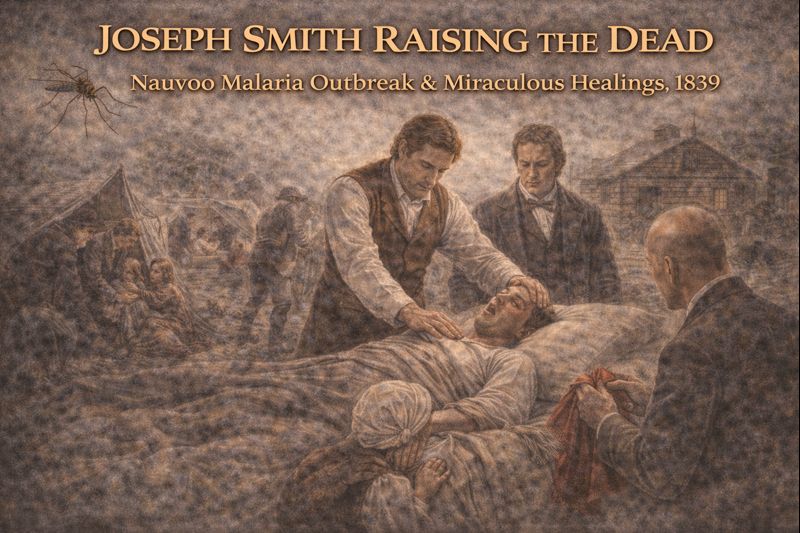
Joseph Smith Raising the Dead– Nauvoo Malaria Outbreak & Miraculous Healings, 1839)
The Nauvoo Sickness Crisis of 1839
When the Saints arrived at the swampy lowlands of Commerce, Illinois—soon to be renamed Nauvoo—they were met not with stability but disease. The stagnant Mississippi backwaters bred thick clouds of mosquitoes, and by July 1839, malaria and other fevers swept through nearly the entire population. Families lay sick in tents, unfinished homes, and makeshift shelters. Joseph Smith himself recorded that from July 8–20, the illness spread so widely that almost no household remained untouched.
Despite being ill himself, Joseph—together with the Twelve—spent hours each day visiting the afflicted, laying on hands, blessing the sick, and comforting the dying. A July 21 entry notes that church meetings were canceled due to the overwhelming sickness, yet Joseph’s journal adds something extraordinary: many were raised up through priesthood administration.
Wilford Woodruff’s Witness of “A Day of God’s Power”
Wilford Woodruff’s journal provides vivid detail that transforms the event from historical summary into lived memory. He recorded that July 22, 1839 became a day he would never forget.
On that morning, Joseph Smith—still fevered—rose from his bed and moved house to house along the riverbank, commanding the sick in a loud voice to arise and be made whole. According to Woodruff, people stood up immediately, walking behind the Prophet as he went from door to door. Notable healings included:
Elijah Fordham, who had been near death
Joseph Noble, similarly afflicted
Woodruff acknowledged that even though many were healed, others—including himself—would later succumb to intense chills and fever. His own suffering reflects the harsh medical reality of the time.
The Red Handkerchief Miracle
One of the most striking accounts from Woodruff’s later autobiography recounts how a desperate father, not a member of the Church, approached Joseph pleading for help for his dying twin infants. Too weak to travel further, Joseph handed Woodruff a red silk handkerchief, instructing him:
“Go and heal the children, and wipe their faces with it.”
Woodruff obeyed, and the infants recovered.
The handkerchief believed to be the one mentioned is preserved today in the Church History Museum.
Brigham Young’s Recollection of Joseph Commanding the Sick to Rise
Although Brigham Young’s own journal is sparse during this illness—likely due to his severe condition—the Manuscript History of Brigham Young recounts his testimony:
Joseph had taken many of the sick into his home, which effectively became a hospital. Rising from his bed, Joseph walked through the house and yard, commanding all present to get up and be healed—and they did.
He then crossed to Montrose, Iowa, where Brigham lay gravely ill. Joseph grasped Brigham’s hand and declared:
“Brother Brigham, arise and be made whole!”
Brigham said the fever left instantly. Together, they continued administering to the sick until all had been blessed. Those who witnessed the day called it “one never to be forgotten.”
A Late Reminiscence of Death and Return: The William D. Huntington Account
A much later story—published in 1892—describes William D. Huntington lying so near death that he felt himself outside his body, observing his grieving family. According to the reminiscence:
Joseph Smith entered with two brethren
Washed his hands
Laid them upon Huntington’s lifeless body
Huntington claimed he re-entered his body instantly, experiencing sharp pain as life returned. He rose, dressed, ate, and spoke as if restored in a moment.
Joseph reportedly said:
“You have witnessed as great a miracle as Jesus performed while on the earth.”
This account is faith-promoting, but historians note that it is far removed from the 1839 events and lacks the reliability of contemporary journals.
The Medical World of 1839: A Landscape of Limited Knowledge
To understand the gravity of the Nauvoo healing accounts, one must understand 19th-century medicine:
Germ theory did not yet exist.
Mosquitoes were not known to spread malaria.
Doctors practiced:
Rushian medicine (bleeding, purging, “balancing humors”), or
Thomsonian medicine (herbal heating, induced vomiting, extreme temperature therapy)
Priesthood blessings offered a hope that medical science could not.
Individuals Documented as Healed
Contemporary sources provide names and descriptions with unusual clarity:
Elijah Fordham – healed instantly after Joseph’s command
Joseph Noble – rose and walked
Brigham Young – cured on the spot in Montrose
Many unnamed Saints in Nauvoo and Montrose
These accounts appear in:
Joseph Smith’s own journal
Wilford Woodruff’s daily entries
Woodruff’s 1857 life history
The Manuscript History of Brigham Young
Together, they form the historically grounded core of the Nauvoo healing narrative.
Listen to the full podcast here:
Season 5, Episode 1 – Joseph Smith Raising the Dead