
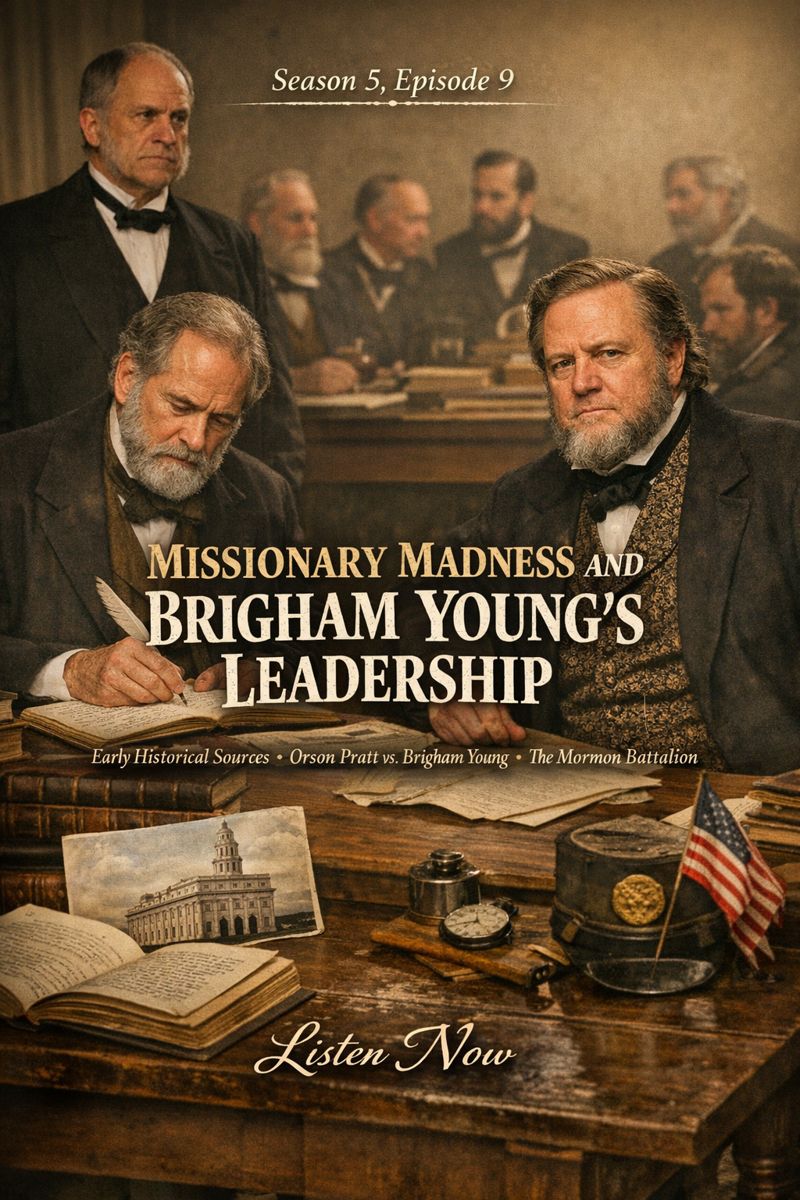
Early Historical Sources and the Study of Church Origins
Season 5, Episode 9 turns again to the earliest historical sources of the Restoration and immerses the reader in the world of Joseph Smith, the apostles who followed him, and the doctrinal tensions that emerged as the Church grew. The podcast uses original journals and records—especially those of Wilford Woodruff—to illuminate moments when strong personalities, inspired leadership, and genuine doctrinal confusion collided, revealing how the early Church learned to navigate revelation, unity, and prophetic authority.
Orson Pratt and the Nauvoo–Utah Doctrinal Disputes
During the 1850s and 1860s, the Quorum of the Twelve experienced one of the most intense internal doctrinal debates of the century. Orson Pratt, a brilliant mathematician, theologian, and missionary, developed ideas about the nature of God that troubled Brigham Young. Pratt taught that worship should be directed not to God’s literal embodied person but to His attributes, arguing that the divine perfections—not the divine being—were the true focus of adoration. Brigham Young strongly disagreed and instructed Pratt to cease teaching these ideas. Pratt, however, persisted, leading to a formal council where the apostles—guided by the First Presidency—confronted the issue.
The Apostolic Council and Wilford Woodruff’s Account
The minutes of this council, preserved in journals such as that of Wilford Woodruff, show the emotional and spiritual weight of the moment. Woodruff rebuked Pratt sharply, reminding him that he had once lost his position in the Quorum during the John C. Bennett crisis of 1842, and had returned only after rebaptism and repentance. Woodruff recorded that Pratt suggested he would not have written certain doctrines had he realized Brigham Young worshiped “a God without attributes,” a statement Woodruff said “chilled the blood” of the apostles listening. Other apostles echoed Woodruff’s concern, warning that opposing the living prophet set a person on the same path that had caused previous apostasy.
Brigham Young’s Position and His Loyalty to Joseph Smith
Brigham Young responded with doctrinal clarity and unwavering loyalty to the prophetic order established by Joseph Smith. He taught that revelation for the Church must come through the prophet, and that personal inspiration should never be taught publicly ahead of prophetic direction. This conviction was shaped during Zion’s Camp in 1834, when Brigham received independent revelation but later felt chastened for speaking before Joseph confirmed it, reinforcing his lifelong commitment to prophetic order.
The Mormon Battalion and Brigham Young’s Inspired Leadership
In 1846, as the Saints gathered at Winter Quarters preparing for the westward migration, U.S. Army Captain James Allen requested the formation of the Mormon Battalion. Exhausted, displaced, and distrustful after their expulsion from Nauvoo, many Saints—including Wilford Woodruff—suspected government motives and opposed sending men away. Brigham Young, however, discerned a divine purpose and supported enlistment. History affirmed his judgment: battalion wages aided struggling Saints, and the westward migration continued.
Brigham Young’s Leadership After the Martyrdom
The podcast explains that after Joseph Smith’s death, not every apostle agreed with Brigham Young, and some, like Orson Pratt, engaged in serious doctrinal disputes. Yet despite disagreements, the Quorum of the Twelve sustained Young as prophetic successor. The unity of the quorum preserved the Church during a turbulent succession crisis. Those who broke away—leaders such as Sidney Rigdon, James Strang, and later various Restorationist branches—gradually abandoned the temple ordinances restored by Joseph Smith. Brigham Young, by contrast, guarded the endowment, the sealing power, and the ordinances for the living and the dead. Under his leadership, temple worship expanded, and the doctrines introduced by Joseph smith—rather than fading—became the defining heart of Latter-day Saint theology.
The Preservation of Temple Ordinances Through Prophetic Keys
The episode concludes by emphasizing that the clearest historical line of continuity between Joseph Smith’s Nauvoo teachings and modern Latter-day Saint practice runs directly through Brigham Young. The offshoot movements that contested succession did not maintain sealing ordinances, the endowment, or the keys of salvation. Brigham Young did. Through him, the Saints crossed the plains, built temples, kept sacred ordinances alive, and ensured that the Restoration did not merely survive, but flourished.
Listen to the full podcast here:
Season 5, Episode 9 – Missionary Madness and Brigham Young’s Leadership
Brigham Young in 19th-century portrait