
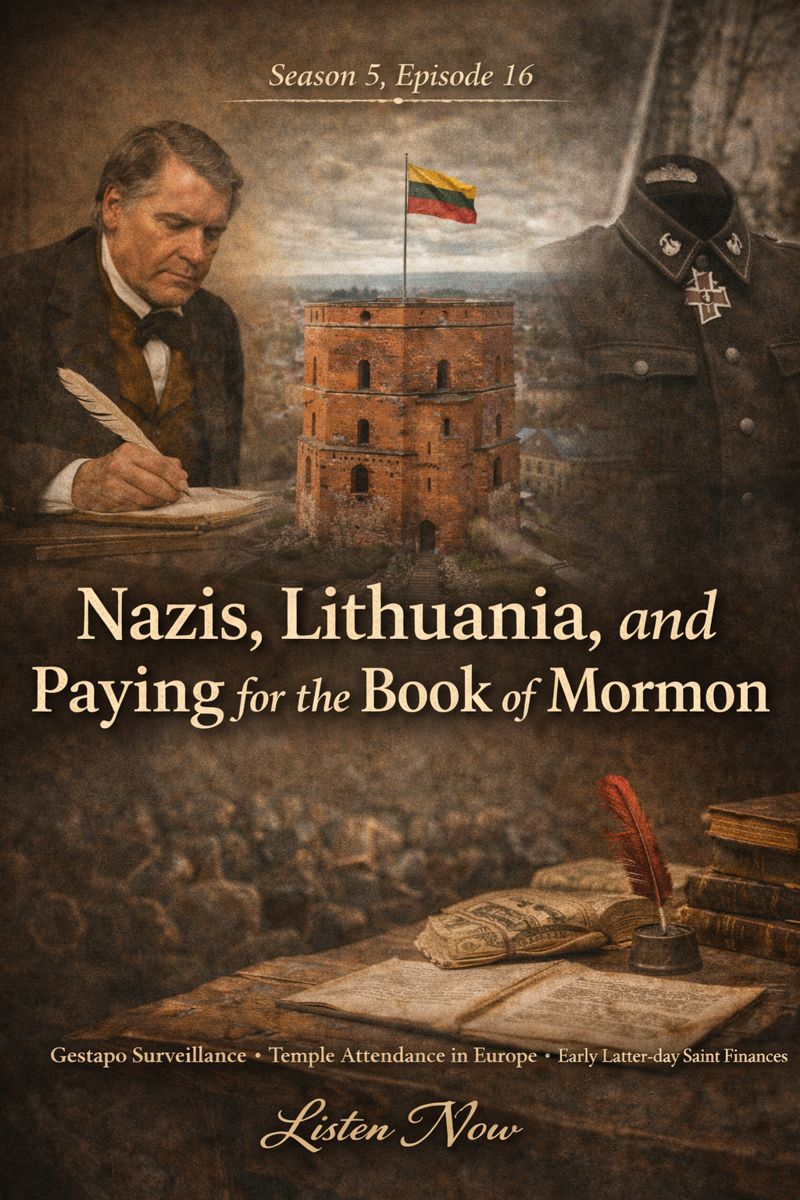
Paying for the Book of Mormon was one of the most significant financial sacrifices in early Latter-day Saint history. The cost of publication required personal risk, legal agreements, and long-term uncertainty, shaping both the historical narrative and later interpretations of the Book of Mormon’s origins.
The Sound of Music and Historical Adaptation
The Broadway musical The Sound of Music premiered in 1959, becoming one of the most successful stage productions of its era. When Hollywood adapted it in 1965, several narrative elements were changed. One example is the redesigned character of Rolf, whose film portrayal differs sharply from the musical’s original version. These differences reflect the creative liberties often taken when adapting stage works to cinema.
Gestapo Surveillance of Latter-day Saints in Nazi Germany
In a remarkable archival discovery, a historian obtained a Nazi Gestapo file documenting surveillance of Latter-day Saint congregations before World War II. Secret police officers and informants attended LDS meetings, reporting details to government ministries as potential grounds for restriction or banning. The documents reveal suspicion and hostility, including antisemitic commentary directed at Church President Heber J. Grant, directly contradicting claims that Latter-day Saints collaborated with the Nazi regime.
Temple Patron Assistance in Latter-day Saint History
The Temple Patron Assistance Fund is a Church-administered effort designed to help first-time temple attendees—particularly those receiving endowments or sealings—travel to temples that may be geographically distant. These policies are overseen by Area Presidencies, meaning guidelines differ by region according to local needs and circumstances.
Latter-day Saints in Lithuania
Lithuania today has approximately 1,000 Latter-day Saints, with the nearest temple being the Helsinki Finland Temple—a journey involving long-distance bus travel and a ferry crossing. Because of the distance and cost, local leaders have organized significant efforts to increase temple participation, a major logistical and spiritual undertaking for a small community.
Martin Harris and Early Latter-day Saint Finances
Martin Harris owned over 200 acres of farmland near Palmyra, New York. In 1825, he and his wife executed a jointure agreement assigning 80 acres to her benefit, though the document was not filed until 1828, when Harris was already involved with Joseph Smith. U.S. law at the time did not permit married women to hold property independently, so the land was placed under her brother’s name. Harris retained 151 acres, which later became essential in financing the Book of Mormon.
Paying for the Book of Mormon: The Cost of Printing (1829–1830)
The printing cost was $3,000, a staggering amount—around fifteen times the average annual income of an American laborer. On August 25, 1829, Harris mortgaged his 151-acre farm to Palmyra printer Egbert B. Grandin to guarantee payment.
Doctrine and Covenants 19: A Command to Pay the Debt
In a revelation now known as Doctrine and Covenants 19, Martin Harris was commanded to:
“Impart of thy property” and pay the debt owed to the printer.
Early accounts, including Joseph Knight Sr.’s reminiscence, describe Harris as distraught when early sales of the Book of Mormon were slow. Although later in life he claimed to have recovered the money, financial records leave the matter uncertain.
Joseph Smith’s Teachings on the Second Coming (D&C 130)
With the public fascination created by William Miller’s predicted dates for Christ’s return, Joseph Smith taught in April 1843 that he had prayed for understanding and heard a voice stating that if he lived to age 85, he would “see the face of the Son of Man.”
Joseph made clear he did not interpret this as a definitive Second Coming date. Instead, he concluded only that the Lord would not return before he reached that age—i.e., not before 1890.
William Miller and the Millerite Movement
Baptist preacher William Miller predicted Christ’s return on multiple dates between 1843 and 1845, culminating in the Great Disappointment of 1844 when the prophecy failed. Miller’s calculations were drawn from interpretations of Daniel, Revelation, Amos, and Malachi. His movement’s collapse became one of the most documented prophetic failures in American religious history.
Joseph Smith’s Teachings on Signs of the Times
Joseph taught extensively that the Second Coming must be preceded by numerous scriptural signs:
• The return of Judah to Jerusalem
• Wars and rumors of wars
• Celestial phenomena such as the darkened sun and blood-red moon
• Earthquakes and upheavals
• A heavenly sign of the Son of Man that the world would dismiss as a comet or planet
His journals record that he insisted Christ would not come in 1843, nor within “forty years to come” from 1844, citing the appearance of a rainbow as divine indication that that year was not the time of Christ’s return.
paying for the Book of Mormon
Understanding paying for the Book of Mormon provides critical insight into the financial, legal, and spiritual challenges faced by early Church leaders and supporters during its publication.
Listen to the full podcast here:
app20602.cloudwayssites.com/criticism-of-joseph-smith/
Season 5, Episode 16 – Nazis, Lithuania, and Paying for the Book of Mormon