
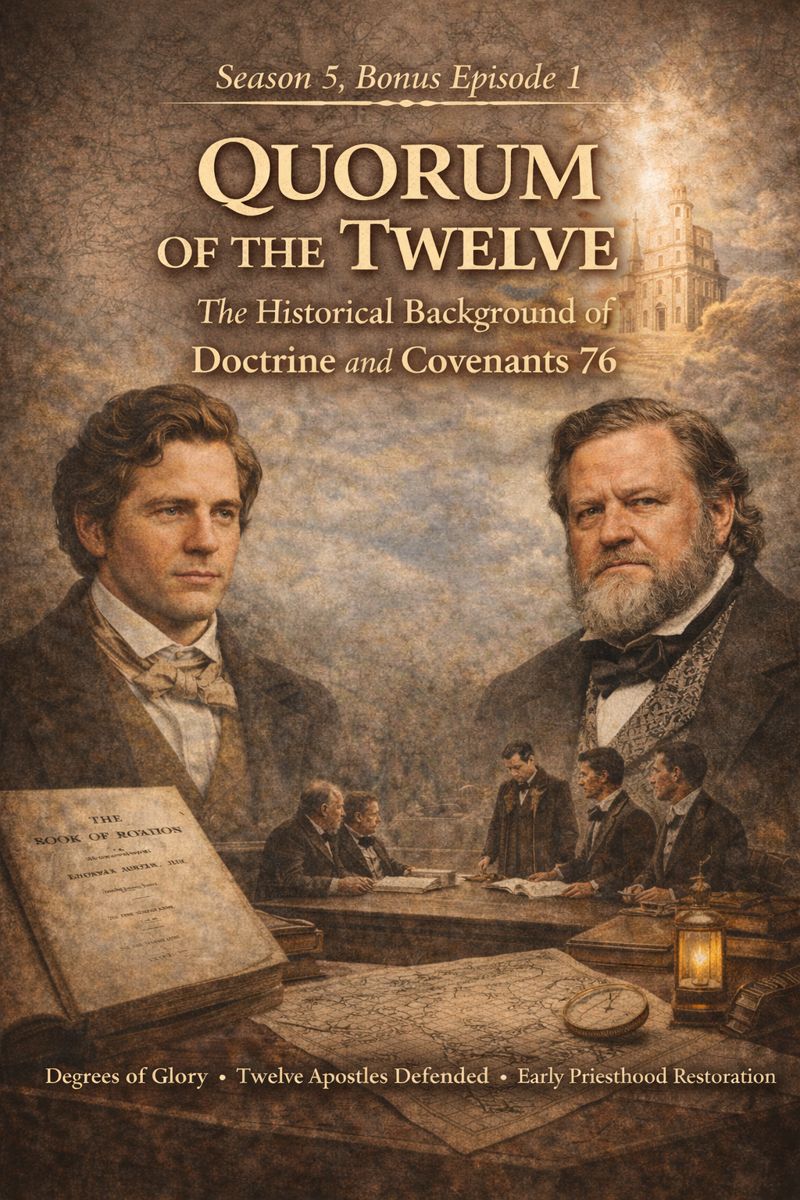
Quorum of the Twelve
The Historical Background of Doctrine and Covenants 76
Brigham Young frequently emphasized that the revelation known as “The Vision” (D&C 76), received in 1832, was among the greatest ever given through Joseph Smith. Its significance lay not merely in the introduction of multiple degrees of heavenly glory but in its transformation of Christian thought regarding damnation. In contrast to traditional Protestant teachings of an eternal and unending hell, the revelation taught that Christ’s Atonement extended to all except the sons of perdition. Even the wicked, after suffering for their sins, would ultimately inherit a kingdom of glory, and those who lived and died without hearing of Jesus Christ would likewise be saved.
This broadened understanding of divine mercy contradicted assumptions common among some early Latter-day Saints, who initially believed prominent Christian reformers were condemned. Brigham Young corrected this view by explaining that the Spirit testifies of truth wherever it appears, regardless of denomination. He taught that D&C 76 revealed more about salvation and God’s purposes than any revelation he had known.
The Scope of the Atonement and the Degrees of Glory
The teachings of D&C 76 reframed salvation as a universal process rather than a narrow path available only to a few. In its vision of the celestial, terrestrial, and telestial kingdoms, almost all of God’s children would ultimately inherit glory. Eternal punishment applied solely to the sons of perdition, and the traditional Protestant division between heaven and hell was replaced with a model emphasizing growth, learning, and redemption. The Latter-day Saint understanding of salvation therefore differed sharply from surrounding Christian traditions, asserting that nearly everyone would go to heaven.
William E. McLellin and Early Warnings
Doctrine and Covenants 66:10 contains a direct warning to William E. McLellin concerning the temptation of adultery. After his apostasy, accusations arose in Missouri claiming that he participated in theft and plundering during the 1838 conflicts, including the destruction of the homes of Joseph Smith and Sidney Rigdon. These events aligned with the earlier revelation cautioning him against moral vulnerability.
Historical Claims of a Supposed Priesthood Loss in 1834
A modern theory claims the Church lost priesthood authority in 1834 due to a temporary name change or that only those present at the 1831 Isaac Morley Farm meeting held the true Melchizedek Priesthood. Historical records refute both ideas. Joseph Smith never taught that priesthood authority was lost, and no revelation supports such a claim. The name change was administrative, ordinations were not limited to one meeting, and conference minutes show that four future apostles were present. The priesthood restored in 1829 continued without interruption.
D&C 80 and the Case of Stephen Burnett
Stephen Burnett received a revelation recorded in Doctrine and Covenants 80 directing him to preach the gospel. Despite this spiritual experience, Burnett apostatized in 1838. In a letter to Lyman Johnson, he accused Joseph Smith and Sidney Rigdon of deception and claimed Martin Harris stated that none of the Book of Mormon witnesses physically saw the plates. Burnett provided no evidence for these statements, which contradicted the consistent lifelong testimonies of the witnesses themselves. Some witnesses, such as Hiram Page, expanded their accounts in later years. Burnett’s letter is therefore considered historically unreliable, though it is often used by modern critics.
Evaluating Claims Regarding the Apostles and “Early Apostasy”
Several historical claims circulated in an email discussed in this episode asserted that the Quorum of the Twelve never received an endowment of power, that plural marriage originated with the Cochranites, and that Joseph Smith did not teach or practice polygamy. Historical evidence contradicts each of these claims.
Not all of the original Twelve were church members when early spiritual outpourings occurred in 1831, so the claim rests on a misunderstanding of the timeline. Regarding the Cochranites—a small sect from Maine practicing free-love “spiritual wifery”—no evidence exists showing any early Latter-day Saint converted from that group or adopting their teachings. The idea that the Cochranites influenced LDS plural marriage traces to late, second-hand, unreliable sources, not contemporary records.
The Question of D&C 131 and 132
Some claim that Doctrine and Covenants 131 and 132 were invented later by Brigham Young, but historical manuscripts prove otherwise. D&C 131 originated from William Clayton’s notebook recording Joseph Smith’s teachings in 1843, and D&C 132 was dictated by Joseph Smith in 1843, copied by Clayton and Newel K. Whitney, and referenced by Hyrum Smith and Joseph’s plural wives long before the revelation was added to the Doctrine and Covenants in 1876. Scripture canonization in LDS history has always occurred gradually, so late inclusion does not imply fabrication.
The Name of the Church and the Question of Apostasy
The temporary name “The Church of the Latter Day Saints” was adopted in 1834 by unanimous vote in a meeting Joseph Smith moderated. Later, D&C 115 designated the full name “The Church of Jesus Christ of Latter-day Saints.” The theory that the 1834 name indicates apostasy contradicts both the revelation and the historical record.
The Nauvoo Temple and Claims of “Rejection”
Some argue the Church was rejected for failing to complete the Nauvoo Temple, but no revelation teaches such a principle. Ordinances were performed in the unfinished temple, and its later destruction by arsonists reflected persecution, not divine rejection.
Reasons for the 1846 Exodus from Nauvoo
Claims that the Saints fled Nauvoo to avoid legal prosecution are historically false. The exodus followed years of hostility, violence, and the assassination of Joseph and Hyrum Smith. Contemporary sources—including governmental and journal records—demonstrate that the Saints were forced to leave.
Why Historians Reject “Early Apostasy” Theories
If these apostasy theories had merit, scholars—particularly non-LDS historians—would advance them. They do not, because the evidence contradicts them. Theories built on late, unreliable, or misquoted sources cannot withstand historical scrutiny. The documented record supports continuous priesthood authority, Joseph Smith’s teachings on plural marriage, the leadership of the Twelve, and the authenticity of the Book of Mormon witnesses.
Listen to the full podcast here: