
The Setting: The School of the Prophets and Early Health Concerns
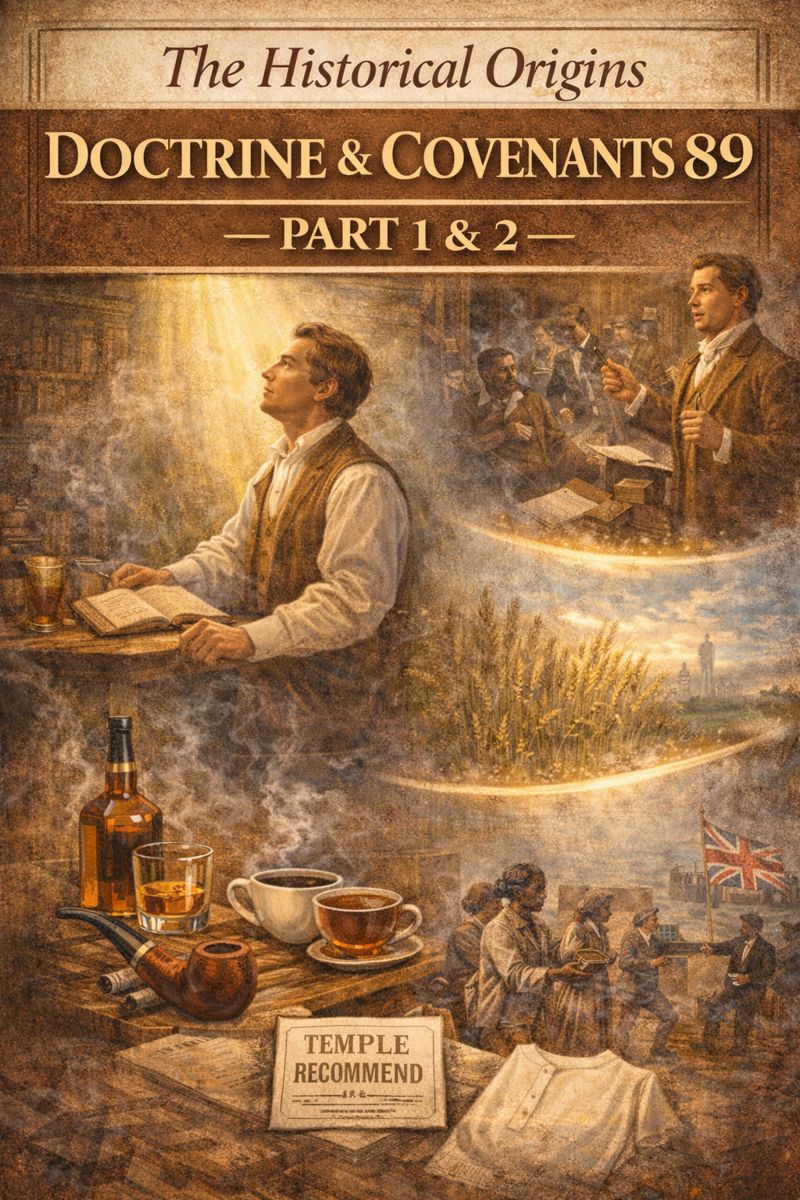
The Word of Wisdom arose in the context of the School of the Prophets, organized in late 1832. Meetings were held in the small, upper room of Newel K. Whitney’s store in Kirtland. The space was overcrowded, poorly ventilated, and frequently filled with smoke from elders who smoked pipes and chewed tobacco. Contemporary recollections—including those attributed to Brigham Young—describe tobacco spit on the floor and lingering smoke that made the room unpleasant to occupy. Joseph Smith observed these conditions closely and reflected on their impact before seeking divine instruction.
The Influence of the American Temperance Mvement
The revelation emerged during a period of expanding temperance activism across the United States. The movement encouraged moderation in alcohol consumption, with only a minority calling for complete abstinence. A smaller number of reformers criticized tobacco, and fewer still commented on coffee or tea. Although Joseph Smith was aware of these cultural forces, the combination of restrictions found in the Word of Wisdom did not reflect any single temperance program of the time.
Joseph Smith’s Inquiry and the Revelation of February 27, 1833
Concerned both by the environment in the School of the Prophets and by broader questions about health and conduct, Joseph Smith discussed the issue with associates and sought guidance from God. The resulting revelation—now Doctrine and Covenants 89—was received on February 27, 1833. It opened by identifying itself as a principle “not by commandment or constraint,” a characteristic that distinguished it from most early revelations.
How Early Saints Understood the Instruction
The early Church did not interpret the Word of Wisdom as a mandatory abstinence code. The guidance emphasized caution and moderation rather than categorical prohibition.
Wine continued to be used for the sacrament throughout the nineteenth century, and the revelation permitted such use. Distilled liquors such as whiskey were discouraged as harmful, yet moderate consumption of alcoholic beverages was still common. Tobacco was described as inappropriate for the body but acceptable for limited medicinal purposes. Early Saints viewed this principally as instruction for the School of the Prophets rather than a universal prohibition.
Interpreting “Hot Drinks” and Dietary Principles
The text of the revelation does not identify coffee or tea by name. However, Hyrum Smith later clarified publicly that “hot drinks” referred specifically to tea and coffee, establishing the interpretation that became standard among early Latter-day Saints. Dietary teachings in the revelation emphasized the value of herbs and grains and advised that meat be used sparingly, though members did not adopt this as a strict rule. The practical application of these principles varied widely during the nineteenth century.
The Promises Attached to the Word of Wisdom
The revelation concluded with promises of physical health, wisdom, and spiritual insight for those who observed its precepts. It also invoked imagery from the Passover story, suggesting that obedience would symbolically protect the faithful. The framing of the Word of Wisdom as a covenant marker underscores its spiritual purpose beyond health considerations.
The Historical Development of Doctrine & Covenants 89 (Part 2)
Early Church Practice: The Word of Wisdom as Counsel (1830s–1840s)
During the earliest decades of the Church, formal disciplinary systems were limited. Excommunication was the primary form of discipline, and it was reserved for serious offenses. As a result, violations of the Word of Wisdom did not typically lead to removal from fellowship. The revelation’s introductory phrase—“not by commandment nor by constraint”—guided early interpretation.
Moderate alcohol use was widespread among early Saints, while drunkenness was condemned. Tea, coffee, tobacco, and alcohol continued to be used by members, reflecting the gradual nature of cultural and doctrinal adaptation.
Hyrum Smith’s Advocacy and Joseph Smith’s Personal Practice
Hyrum Smith publicly encouraged stricter observance and, in a sermon published in the Times and Seasons, identified tea and coffee as the meaning of “hot drinks.” Joseph Smith himself, however, continued to use alcohol, tea, and coffee on occasion. His journals record such instances, including the use of beer in Nauvoo and tea during meals. John Taylor’s later description of the events in Carthage Jail mentions that Joseph and his companions drank wine, clarifying it was not for sacramental use but to lift their spirits during captivity.
Growing Emphasis under Brigham Young (1847–1877)
As Church leader in the Utah period, Brigham Young increasingly pressed for adherence to the Word of Wisdom. In sermons delivered in the 1850s and 1860s, he condemned drunkenness and clarified publicly that “hot drinks” referred specifically to tea and coffee. By 1869, he called upon members under the age of one hundred to cease using tobacco and whiskey. He also predicted that the Word of Wisdom would one day become a test of fellowship, though this standard had not yet been implemented.
Late Nineteenth-Century Developments
During the late nineteenth century, stricter enforcement of the Word of Wisdom gradually expanded. Alcohol and tobacco use became impediments to leadership responsibilities. However, temple attendance was not universally restricted for Word of Wisdom violations, and flexibility was extended to older members whose lifelong habits were more difficult to change. President Joseph F. Smith encouraged strong observance but maintained pastoral accommodations.
Early Twentieth Century Transformation: From Guideline to Commandment
A major shift occurred in 1921 under President Heber J. Grant. Church leaders were instructed to deny temple recommends to those who used alcohol, tobacco, coffee, or tea, marking the first time adherence became a formal requirement for temple worship. The 1933 Church Handbook of Instructions codified these expectations, establishing obedience to the Word of Wisdom as an institutional standard.
Modern Clarifications
In 2019, the Church provided additional guidance on products falling within the scope of the Word of Wisdom. Prohibited items included coffee and coffee-based drinks, green tea, iced tea, vaping products, e-cigarettes, and recreational marijuana. Prescription medical use of opioids or cannabis was acknowledged as acceptable when supervised by a licensed physician.
Listen to the full podcast here:
Season 5, Bonus Episode 7 – Kristy’s KorneЯ – Rerelease of D&C 89 – Part 1
Season 5, Bonus Episode 8 – Kristy’s KorneЯ – Rerelease of D&C 89 – Part 2