Introduction
Many Latter-day Saints today are curious about the relationship between Abraham Lincoln and the early Latter-day Saint movement, as well as how Church members viewed Lincoln. Because the Restoration emerged within the United States, some American Saints blend religious and national history, creating a desire to understand how major figures—such as Lincoln—interacted with or perceived the Church.
However, the political and cultural world of the mid-19th century was vastly different from today. To understand Lincoln’s relationship with the Saints, we must examine the political environment, the rise of the Republican Party, and the longstanding anti-Mormon sentiment that shaped federal policy.
Early Anti-Mormon Rhetoric in American Politics
Hostility toward the Saints existed long before plural marriage became public. Polygamy later provided a convenient justification, but prejudice against Latter-day Saints was already decades old.
A key example is Eber Howe, author of the first anti-Mormon book in U.S. history. While Howe was a critic who harmed the Saints’ reputation, he was simultaneously an abolitionist involved in the Underground Railroad—illustrating the complexity of political identities and moral judgment in the period.
Political Landscape Before the Civil War
The Whig Party
Before its collapse, the Whig Party emphasized:
- National banking
- Tariffs
- Infrastructure
It was weaker than the Democrats, and internal divisions—especially over slavery—led to its dissolution.
The Rise of the Republican Party
Formed in the mid-1850s, the Republican Party was founded on two explicit goals:
- Stop the spread of slavery in U.S. territories
- Eliminate polygamy in the territories
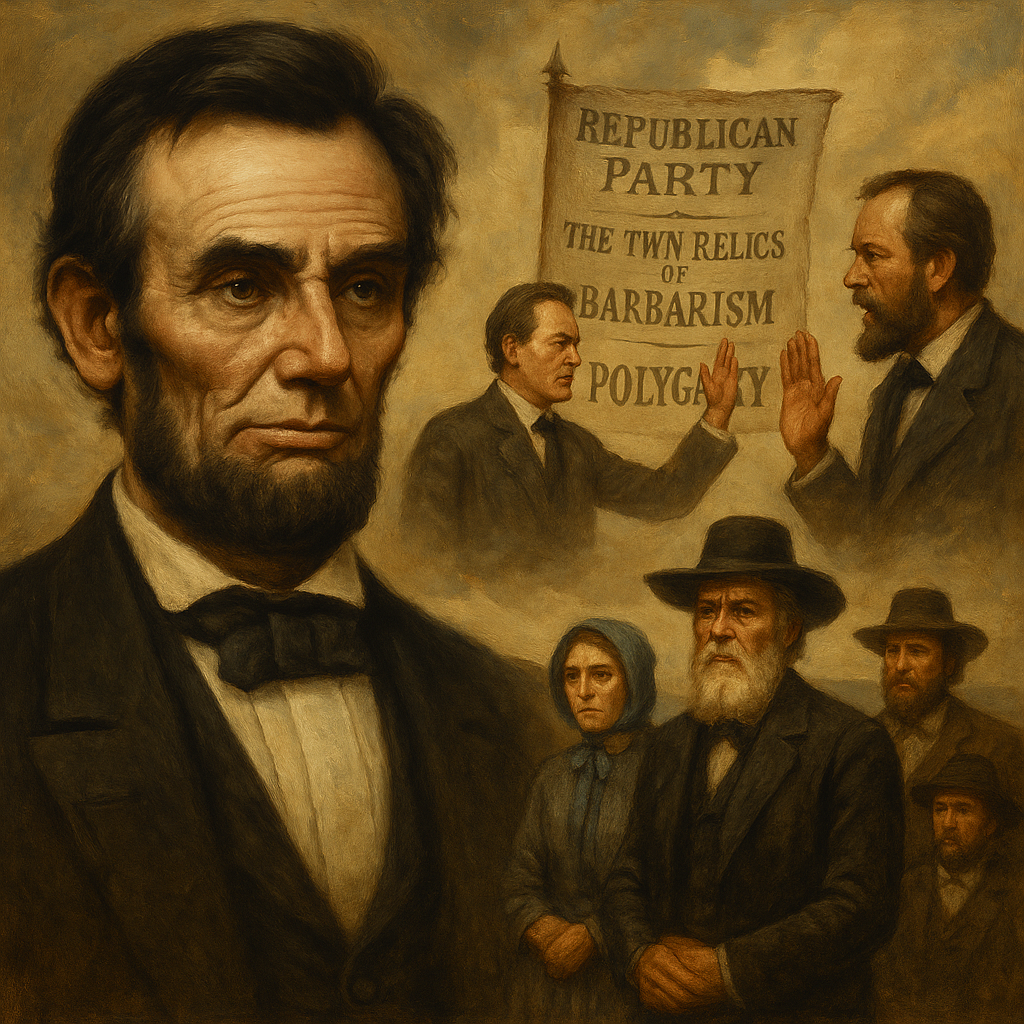
The 1856 Republican platform famously called slavery and polygamy the “twin relics of barbarism.”
From its beginning, Republican ideology was officially anti-Mormon. Although Democrats also opposed the Saints, Republicans made the destruction of polygamy a defining political mission.
Why Democrats Opposed Anti-Polygamy Bills
Democrats did not defend plural marriage because they supported the Church; they defended it because of states’ rights.
In 19th-century political vocabulary:
- Slavery was a domestic institution
- Marriage was also a domestic institution
Democratic reasoning:
“If Congress can outlaw polygamy in a territory, then Congress can outlaw slavery in a territory.”
To avoid setting a legal precedent that endangered slavery, Democrats blocked federal anti-polygamy laws.
Republicans exploited this, accusing Democrats of being “pro-polygamy” and using the Saints as a political weapon.
Republican Attacks Against the Latter-day Saints
Anti-Mormon rhetoric was common in Republican speeches. A notable example is Rep. Stephen C. Foster of Maine, in an 1860 speech promoting the Homestead Bill.
He argued that settling western lands with non-Mormons would:
- Overwhelm Mormon political power
- End polygamy
- “Extinguish Mormonism”
- Subdue the Saints under “Christian civilization”
He accused Latter-day Saints of:
- Defying federal law
- Insulting judges
- Murdering citizens
Published by the Republican Congressional Committee, his speech reveals that anti-Mormonism was mainstream Republican policy.
Why Early Latter-day Saints Distrusted Republicans
By 1860, Utah Latter-day Saints viewed Republicans with hostility due to:
- The Republican platform targeting plural marriage
- Republican politicians attacking the Church in Congress
- Federal attempts to pass anti-polygamy laws
- Connections between Republican leaders and earlier anti-Mormon figures
- The Utah War (1857–1858), which deepened mistrust of the federal government
Thus, when Abraham Lincoln ran for President, most Saints did not see him as a friend.
Lincoln’s Background Before the Election of 1860
Before becoming president, Lincoln:
- Was a former Whig
- Joined the Republicans because of his opposition to slavery
- Became nationally known through the Lincoln–Douglas debates
- Had limited visibility in Utah
In the debates, Lincoln criticized polygamy, though not with the contempt shown by Stephen A. Douglas.
By the late 1850s, both major parties were hostile toward the Church, leaving the Latter-day Saints with no political allies.
Latter-day Saint Perceptions of Lincoln in 1860
When Lincoln won the election, Latter-day Saints viewed him negatively because:
- He led the party committed to destroying polygamy
- Republicans sought to reform or eliminate Mormon political structures
- Federal actions had already harmed the Church in Utah Territory
While modern Saints often admire Lincoln, 19th-century Saints saw him through the lens of persecution and conflict.
Wilford Woodruff’s Journal: Secession, War, and Fulfilled Prophecy
Before Secession (May 1860)
Woodruff noted Lincoln’s nomination and followed debates on the Homestead Bill, aware that its supporters explicitly sought to weaken Mormon influence.
January 1861
Woodruff wrote that Joseph Smith had prophesied catastrophic wars beginning after 1860. As states seceded, Woodruff believed this prophecy was being fulfilled.
He saw the Civil War as divine judgment for:
- Persecution of the Saints
- The deaths of Joseph and Hyrum Smith
Early Civil War Reactions (1861)
News of violence—including Southern attacks on Union troops—confirmed the Saints’ fears.
Brigham Young stated in April 1861 that:
- He wished both North and South would prevail
- The nation was doomed due to its wickedness
- Utah must remain loyal and not rebel
Federal Plans to Reoccupy Utah (Late 1861)
In December 1861, Woodruff recorded that Lincoln ordered troops in California to march on Utah Territory—even while the Union desperately needed soldiers for the war.
This alarmed the Saints:
- Utah had declared loyalty
- Utah had refused to consider secession
- Thousands of troops were still assigned to Utah
Woodruff condemned Lincoln and federal officials as hostile toward the Church.
Corrupt Federal Appointees in Utah
Soon after, Lincoln appointed John W. Dawson as governor. According to Woodruff’s journal:
- Dawson made inappropriate advances toward a widow
- She defended herself violently
- Dawson fled Utah in disgrace
This reinforced the Saints’ belief that corrupt officials were sent to harass them.
Utah’s Repeated Petitions for Statehood
Utah repeatedly petitioned for statehood and was denied—before, during, and after Lincoln’s presidency.
Reasons such as insufficient population were inconsistent:
- Nevada became a state in 1864 with a much smaller population than Utah
The real reason was clear:
- Utah was Mormon
- Plural marriage and LDS political unity were viewed as incompatible with American civilization
Woodruff’s Reflections at the End of 1861
Woodruff summarized:
- Multiple states had seceded
- War was widespread
- Casualties and costs were enormous
He believed divine judgments would continue until:
- The blood of Joseph and Hyrum Smith was avenged
- The wicked destroyed one another
- The Saints became triumphant under God’s providence
Abraham Lincoln and the Latter-day Saints: Book of Mormon Claims and Federal Policy
Many Saints wonder whether Lincoln was influenced by the Church or the Book of Mormon.
Historical evidence suggests otherwise.
Lincoln’s Borrowing of the Book of Mormon
In late 1861, Lincoln borrowed the Book of Mormon from the Library of Congress.
Historians note:
- Borrowing does not prove reading
- Lincoln never referenced the Book of Mormon
- His opposition to slavery long predated this period
Claims of influence are not supported by evidence.
Anti-Mormon Books Lincoln Also Checked Out
Lincoln also borrowed anti-Mormon works, including:
- John Hyde – Mormonism: Its Leaders and Designs
- J. B. Turner – Mormonism in All Ages
This complicates claims that the Book of Mormon softened his views.
Federal–LDS Relations During 1861–1862
Request for LDS Troops (1862)
Brigham Young raised soldiers to protect mail routes. These were the only LDS troops to serve the Union.
The Homestead Act (1862)
Some Republican sponsors openly stated its goal was to “extinguish Mormonism.”
The Morrill Anti-Bigamy Act (1862)
Lincoln signed the first federal anti-Mormon law, criminalizing plural marriage retroactively.
Federal Troops Remain in Utah
Troops under Patrick Connor remained in Utah, hostile to the Saints, and later perpetrated the Bear River Massacre.
Lincoln’s View of the Church According to Evidence
Records suggest Lincoln:
- Viewed the Saints with suspicion
- Signed laws harmful to the Church
- Allowed military occupation of Utah
No evidence shows softened views or policy change.
Lincoln’s Greatness and His Anti-Mormon Actions
Acknowledging Lincoln’s hostility does not diminish:
- His preservation of the Union
- His leadership during the Civil War
- His role in ending slavery
Latter-day Saints can honor Lincoln without rewriting history.
LDS theology holds that truth continues beyond mortality, and later visions place Lincoln among those seeking temple ordinances.