
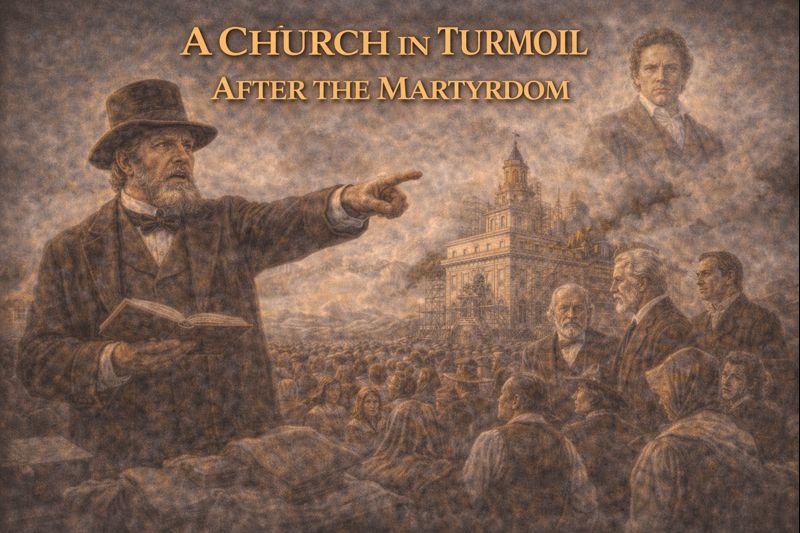
A Church in Turmoil After the Martyrdom
The deaths of Joseph Smith and his brother Hyrum in the summer of 1844 plunged Nauvoo into fear, uncertainty, and grief. Without the Prophet, the Saints faced a new and unsettling question: Who now held the authority to guide the Church? The city trembled under the threat of hostile mobs, while rumors spread about leadership claims and secret instructions allegedly given by Joseph before his death. Some members feared that without decisive direction, the Church might fragment entirely or be forced to abandon its sacred projects—especially the Nauvoo Temple, which remained unfinished.
Splinter Movements and Competing Claims
In the months following Joseph’s death, several men stepped forward with competing narratives, insisting that they, not the Apostles, held the rightful path forward. James Emmett gathered followers by claiming prophetic direction for a colony far from Nauvoo and asserted that Joseph had privately appointed him to lead a group of Saints westward. Others, including Lyman Wight and George Miller, drew upon earlier permissions Joseph had granted for specific exploratory missions—particularly regarding potential settlement in Texas. Yet as these groups began preparing to leave, rumors circulated that the Apostles secretly supported them, despite the Twelve’s public declarations urging the Saints to remain gathered.
These smaller factions sowed confusion and fear. Many Saints wondered whether they should flee the city or remain faithful to the collective effort to finish the temple. The unity that had characterized Nauvoo under Joseph now hung in the balance.
Brigham Young Reasserts the Prophet’s Instructions
In August 1844, Brigham Young addressed a vast congregation, clarifying the confusion. Drawing upon the keys Joseph Smith had conferred upon the Twelve before his death, Young reminded the people that no man could simply rise up and lead the Church without the authority Joseph had already organized. The Twelve, acting unanimously, held the governing power of the kingdom.
Young acknowledged that Joseph had granted limited permission to Wight and Miller to lead a single company connected to the Pinery Mission, yet emphasized that this authorization extended to no one else. If these men broke from the Apostles’ direction, they would, he warned, “go to destruction.” The Church could not be led by self-appointed captains or individuals claiming private instructions; it must follow the pattern Joseph had established.
The Temple at the Center of the Crisis
Central to Brigham Young’s counsel was the Nauvoo Temple. Joseph had commanded the Saints to complete it so that they could receive the ordinances of the endowment before the Church was required to leave the city. Young warned that scattering into the wilderness—driven by fear or by the influence of unauthorized leaders—would make temple completion impossible. The blessings Joseph had introduced could not be improvised in forests or open plains. Only by remaining united and finishing the temple could the Saints receive the ordinances of power Joseph had promised.
The Call for Unity Under Apostolic Leadership
Young spoke directly to the people’s fear and confusion, declaring, “United we stand; divided we fall.” The Saints, he insisted, must not imitate the ancient Israelites who scattered when faced with adversity. Rather than abandoning Nauvoo, they should plow their fields, strengthen their city, and prepare themselves spiritually.
In moving appeals, Young reminded the Saints that Joseph and his family lay buried in Nauvoo. This was a sacred place of Restoration history—the city where revelation flowed, where priesthood keys were consolidated, and where the endowment first entered the world. To flee impulsively would mean not only abandoning the temple but abandoning the resting place of the Prophet.
Revelation Cannot End With Joseph
Perhaps Brigham Young’s most pointed message concerned the nature of revelation itself. If revelation had ended with Joseph Smith, he declared, the Church would be “worth less than the ashes of straw.” The Restoration required living prophets and continuing revelation to guide the Saints through trials and into future lands not yet designated. Without revelation, the Church would lose the very foundation Joseph had laid.
The Foundation for the Westward Exodus
This period—marked by confusion, competing voices, and the urgent pleas of the Apostles—ultimately forged the path the Church would follow. By reaffirming the authority of the Twelve, insisting on unity, and directing the Saints to finish the temple before departure, Brigham Young preserved the heart of Joseph’s work. The ordinances of Nauvoo were completed, the Saints received their promised blessings, and when the signal finally came to leave the city, they did so under apostolic direction, not under the claims of competing leaders.
The decisions made in Nauvoo in 1844 and 1845 laid the foundation for the organized migration west and the continuation of temple ordinances central to Latter-day Saint life. Had the Saints followed unauthorized movements or scattered in fear, the Restoration may have fragmented. Instead, under the keys Joseph had given the Twelve, the Church moved forward in unity and power.
Listen to the full podcast here:
https://www.youtube.com/@standardoftruthpodcastllc
Season 4, Episode 42 – Following the Prophet Joseph Smith After his Death