
Historiography and the Evolution of Sources
In 1975, Elder Dallin H. Oaks and historian Marvin S. Hill published Carthage Conspiracy through the University of Illinois Press, a peer-reviewed academic publisher. This gave the book strong academic credibility and established it as the standard study of the trials connected to the murder of Joseph Smith. Like all historical works, however, it was written before many later discoveries. In the decades since, new letters, journals, legal documents, and archival materials have come to light, allowing historians to refine or expand earlier interpretations. Foundational works remain important even as the historical record deepens.
Historians face similar challenges when examining Emma Smith’s involvement in the lost 116 pages. Since no manuscript pages survive, scholars rely on later recollections, including Martin Harris’s statement that Emma wrote more of the early text than he did. Newly discovered sources could shift that understanding. Richard L. Bushman’s biography Rough Stone Rolling is another example: it was written before the Joseph Smith Papers released many early documents, such as Jonathan Hadley’s 1829 newspaper report about the plates and the angel. With additional sources now available, arguments once based on limited material can be refined.
Dr. Dirkmaat’s dissertation on the Latter-day Saints’ departure from the United States was also completed prior to public access to the Council of Fifty minutes. Once published, these records clarified several details and demonstrated how new archival access reshapes historical narratives. This reflects a fundamental truth: historical interpretation follows the availability of documents.
Contradictions Between American Ideals and LDS Experience
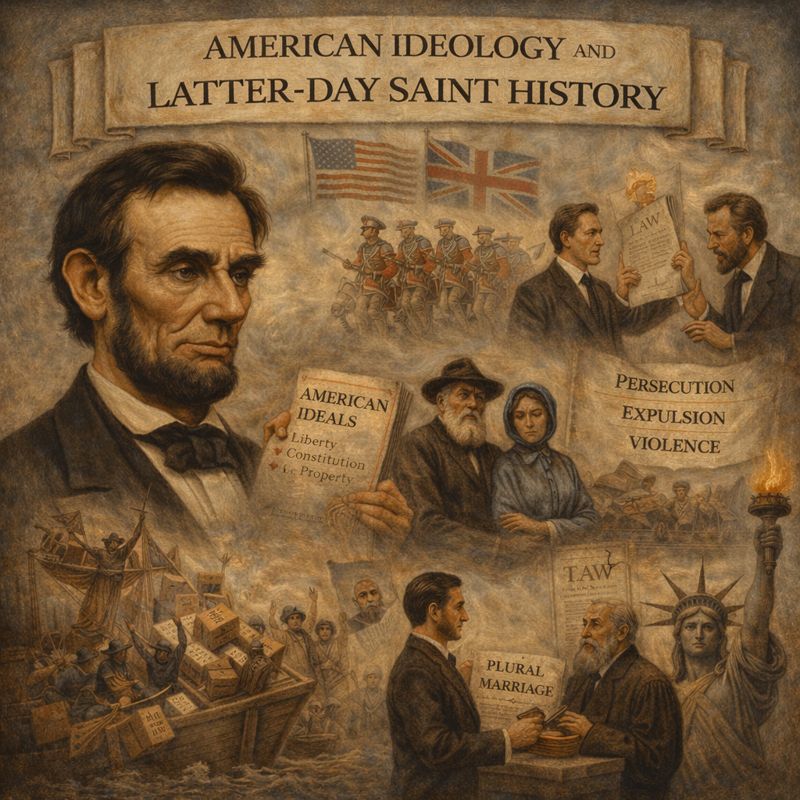
Early Latter-day Saints understood themselves as living according to America’s founding ideals—liberty, conscience, property, and constitutional rights. Their lived reality was sharply different. They were driven from state after state: New York, Ohio, multiple Missouri counties, and Illinois. Their property was destroyed, their leaders jailed or murdered, and governments refused to intervene. Modern assumptions about American religious freedom make such events seem impossible, yet they mirror the experiences of many minority groups in U.S. history, including Native Americans and African Americans. Mob violence, expulsion, and denial of legal protection have long marked the American landscape.
To understand how persecution occurred in a nation claiming to value liberty, it is necessary to examine early American religious culture.
Early American Religious Culture
Puritan Massachusetts, often idealized as a “city upon a hill,” enforced religious uniformity. Puritans fled persecution in England but did not extend full liberty to dissenters: Roger Williams and Anne Hutchinson were expelled for challenging doctrine and authority. Virginia was founded for economic reasons, replicating English society rather than promoting religious diversity. Pennsylvania, founded by Quakers, offered broader religious toleration but still fell short of modern pluralism. These examples show that early Americans often sought freedom for themselves, not universal liberty for all.
Nineteenth-Century Application
This tradition carried into the nineteenth century. Communities in Missouri and Illinois saw themselves as defending American values when driving out the Saints. They viewed Latter-day Saints as religiously deviant, politically threatening, or economically dangerous, and justified violence as protecting local rights and moral order. Meanwhile, the Saints appealed to state and federal institutions—including Governor Dunklin, Congress, and President Martin Van Buren—for justice and protection. Their petitions were repeatedly ignored, reinforcing their belief that the nation had failed its own ideals.
Legal Conflict and Plural Marriage
In Utah, plural marriage became the center of legal and constitutional conflict. Latter-day Saints argued that plural marriage was a religious practice protected by the First Amendment. Federal officials and courts countered that belief was protected, but religiously motivated actions could be restricted. Judges compared polygamy to acts they deemed inherently harmful, such as violence or human sacrifice, establishing a precedent that certain religious practices could be prohibited.
Many critics assumed that no rational person would choose plural marriage, concluding that believers must be deceived or coerced. This view allowed Americans to believe they were defending liberty and morality even while restricting the rights of a minority.
Imperial Background and the Road to the American Revolution
The ideological roots of nineteenth-century conflicts reach back to the Seven Years’ War, known in America as the French and Indian War. Britain’s victory in 1763 dramatically expanded its North American territory but left the empire heavily in debt. Maintaining troops, forts, and Native American diplomacy was expensive. To fund these costs, Parliament taxed the colonies directly for the first time.
Lacking income taxes, the government relied on property taxes and customs duties. Earlier duties served to regulate trade; newer taxes were designed explicitly to raise revenue.
The Stamp Act and Colonial Resistance
The Stamp Act of 1765 placed a paid stamp on legal documents, newspapers, and printed materials. Although not financially burdensome, colonists argued that it violated constitutional principles because Parliament taxed them without representation in that body. Protests and boycotts forced its repeal.
Parliament responded with the Townshend Duties, taxing goods like glass, paint, paper, lead, and tea—items not produced in the colonies, making enforcement straightforward. Colonists again rejected the taxes, arguing that accepting them would concede Parliament’s right to tax without consent.
Tea, Taxation, and Ideology
Tea became the symbol of the struggle. The East India Company faced financial collapse, and Parliament passed the Tea Act of 1773 to stabilize it. The Act removed an 8-pence British import duty on tea but kept the 3-pence colonial duty, resulting in dramatically cheaper tea in America.
Yet colonists feared that buying tea would imply acceptance of Parliament’s taxing authority. Since taxed and untaxed tea looked identical, consumers could not distinguish them. To prevent enforcement of the duty, Boston protestors destroyed the tea cargo in December 1773—an event known as the Boston Tea Party. Their concern was ideological, not economic: a small tax, accepted once, could justify larger ones later.
Revolutionary Ideology and Its Legacy
The American Revolution blended concepts of property rights, individual liberty, and justified resistance to perceived tyranny. This ideological heritage shaped later disputes involving the Latter-day Saints. Both the Saints and their opponents appealed to the same revolutionary ideals but interpreted them differently.
Missourians believed they defended local sovereignty, property, and social order by resisting the Saints. Latter-day Saints believed they defended constitutional liberty against mob violence and governmental neglect. Each side understood itself as the true heir of American principles.
This shared ideological inheritance helps explain why nineteenth-century Americans could champion liberty while denying it to minorities. It also clarifies why Latter-day Saints saw themselves as loyal defenders of the Constitution even while suffering expulsion, violence, and legal suppression.
Podcast Reference
Listen to the full podcast here:
https://www.youtube.com/@standardoftruthpodcastllc