
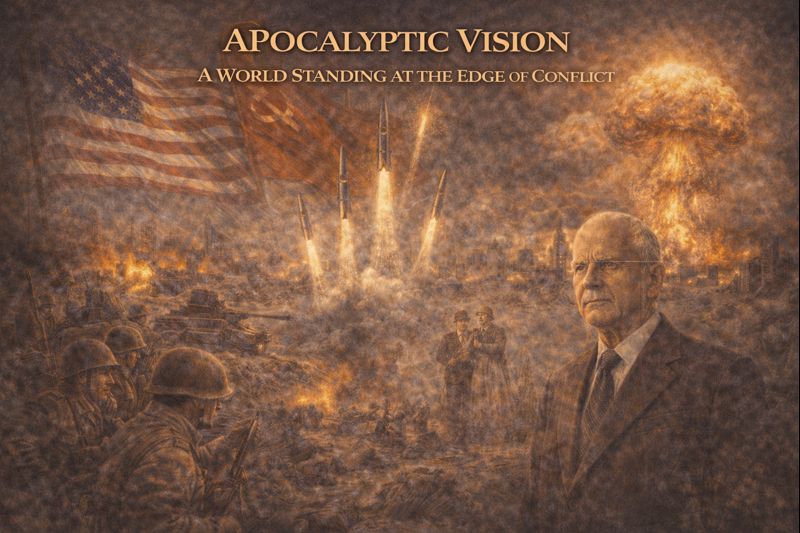
A World Standing at the Edge of Conflict
In the years following the devastation of the Second World War, global anxiety remained a constant companion to daily life. Nations were rebuilding, the memory of atomic destruction was still fresh, and a new geopolitical rivalry was beginning to cast its shadow across the earth. As the United States and the Soviet Union entered the Cold War, the threat of nuclear annihilation became a fear shared by millions. The rising tensions of the 1950s, the later pressures of the Cuban Missile Crisis, and the widespread public dread of nuclear war during the 1980s all shaped the cultural memory of the Latter-day Saints, who watched these unfolding events through the lens of scripture and prophecy.
President George Albert Smith and His Public Warning
Within this anxious era, George Albert Smith—president of the Church from 1945 to 1951—spoke openly about the moral and spiritual state of the world. His most direct apocalyptic warning came in the April 1950 General Conference, where he declared that unless humanity changed its course, “it will not be long before those who are scattered over the face of the earth by millions will die like flies.” The statement appears in the official conference report and stands as the only fully verifiable prophecy of impending calamity associated with him. It reflected his profound concern for a world armed with new and terrible destructive power and drifting further from principles of righteousness.
The Reminiscence of a Vision and the Problem of Historical Verification
Decades after President George Albert Smith’s death, David Horne recorded a memory of a private vision he claimed Smith shared in 1946, describing future global conflicts involving the United States, the Soviet Union, Europe, the Middle East, nuclear warfare, missile technology, and even political changes within the U.S., including a claim that Russia would demand Alaska’s return. When historians examined these claims, they found no corroborating evidence. No journals, clerical notes, meeting minutes, or private papers from George Albert Smith or his associates mention such a vision. Arthur Haycock, secretary to multiple Church presidents, stated he had never heard of it, and historian Leonard Arrington confirmed that no record of the account exists in official archives.
For this reason, the Church’s historical record recognizes only the publicly delivered 1950 conference statement. The dramatic private vision belongs to the realm of unverified reminiscence—memorable to some but unsupported by contemporary evidence.
Echoes of Early Latter-day Saint Faithfulness
The discussion also reflects on earlier moments in Church history, highlighting individuals who remained faithful even when leaders or family members fell away. Thomas B. Marsh, an early apostle who later left the Church, is contrasted with converts like Lewis and Ann Abbott, who stayed committed despite his departure. Similarly, Olive Boyington Hale remained steadfast even after her brother abandoned the faith during the Kirtland financial crisis. She and her husband, Jonathan Hale, followed the Saints from Ohio to Missouri and Illinois and ultimately died during the hardships of the westward migration in Iowa in 1846. Their story reflects a recurring Restoration pattern of perseverance, sacrifice, and faith amid uncertainty.
Historical Method, Archival Reality, and Official Doctrine
The episode emphasized that Church historians gather all sources—friendly, hostile, verified, and unverified—into archival collections. Their presence in the archive does not transform them into accepted fact. Official Latter-day Saint doctrine rests not on rumor or reminiscence but on what is “recorded,” “true,” and “faithful,” as the Lord declared in Doctrine and Covenants 1. This principle guides historical evaluation: a document must be contemporary, supported, and consistent with other sources before it can be treated as authoritative.
Apocalyptic Expectation Through Latter-day Saint Eyes
The Saints have never been strangers to apocalyptic expectation. Throughout the nineteenth century, many interpreted the turbulence of the American Civil War as evidence of the approaching Second Coming. Similar thoughts were expressed in the world wars of the twentieth century, and again during the nuclear anxieties of the Cold War. Such anticipation reflected not only scripture but also a long-standing human pattern: interpreting present-day upheaval through the language of prophecy.
Unlike traditions influenced by dispensationalism or rapture theology, Latter-day Saint teachings maintain a different eschatological framework—one centered on priesthood authority, gathering Israel, and preparing a people ready to receive the returning Christ. That framework shaped how the Saints understood war, crisis, and the shifting political landscapes of their own time.
Through these reflections, the episode places President George Albert Smith’s words—both the verified warnings and the unverified memories—into the broader tapestry of Latter-day Saint history, where faith, fear, and hope often intersect during the world’s most turbulent moments.
Listen to the full podcast here:
https://www.youtube.com/@standardoftruthpodcastllc
Season 4, Episode 36 – George Albert Smith’s Apocalyptic Vision