
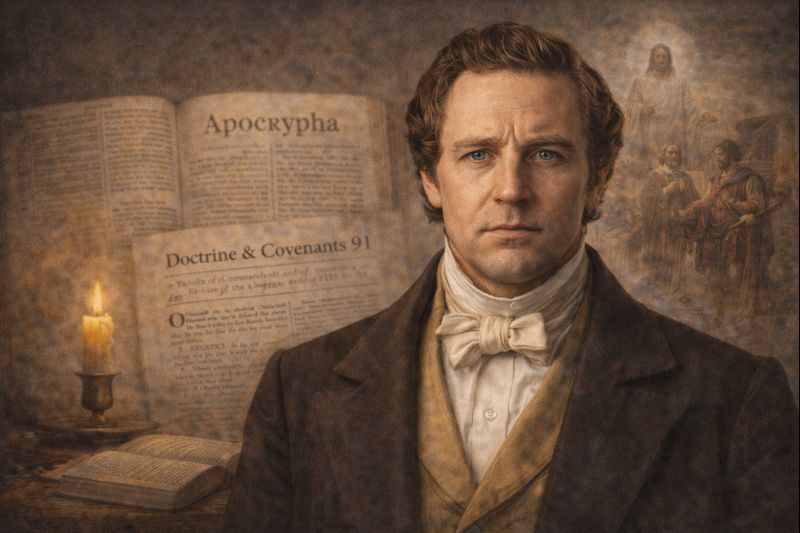
Context of the Revelation
Doctrine & Covenants 91 was received on March 9, 1833, one day after Joseph Smith received Doctrine & Covenants 90.
Doctrine & Covenants 90 commanded Joseph Smith to finish the translation of the Bible, preside over the Church and the School of the Prophets, and receive further revelation that would “unfold the mysteries of the Kingdom.”
This instruction raised a natural question: did the Bible translation include the disputed books found between the Old and New Testaments?
The answer became Doctrine & Covenants 91.
Understanding Doctrine and Covenants 91 and the Apocrypha requires examining the historical debates over biblical canon and the religious environment in which Joseph Smith received this revelation.
What Are the Disputed Texts Commonly Called the Apocrypha?
This collection consists of ancient Jewish religious writings that:
- Were not part of the Hebrew Bible
- Appeared in the Greek Septuagint (2nd century BCE)
- Circulated during the time of Jesus
- Were included in early Christian Bibles
Examples include Tobit, Judith, Wisdom of Solomon, Ecclesiasticus (Sirach), Baruch, and 1–2 Maccabees.
Why These Texts Became Controversial
The debate developed gradually due to theological and political pressures.
Early Christianity
Early Christians inherited differing scriptural traditions. While the Hebrew canon ended with Malachi, Greek-speaking Christians used broader collections preserved in the Septuagint.
The Protestant Reformation
Martin Luther translated these writings but separated them, calling them useful for reading but not equal to scripture. Later reformers rejected them entirely.
The American Religious Climate in the Early 1800s
During Joseph Smith’s lifetime, anti-Catholic sentiment was widespread. Protestant leaders increasingly viewed these books as corrupt influences.
In 1828, the American Bible Society stopped printing Bibles containing them. Joseph Smith’s Bible, printed the same year, still included them—placing him at the center of a live theological debate.
Why Joseph Smith Asked About These Texts
Joseph Smith’s question arose from three factors:
- His command to complete the Bible translation
- The presence of these writings in his Bible
- Ongoing Protestant disputes about scripture
He sought divine guidance on whether they should be translated or treated as inspired scripture.
Narrative Expansion in Non-Canonical Writings
Stories such as Bel and the Dragon dramatically expand biblical accounts, including additional miracles and prophetic encounters. These expansions explain why some readers valued the texts while others distrusted them.
Historical Forces Behind Doctrine & Covenants 91
Joseph Smith’s inquiry occurred amid competing viewpoints:
- Catholic tradition viewed these books as inspired
- Early Protestants found them useful but secondary
- Nineteenth-century Protestants rejected them entirely
Doctrine & Covenants 91 provided clarity within this contested environment.
Conclusion
Doctrine & Covenants 91 addresses a real historical controversy rather than introducing new scripture. It reflects the tension between tradition, canon formation, and revelation in early nineteenth-century Christianity.
Doctrine and Covenants 91 and the Apocrypha together illustrate how revelation addressed long-standing questions about scripture, tradition, and authority in early Christianity.
Internal Resources for Further Study
For related discussions on canon and revelation, see: