
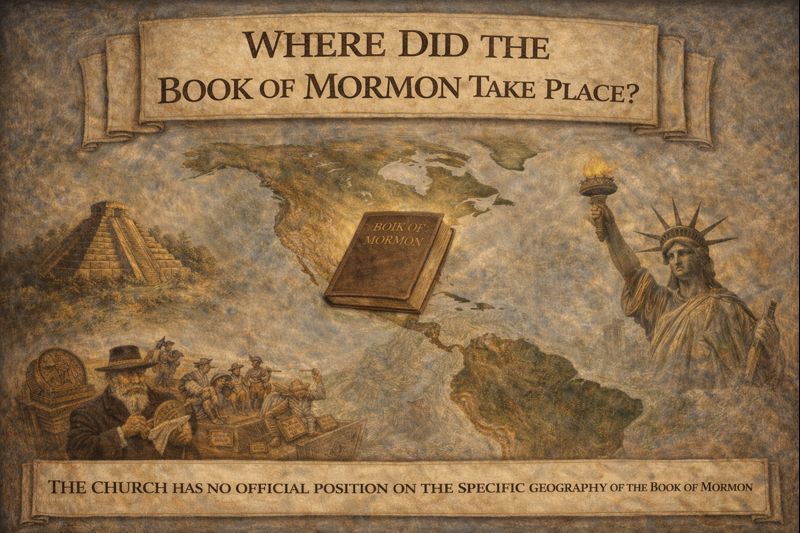
Introduction to Early Ideas About Book of Mormon Geography
Debates about Book of Mormon geography date to the earliest years of the Church. No official revelation has ever mapped its geography, and early leaders expressed differing, sometimes contradictory, views. Modern Church statements affirm only that the Book of Mormon took place somewhere in ancient America, without specifying where.
Early Old World and Colonial Views on Indigenous Origins
Long before the Book of Mormon appeared, Europeans and early Christians proposed that Indigenous peoples of the Americas descended from the ancient Israelites.
A 16th-century example is Fray Diego de Landa, a Spanish Franciscan in the Yucatán, who recorded Indigenous traditions claiming their ancestors came from the East and were guided by God. Landa interpreted these accounts through a Christian lens and believed they supported Jewish ancestry for New World populations.
Although Landa’s writings include bias and errors, they reveal that the idea of an Israelite origin for Indigenous peoples predated both the Book of Mormon and View of the Hebrews.
Historical Context for Geography Debates After 1830
Since the Book of Mormon’s publication, members have proposed various geographical models.
The modern position of the First Presidency and Quorum of the Twelve (2019) is:
The Church has no official position on the specific geography of Book of Mormon events.
Early Latter-day Saints—including Joseph Smith—held differing geographic assumptions over time.
Joseph Smith’s Statements About Geography
1834 Letter to Emma Smith
During Zion’s Camp, Joseph Smith wrote Emma that he and others were “wandering over the plains of the Nephites” and observing their “bones.” He associated mound-builder remains in the Midwest with Book of Mormon peoples.
1842 Times and Seasons Editorials
Articles published while Joseph was editor linked Central American ruins from Stephens and Catherwood to Book of Mormon civilization. These articles confirmed Joseph’s openness to a broader American setting but did not create a definitive map.
Oliver Cowdery’s Identification of the Hill Cumorah (1835)
In his Messenger and Advocate Letter VII, Oliver Cowdery asserted that the hill in New York where Joseph recovered the plates was the same “Cumorah” described in the Book of Mormon.
While influential, Cowdery’s statement is not a revelation and reflects his own belief. Joseph Smith did not canonize this claim, and other early Saints held alternative views.
Joseph Smith’s View of the Americas as Zion
A journal entry from Wilford Woodruff records Joseph teaching on April 8, 1844, that:
- The entirety of North and South America is Zion
- The future “mountain of the Lord’s house” would stand in the center of the American continent
- Stakes of Zion would be established throughout both continents
This reflects Joseph’s expansive geographical vision rather than a specific map.
Archaeology and the Limits of Historical Knowledge
Nineteenth-century archaeology was rudimentary. Early Americans—including Latter-day Saints—interpreted earthworks and mounds as evidence of lost ancient civilizations.
Modern archaeology has revealed that:
- Only a fraction of ancient American sites have been excavated
- New LiDAR technology has uncovered massive Maya and other ancient cities previously unknown
- Much ancient American history remains unexplored
Thus, lack of archaeological correlation does not imply absence of ancient civilizations described in the Book of Mormon.
Summary of Early LDS Historical Evidence
Historical evidence shows:
- Joseph Smith linked the Book of Mormon to both Midwestern mound cultures and Central American ruins
- Oliver Cowdery strongly identified the New York hill with Cumorah
- Times and Seasons articles pointed to Central America
- Joseph Smith viewed all the Americas as sacred geography
No early source amounts to an official Church declaration.
Modern Church Position
The official position remains:
- The Church does not endorse any specific Book of Mormon geography theory
- All models—limited geography, hemispheric geography, Mesoamerican, Heartland, Baja, or others—are considered opinions, not doctrine
- The Book of Mormon’s purpose is to establish Jesus Christ’s divinity, not to reveal a modern map
Missionary Service and Early Adulthood
Before attending college, Garrett served a mission in Wisconsin. The mission had very few Latter-day Saints, and the small congregations relied heavily on one another. Garrett observed the strength of these communities and gained formative leadership experience.
University Education
Garrett originally hoped to attend Brigham Young University but accepted a full academic scholarship from Utah State University, where he completed his undergraduate degree in history and met his future wife.
For graduate studies, Garrett attended the University of Colorado Boulder, which provided strong academic support and funding. He was one of very few Latter-day Saints in the program. His doctoral dissertation examined United States government interactions with the Latter-day Saints from the Church’s founding through the Utah territorial period.
Professional Career
After completing his Ph.D., Garrett joined the Joseph Smith Papers Project, contributing to documentary editing and historical research focused on early Church history.
Biography of Renee Dirkmaat
Garrett’s mother, Renee Dirkmaat, always valued education. She studied political science and English and became a teacher. During the 1960s, she was active in political organizations and participated in internships in Washington, D.C.
At BYU, she served as secretary of the College Democrats and once invited U.S. Vice President Hubert Humphrey to speak on campus.
Later, she returned to Idaho, where she taught school in Shelley. There she met Garrett’s father, a nuclear engineer. They married and raised their family in Idaho, where Garrett spent his childhood.