
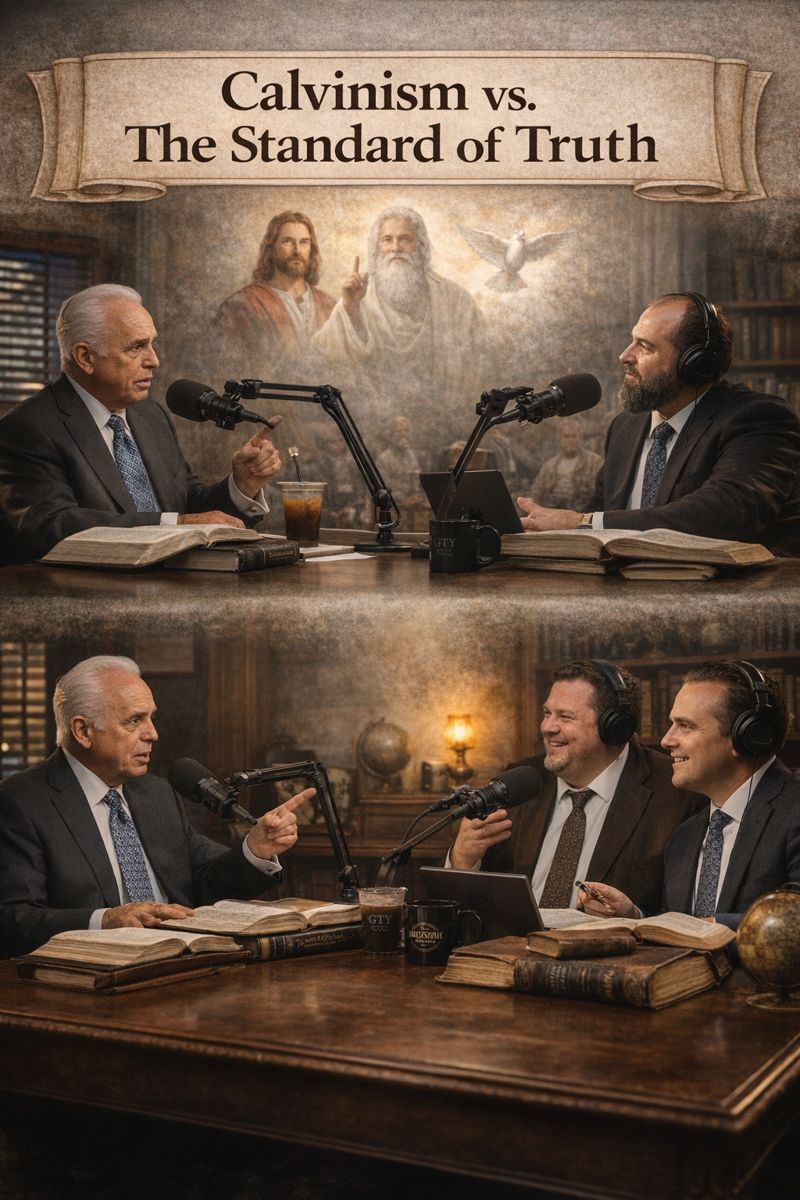
A Conversation Between Two Worlds of Theology
In this episode of the Standard of Truth podcast, two Latter-day Saint historians—Dr. Garrett Dirkmaat and Dr. Richard LeDuc—examine clips from Pastor John MacArthur, one of the most influential Calvinist preachers of modern times. The conversation becomes a window into two dramatically different theological universes: the Calvinist world shaped by Augustine, the Reformation, and creeds, and the Latter-day Saint world shaped by Joseph Smith’s revelations. What emerges is not merely a doctrinal disagreement but a contrast between two fundamentally different views of God, humanity, agency, salvation, and eternity.
The Western Christian Story That Shaped Calvinism
For more than a thousand years, Western Christianity shared a common narrative: God created everything out of nothing, including the human soul, at a moment of His choosing. Adam’s fall plunged all humanity into a state of corruption and separation. Salvation required divine grace, yet damnation loomed as the natural default for the entire human family. Hell, in this classical framework, was a state of eternal and conscious suffering for the majority of God’s creations.
Calvinism intensified this vision. Rooted in the teachings of John Calvin, the Reformed tradition insisted that God had chosen, before the creation of the world, exactly who would be saved and who would be eternally damned. Human choice was powerless; divine sovereignty was absolute. Christ’s atonement applied only to the elect, and grace was irresistible for those predestined to receive it. From this perspective, God deliberately creates people knowing they will suffer forever, and this is understood to manifest His glory and justice. Pastor MacArthur’s comments in the audio clips are fully aligned with this historical theology.
Why God Creates People Who Will Go to Hell
MacArthur addresses the painful question openly. In his understanding, God does not merely allow people to be created—He creates them intentionally, fully aware that they will never be saved. The incompatibility between this and human moral intuitions is not to be resolved but accepted. God is perfectly righteous even when His actions seem incomprehensible. For Calvinists, the tension is not to be solved but submitted to: divine sovereignty and glory overshadow all questions of fairness.
The Fate of Sincere Non-Christians
When asked about Jews, Buddhists, Confucianists, Mormons, and others who sincerely live moral lives outside of Christianity, MacArthur answers with historical consistency: all who die without faith in Christ are condemned. Good works, moral striving, religious devotion—none of these can save. Even many professing Christians are, in his view, damned if their faith is not the “right” kind. This leaves the overwhelming majority of humanity—past, present, and future—under eternal condemnation.
The Latter-day Saint Worldview as a Radical Theological Departure
The podcast hosts respond by contrasting this with Joseph Smith’s revelations, which present a radically different cosmology. Latter-day Saints reject creation ex nihilo and instead teach that human intelligence is eternal. God is a Father organizing and elevating His children, not calling them into existence for the purpose of displaying sovereignty through damnation.
In the LDS view, there was a premortal council in which all of God’s children chose the plan of mortality, agency, and redemption. The fall was part of this plan, not a disaster. Mortality is not a trap but an arena for eternal growth. God’s declared purpose, in Moses 1:39, is not to demonstrate justice through reprobation but to bring about immortality and eternal life for His children.
A Vision of Salvation That Extends Beyond Earth Life
Doctrine and Covenants 76—Joseph Smith’s “Vision” of the three degrees of glory—shattered traditional Christian assumptions. Instead of a binary heaven and hell, the afterlife is revealed as a vast spectrum of kingdoms, each glorious beyond present comprehension. Nearly all humanity will inherit a kingdom of glory. Only the sons of perdition, a group so small that President Dallin H. Oaks called them “too few to mention,” experience something akin to the traditional hell.
Even those who never knew Christ in this life will hear His gospel in the next world. Temple ordinances provide a way for them to receive every blessing of salvation. In LDS doctrine, divine judgment is based on light, opportunity, honesty of heart, and willingness to follow truth. The Buddhist monk, the devout Jew, the sincere Muslim, the Catholic grandmother—all are God’s children, and none are condemned for ignorance.
A God Whose Work Is to Save, Not to Damn
Dirkmaat stresses that many modern Christians who consider leaving the Restoration for a “generic Christianity centered on Jesus” rarely realize what the dominant Christian theologies of history actually teach. The Restoration does not merely adjust Christian doctrine—it replaces the foundational assumptions of Augustine and Calvin with a wholly different story of God and humanity. In the LDS worldview, God does not create souls from nothing for eternal torment. He raises eternal intelligences toward godhood. Christ’s atonement is expansive, not limited. Salvation is a vast, multi-layered process extending into eternity. Agency and opportunity continue beyond this life.
Two Very Different Christianities
What this episode reveals is a clash between two ancient traditions renewed in modern form. Calvinism presents a God whose glory is shown in both salvation and damnation, whose elect are few, and whose creation includes many destined for eternal suffering. The Latter-day Saint Restoration presents a Father whose glory is to exalt His children, whose plan saves nearly all, and whose love extends far beyond mortality. For Dirkmaat and LeDuc, this restored vision is coherent, merciful, and deeply rooted in historical revelation—not a departure from Christianity but a correction of the theological narrowing that developed over centuries.
Listen to the full podcast here:
Season 5, Episode 13 – Calvinism vs The Standard of Truth Podcast