
Why the Name of the Church Matters
Latter-day Saints believe the Church’s name is important because it was given by revelation and identifies it as the Church of Jesus Christ in the latter days.
The revealed name:
Centers Jesus Christ as the head of the Church
Indicates that this is His restored Church “in the last days”
Modern leaders therefore emphasize using the full revealed name whenever possible, even though historically a variety of titles and nicknames have been used in different periods.
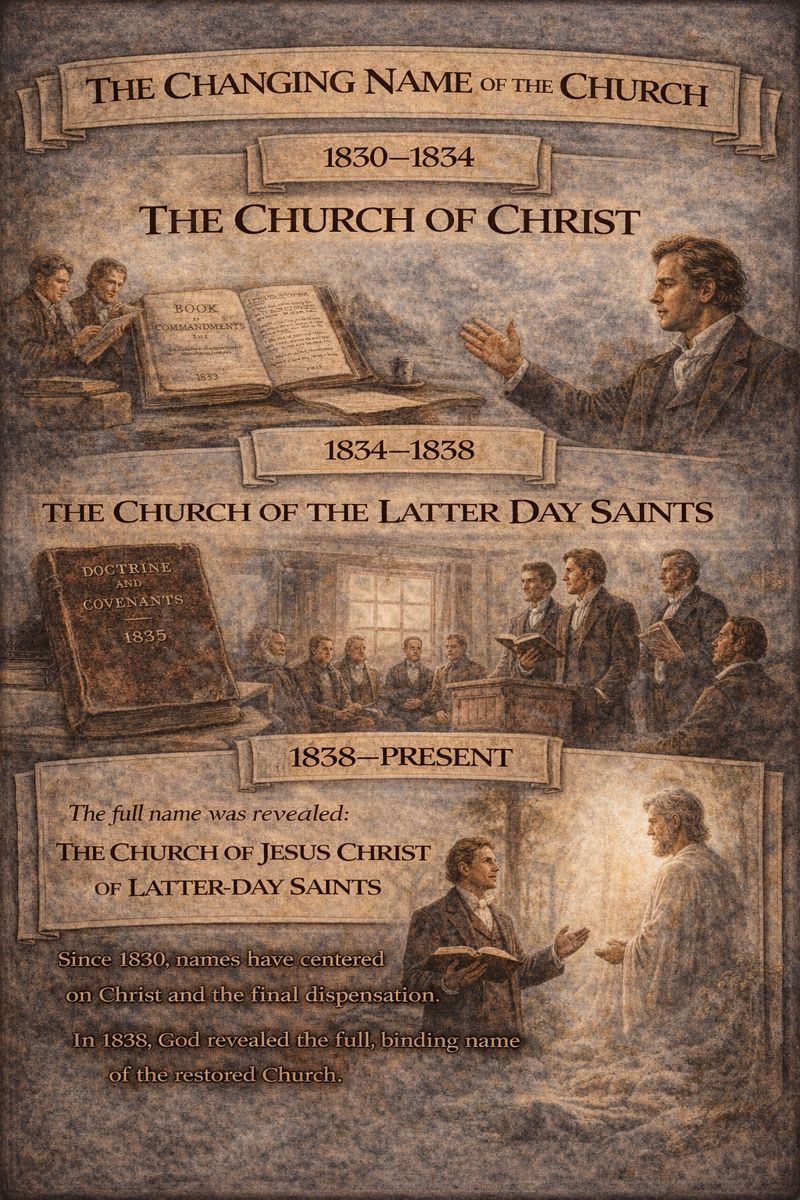
The First Official Name (1830–1834): “The Church of Christ”
When the Church was formally organized on April 6, 1830, its legal and official name was:
The Church of Christ
This naming follows the pattern in the Book of Mormon (e.g., 3 Nephi 27), where the resurrected Christ instructs that His church should bear His name.
Early documents confirm this usage:
Licenses and certificates from 1830 identify priesthood holders, such as Joseph Smith Sr., as officers in “this Church of Christ, established and regularly organized in these last days.”
The Book of Commandments (predecessor to the Doctrine and Covenants) likewise uses “Church of Christ” in its headings and texts.
The Second Official Name (1834–1838): “The Church of the Latter Day Saints”
On May 3, 1834, at a general conference:
A motion was made by Sidney Rigdon, seconded by Newel K. Whitney,
To change the name of the Church to:
“The Church of the Latter Day Saints.”
The vote passed unanimously with Joseph Smith presiding. From 1834 until 1838, this became the Church’s official title.
Evidence of this period
The 1835 Doctrine and Covenants bears the title:
“Doctrine and Covenants of the Church of the Latter Day Saints.”
No surviving contemporary document explicitly explains why the change was made, but later historians have suggested possible reasons, such as:
Distinguishing the Church from other contemporary “Church of Christ” bodies (e.g., Stone–Campbell congregations)
Reducing confusion in areas where “Church of Christ” was already a common label
These remain educated guesses; no direct statement of intent is preserved.
The Revealed Name (1838–Present): “The Church of Jesus Christ of Latter-day Saints”
In April 1838, a revelation (now Doctrine and Covenants 115:4) declared:
“For thus shall my church be called in the last days, even The Church of Jesus Christ of Latter Day Saints.”
Key points
This name combines the Christ-centered title “Church of Jesus Christ” with the descriptor “Latter-day Saints.”
Later printings standardized capitalization and hyphenation to today’s form:
The Church of Jesus Christ of Latter-day Saints.
This is the name recognized as revealed and binding for the modern Church.
Historical Use of the Nickname “Mormon”
The early Saints did not officially name themselves “Mormons,” but:
The term quickly emerged as a nickname, especially from outsiders, referencing the Book of Mormon.
By the late 1830s and 1840s, “Mormon” had become the standard cultural term in newspapers, politics, and public discourse.
Examples
Joseph Smith occasionally used “Mormon” in petitions and public documents.
The U.S. Army officially referred to the volunteer unit in the Mexican–American War as the “Mormon Battalion.”
Although originally often pejorative, the label became deeply embedded in historical sources.
Modern Guidance on Terminology
In recent years, especially since 2018, Church leaders have renewed emphasis on using the revealed name. The official style guidance prefers:
Preferred
“The Church of Jesus Christ of Latter-day Saints”
“The Church of Jesus Christ”
“Latter-day Saints”
“Members of the Church of Jesus Christ”
Avoid
“Mormon Church”
“LDS Church”
“LDS” as a standalone identity label
“Mormons” as a primary term for members (except in fixed historical names like Book of Mormon, Mormon Trail, Mormon Battalion)
Reason:
Short nicknames tend to erase explicit reference to Jesus Christ.
Why Historians Still Use Older Terms
Historians often match the terminology of the period they are studying to avoid anachronism:
1830–1834: members are accurately “members of the Church of Christ.”
1834–1838: they can be described as “Latter Day Saints” following the official name.
After 1838: they belong to “The Church of Jesus Christ of Latter Day Saints” (and later standardized spelling).
In quoting 19th-century sources, “Mormon” is retained because that is the original wording.
Outside scholars still commonly use “Mormon” because it remains widely recognized culturally, even though faithful usage now prefers the full revealed name.
Other Churches With Similar Names
Following Joseph Smith’s death, various groups claimed continuity with early Mormonism and adopted similar names, such as:
Church of Jesus Christ (Bickertonite)
Reorganized Church of Jesus Christ of Latter Day Saints (now Community of Christ)
Fundamentalist Church of Jesus Christ of Latter-Day Saints (FLDS)
Because multiple movements use comparable titles, precise use of The Church of Jesus Christ of Latter-day Saints is important to distinguish the worldwide restored Church from these other organizations.
Summary of Name Development
1830–1834 – The Church of Christ
1834–1838 – The Church of the Latter Day Saints
1838–present – The Church of Jesus Christ of Latter-day Saints (name given by revelation)
Historically, “Mormon” became a common nickname. In the present, the Church invites members and others to use the full revealed name to keep Jesus Christ at the center.