
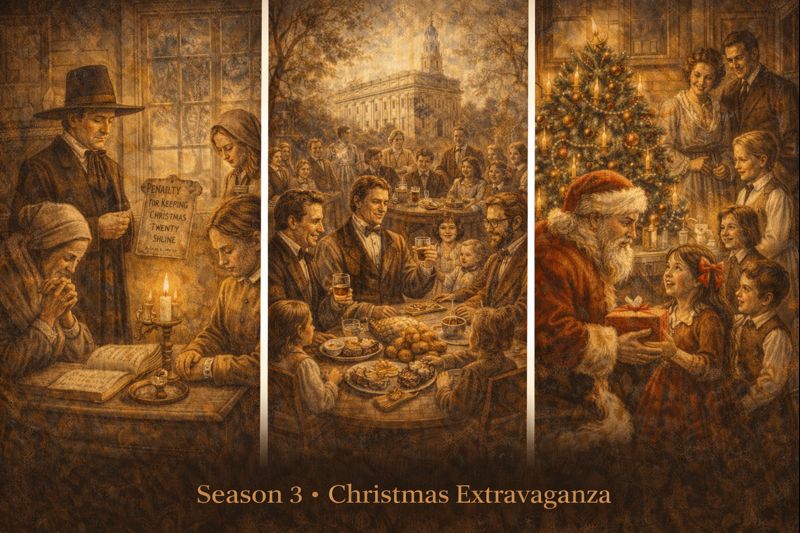
The Origins of Christmas (Christmas Extravaganza) in Christian Tradition
The celebration now known as Christmas has its roots in the early development of Christian worship in Europe. The very word “Christmas” is derived from the term Christ-Mass, the Catholic mass dedicated to commemorating the birth of Christ. As Christianity spread across medieval Europe, holy days such as Christmas became woven into the fabric of social and religious life. In a world without weekends, without regulated labor, and without consistent periods of rest, feast days offered rare relief from endless work. They soon became occasions for communal meals, singing, public gatherings, and festive celebration. Christmas, therefore, developed not only as a liturgical observance but as one of the few days when the common people could rest, rejoice, and participate in community life.
Puritan Rejection and the Reformation’s Impact
With the arrival of the Protestant Reformation in the sixteenth century, this deeply embedded tradition came under scrutiny. Reformers such as John Calvin were determined to purge Christianity of anything they considered extrabiblical or associated with Catholic ritual. Because Christmas was not commanded in the Bible, and because it had become associated with festivities, drinking, theaters, and merrymaking, many reformers viewed it as spiritually dangerous. Among the most rigorous guardians of biblical purity were the Puritans, who believed that all Christian worship must be justified by scripture. Christmas, lacking explicit biblical instruction and accompanied by popular revelry, was rejected as a “popish” invention. In England during periods of Puritan influence, celebrations were discouraged, theaters were closed, and public festivities were condemned.
Christmas in Early America
When Puritan settlers carried their religious convictions to the New World, Christmas fared no better. In New England, the holiday was not merely discouraged—it was outlawed. Massachusetts enacted legislation imposing a fine on anyone who observed Christmas by resting from labor, holding a feast, or engaging in any festive activity. Christmas was treated as a dangerous remnant of Catholicism that encouraged idleness and moral decline. In contrast, the southern colonies, settled primarily by Anglicans, did observe Christmas, but their celebrations were modest and far less elaborate than the centuries-old traditions of Europe.
Over time, however, American attitudes began to shift. The weakening of Puritan influence, combined with increasing immigration from regions such as Germany and the Netherlands, introduced new customs into American life. German Christmas trees, Dutch traditions surrounding Saint Nicholas, and other European symbols began to permeate the cultural landscape. Between approximately 1860 and 1880, Christmas transformed into the holiday Americans recognize today, complete with decorated trees, stockings, and the custom of giving gifts.
Christmas Among Early Latter-day Saints
The earliest members of The Church of Jesus Christ of Latter-day Saints inherited the Puritan-inflected simplicity of their New England background. As a result, Christmas among the Saints in the 1830s and 1840s was quiet, religious, and focused on community rather than decoration or commercial celebration. Their gatherings usually included shared meals, spiritual reflection, singing, sermons, and time spent with fellow Saints. Customs such as Christmas trees, Santa Claus, stockings, and children’s presents were largely absent from early Latter-day Saint culture and did not become widespread until much later in the nineteenth century.
Wilford Woodruff’s Observations
Wilford Woodruff’s journals provide a rare and richly detailed glimpse into these early celebrations. While serving in England in 1840, he recorded church meetings, spiritual discussions, and a traditional English Christmas feast with mutton, pies, and plum pudding. Woodruff noted how much more fully Christmas was celebrated in England compared to America, a reflection of the Puritan legacy still embedded in American culture.
In Nauvoo in 1841, Christmas was marked by a supper with the Twelve Apostles. Woodruff recorded sleigh rides, social visits, and the unusual generosity of Heber C. Kimball, who gave each Apostle a lot of land as a Christmas gift. Two years later, in 1843, Woodruff attended a large dinner at the Nauvoo Mansion, where Saints gathered for conversation, encouragement, and reflection on gospel teachings. When Woodruff returned to England in 1845, he encountered large “tea meetings” attended by hundreds of Saints, where preaching, music, and spiritual messages shaped the day.
Transformation After 1870
A significant cultural transition took place for the Latter-day Saints beginning in the 1870s. As American Christmas customs evolved nationwide, the Saints likewise adopted more modern practices. Christmas trees, stockings, children’s presents, and family-centered celebrations entered Latter-day Saint life. Woodruff’s later journal entries reflect this shift. By 1877 he describes children receiving presents from Christmas trees and Sabbath schools organizing festivities. In the 1880s he records filling stockings, sending financial gifts to children and grandchildren, and even providing food to imprisoned Saints who were incarcerated for practicing plural marriage. He also noted the increasing financial cost of purchasing gifts for family—a sign that Christmas was becoming more elaborate and culturally aligned with broader American celebrations.
In this evolution, the Latter-day Saints moved from a restrained, Puritan-style observance to a warm, family-centered holiday that resembled the Christmas traditions developing across the United States. The change did not diminish the religious significance of Christmas among the Saints; rather, it enriched their celebrations with symbols of joy, generosity, and family unity.
Listen to the full podcast here:
https://www.youtube.com/@standardoftruthpodcastllc
Season 3 – Christmas Extravaganza