
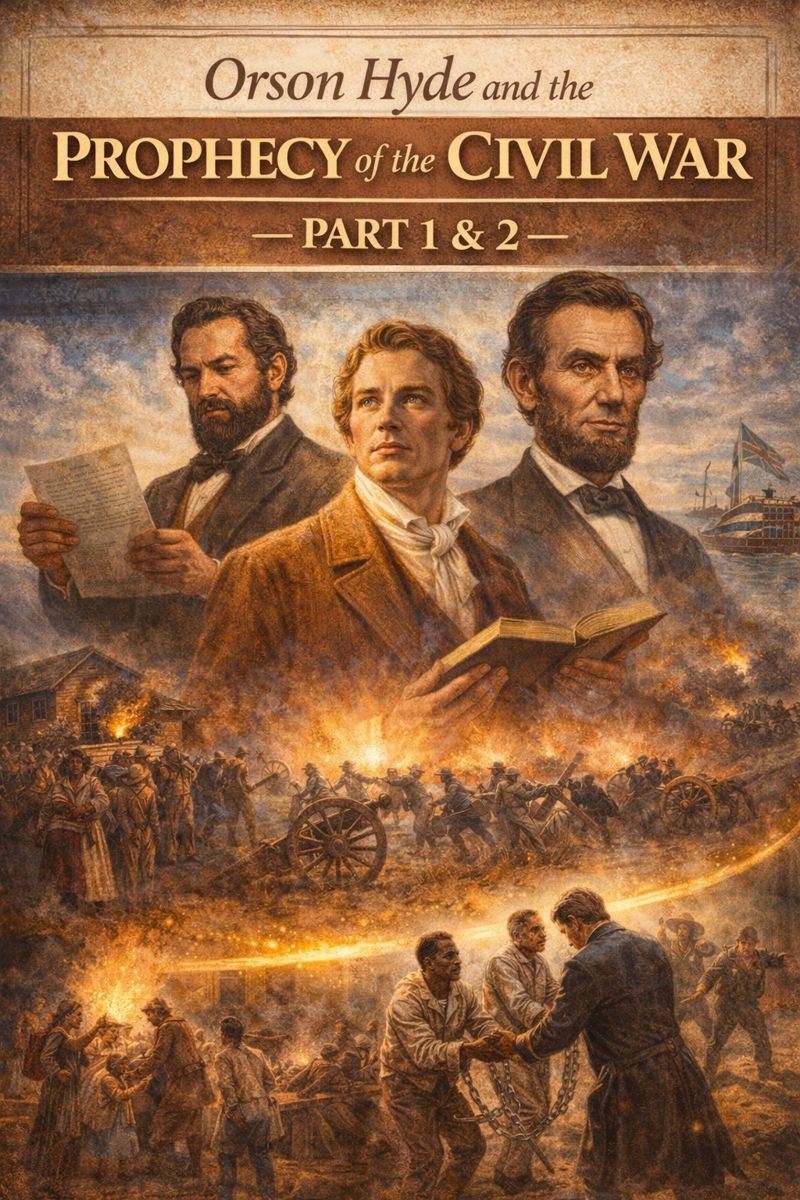
Joseph Smith’s Civil War Prophecy and Its 19th-Century Setting
In December 1832, Joseph Smith recorded a revelation later canonized as Doctrine and Covenants 87. The revelation declared that war would begin with the rebellion of South Carolina, that the Southern States would divide against the Northern States, that the conflict would lead to immense suffering, and that Southern States would ultimately call upon foreign powers such as Great Britain. The revelation also predicted that war would spread to all nations and that enslaved people would be mobilized in the conflict.
In 1832, the United States was not anticipating a bloody civil war. Even as late as 1860, the year before hostilities began, many Americans believed the nation would avoid extended conflict. The most recent tension involving South Carolina was the Nullification Crisis of 1832–33, which concerned tariff disputes rather than slavery. Most Americans assumed that the Missouri Compromise of 1820 had resolved sectional disputes over slavery. Abolitionism in the 1830s represented less than one percent of the Northern population, and national political discourse did not anticipate a war centered on slavery.
The prophecy was striking because nothing in the political climate of 1832 suggested a long, bloody war beginning in South Carolina. If Joseph Smith had simply extrapolated from current events, he would have predicted another dispute over tariffs rather than a conflict over slavery, and few Americans believed such a conflict could expand into a national war.
During the Nullification Crisis, South Carolina attempted to nullify federal tariffs, but the confrontation quickly de-escalated. This outcome convinced many Americans that states would not take up arms against the Union. Newspapers through early 1861 frequently dismissed the likelihood of war. A Charleston newspaper in March 1861 argued that Fort Sumter would be seized without a fight, and a Missouri paper in January 1861 predicted a peaceful resolution to secession. Civilian spectators who traveled to watch the first battle of Bull Run demonstrate the widespread belief that any conflict would be brief and essentially symbolic. The U.S. Army had only about sixteen thousand soldiers, reinforcing the assumption that extended warfare was impossible.
Events ultimately unfolded in remarkable harmony with Joseph Smith’s prophecy. The war began in South Carolina with the firing on Fort Sumter in April 1861, became the bloodiest conflict in American history, and saw the Confederacy seek foreign assistance, including from Great Britain. Enslaved people fled to Union lines, and thousands joined the United States Colored Troops. Leaders such as Abraham Lincoln depicted the war as divine judgment, echoing themes in Joseph’s revelation.
Latter-day Saints believed the nation’s suffering reflected earlier injustices against them, including violent expulsions from Missouri and Illinois, the murder of Joseph and Hyrum Smith, and the failure of the federal government to offer redress. Many Saints viewed the Civil War as fulfillment of scriptural warnings that nations bringing harm upon the righteous would face divine consequences.
Orson Hyde later commented that warfare would expand beyond America, eventually reaching Europe and the “banks of the Rhine,” a statement some later readers associated with twentieth-century global conflicts. Further context for Hyde’s commentary is examined in the following episode.
Orson Hyde and the Prophecy of the Civil War — Part 2
Zion’s Expulsion, Revelation, and Orson Hyde’s 1862 Letter
Early Latter-day Saints believed that Zion in Jackson County, Missouri, was the designated location for the City of God. Unlike temporary gathering places such as Kirtland, Zion was viewed as permanent and central to preparing for the Second Coming. The violent expulsion of the Saints from Jackson County in late 1833 created a profound crisis, challenging their expectations of establishing Zion at that time.
On December 10, 1833, shortly before receiving Doctrine and Covenants 101, Joseph Smith wrote a letter to the Saints in Missouri. He explained that he could not learn by revelation that Zion had forfeited her claims. He reaffirmed the principle in Doctrine and Covenants 58 that blessings follow tribulation and stated that Zion would be redeemed in the Lord’s due time, though the timing was not revealed. When Joseph inquired about when Zion would be redeemed, the divine answer was simply, “Be still and know that I am God.” Joseph expressed deep sympathy for their suffering, acknowledging that even as a prophet he did not always receive immediate answers.
Doctrine and Covenants 101 addressed the Saints’ afflictions, taught that they must be tried as Abraham, and affirmed that Zion would eventually be redeemed. The Saints continued for decades seeking clarity on how and when they would return.
By 1862, Utah Territory, populated overwhelmingly by Latter-day Saints, faced constant conflict with federal officials appointed from outside the territory. Utah sought statehood to elect its own governor and judges, but was repeatedly denied, even as Southern states in open rebellion suffered the consequences of secession. Utah was rejected on claims of insufficient loyalty despite its compliance with federal demands.
Wilford Woodruff recorded a mass meeting held in Salt Lake City in early 1862, where Brigham Young declared that the time had come for Utah to organize a state government. The meeting’s participants voted unanimously. Afterward, Orson Hyde read a letter intended for the Missouri Republican newspaper. Woodruff described the gathering as composed of prophets, apostles, priests, and Saints acting under divine guidance.
Orson Hyde’s published letter reviewed past injustices suffered by the Saints and linked them to the national turmoil of the Civil War. He reminded Missouri readers of the Saints’ expulsion, government failure to intervene, property destruction, and loss of life. Hyde stated that Missouri had suffered ever since and declared that the state’s former prosperity departed with the Saints.
Hyde referred to Joseph Smith’s statements in Nauvoo predicting that if the federal government did not redress wrongs against the Saints, the nation would be overrun by mobs. Hyde had personally heard Joseph speak of this after returning from Washington, D.C., where President Van Buren refused assistance. Hyde connected the martyrdom of Joseph and Hyrum Smith and the forced expulsion from Illinois with the nation’s later suffering, arguing that these injustices contributed to divine displeasure.
Hyde described the Civil War as a divine judgment, invoking imagery from Revelation and asserting that peace would be removed from the earth. He urged the nation to restore the Saints’ rights and compensate them for losses in Missouri and Illinois or face continued turmoil.
Hyde reiterated earlier warnings that the war in America was only the beginning of greater global conflict and predicted that destruction would eventually reach Europe’s “banks of the Rhine.” Later generations sometimes associated these comments with major European wars, though Hyde did not specify.
He also explained that the Saints’ location in the Rocky Mountains fulfilled prophetic imagery of refuge and divine protection and invited the meek and humble of the earth to gather with them. Hyde concluded by affirming the sincerity of his message and urging its publication, which the Missouri Republican likely printed for purposes of ridicule rather than sympathy.
Listen to the full podcast here:
Season 5, Episode 38 – Orson Hyde and the Prophecy of the Civil War – Part 2
Season 5, Episode 37 – Orson Hyde and the Prophecy of the Civil War – Part 1