
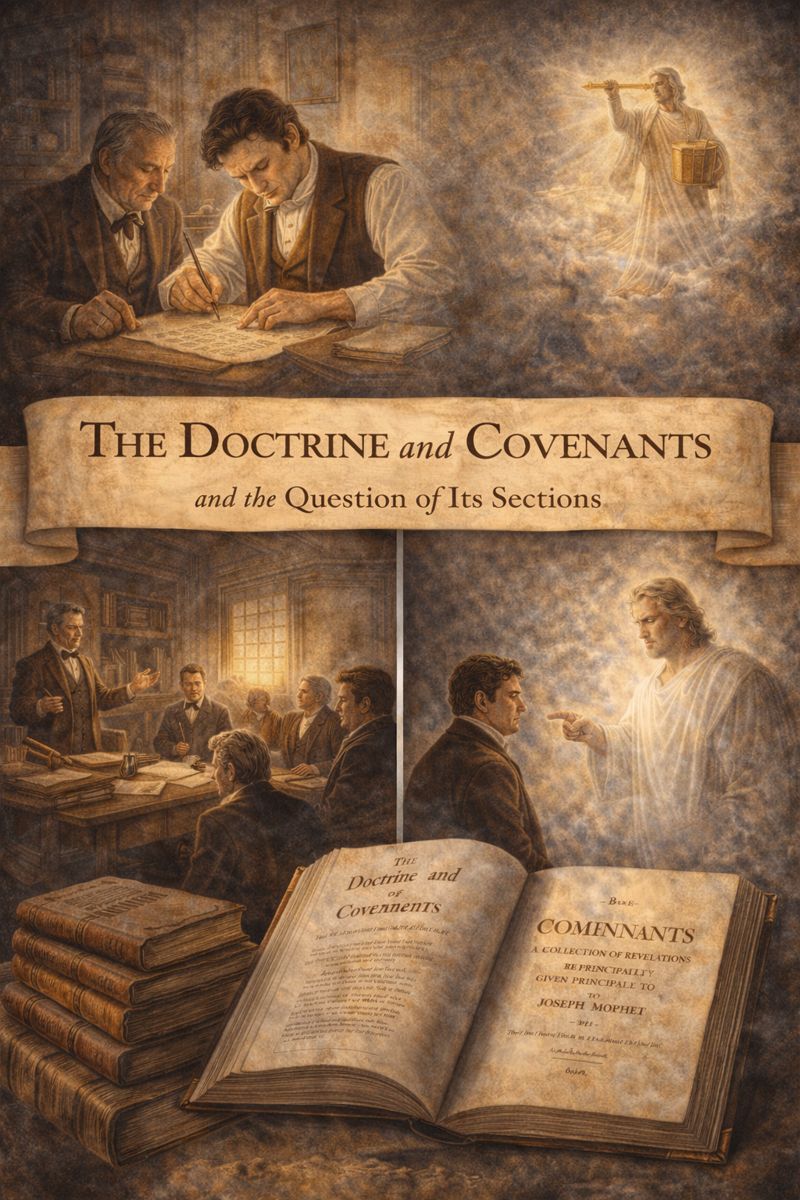
The Doctrine and Covenants and the Question of Its Sections
The Doctrine and Covenants did not always appear in the form we know today. The current Latter-day Saint edition contains 138 sections and two Official Declarations, but early editions differed as new revelations were received, written, organized, and prepared for publication. Understanding this development helps explain why certain sections appear out of chronological order and why some revelations carry a unique historical weight in the unfolding of the Restoration.
How the First Written Revelation Actually Appeared
Doctrine and Covenants 3 holds a distinct place in Latter-day Saint history because it was the first revelation ever recorded in writing. Before that moment Joseph Smith had received profound divine experiences—his First Vision in 1820, the recurring visits of Moroni beginning in 1823—but none of these had been formally written as revelations at the time they occurred.
In July 1828, when Martin Harris lost the 116 manuscript pages, Joseph turned to the Lord in anguish. The revelation that came in response, now known as D&C 3, was immediately written down. It rebuked Joseph yet assured him that God’s purposes would not fail, even when His servants faltered. This moment marked the beginning of a continuous written record of revelation for the Church.
Why Sections 1 and 2 Come Before Section 3
Although D&C 3 was the earliest revelation written, it did not appear first in the book. Doctrine and Covenants 1 was dictated in November 1831 as the Lord’s official Preface to the forthcoming Book of Commandments. Because of that role, it was placed at the head of the volume even though it came years after D&C 3.
Doctrine and Covenants 2, meanwhile, records Moroni’s words from 1823, but the text itself was written in Joseph Smith’s 1838–39 history. It was placed near the beginning due to its doctrinal significance, not because the written record predated other revelations.
Thus the order we see today reflects editorial purpose and theological emphasis rather than historical sequence.
Preparing the Revelations for Publication
In 1831 Church leaders assembled to select and organize the revelations for publication. During that meeting the Lord provided the revelation that became D&C 1, framing the entire collection. These texts formed the basis of the Book of Commandments in 1833 and later the Doctrine and Covenants in 1835, marking the emergence of a modern canon—a written body of continuing revelation guiding a living church.
Why the Historical Context Matters
Knowing the background of D&C 3 clarifies how revelation developed in the early Restoration. It shows Joseph’s vulnerability during the translation of the Book of Mormon, the pressure he faced, and the divine correction that shaped his prophetic role. It also demonstrates that revelation came gradually, in real circumstances and real struggles, and that God’s work moves forward despite human weakness. D&C 3 stands as the moment when the Restoration gained a written prophetic voice, laying the foundation for the scriptural record that continues to define Latter-day Saint faith.
Listen to the full podcast here:
Season 5, Bonus Episode 1 – Search These Commandments and a New Theme Song