
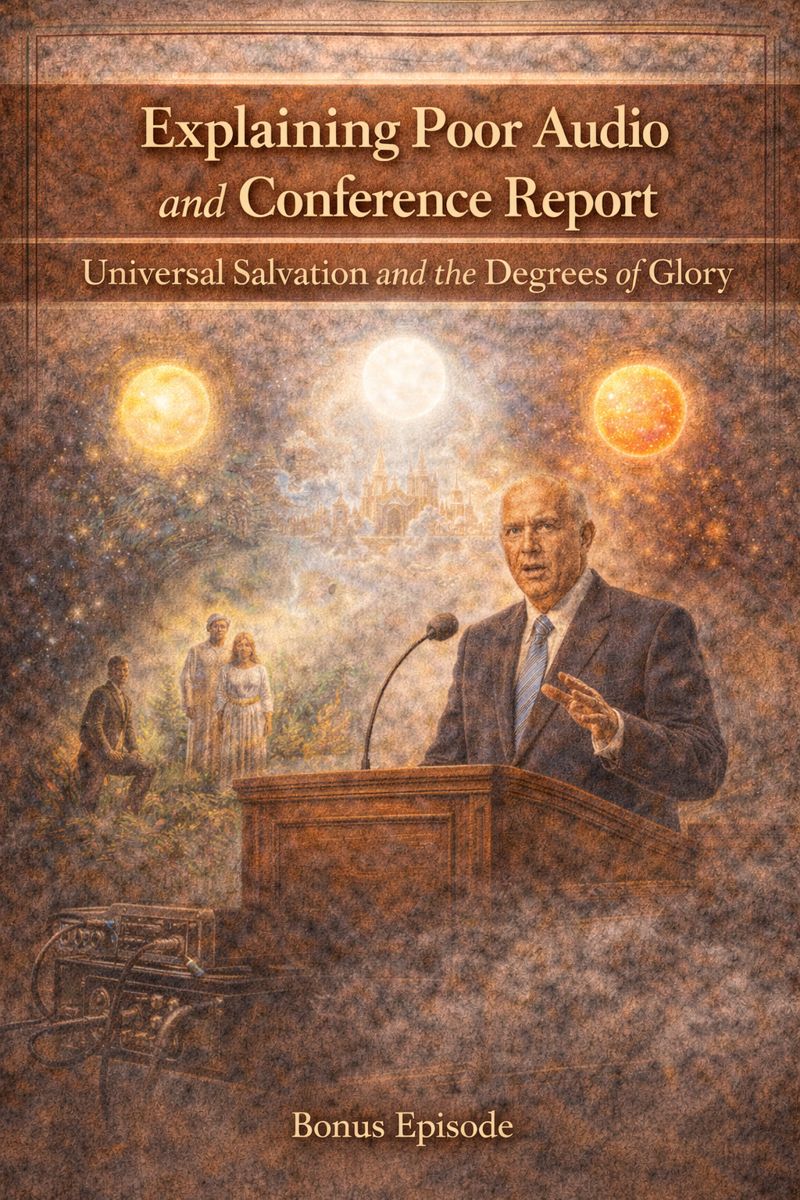
Universal Salvation and the Degrees of Glory
In this bonus episode, the discussion turns to themes emphasized in the most recent General Conference, particularly the doctrine of universal salvation as revealed through the Prophet Joseph Smith. Unlike traditional Christian teachings that divide eternity into a simple opposition between heaven and hell, Latter-day Saint doctrine teaches that nearly all of God’s children will ultimately inherit a kingdom of glory. This understanding originates in the visions given to Joseph Smith and Sidney Rigdon in 1832, which revealed the celestial, terrestrial, and telestial worlds and affirmed that only the sons of perdition—those who fully reject God after receiving a perfect knowledge of Him—will remain outside a kingdom of glory.
President Oaks, President Nelson, and earlier leaders such as Joseph Smith and Brigham Young have repeatedly taught that the Lord’s plan is far more expansive and merciful than many Christians suppose. Salvation, in the restored sense, refers to deliverance from hell and the resurrection into glory, a gift granted to almost all of humanity. Exaltation, however, is something different. It is the possibility of becoming like Heavenly Father and Heavenly Mother and requires covenants, ordinances, and faithfulness to those covenants. Thus, while universal salvation is assured except in rare cases, exaltation remains conditional upon repentance, obedience, ordinances, and priesthood authority.
The Purpose of the Church in the Lord’s Plan
A major theme from Conference centered on the purpose of the Church itself. The Brethren emphasized that the Church was not organized merely to help people behave ethically or to promote compassion—worthy pursuits that many religious and secular organizations undertake with great success. President Russell M. Nelson explained that the Church’s unique purpose is to provide the ordinances and covenants made possible only by restored priesthood authority. Through baptism, confirmation, temple ordinances, endowments, and sealings, the Church administers the saving and exalting ordinances that no other institution on earth possesses. These ordinances are essential to preparing individuals and families for eternal life, the greatest of all God’s gifts.
Priesthood Keys and Eternal Authority
President Nelson also spoke powerfully about priesthood keys, the governing authority restored through heavenly messengers during the early years of the Restoration. Without keys, he taught, the Church could exist as a benevolent organization but would lack the power to perform ordinances recognized in heaven. Because of priesthood keys restored by John the Baptist, Peter, James, and John, and later by Moses, Elias, Elijah, and other angelic ministers in the Kirtland Temple, the Church of Jesus Christ of Latter-day Saints carries out the only ordinances that bind on earth and in heaven.
Priesthood keys, therefore, establish the Church’s eternal significance. They are the means by which the Lord directs His work on earth and the mechanism by which families are sealed eternally, the dead are redeemed, and the covenants of exaltation become available to God’s children.
The Eternal Significance of Ordinances
President Oaks’s teaching reinforced the idea that ordinances themselves carry divine covenants. Baptism is not merely symbolic but is the covenantal gateway into the celestial kingdom. Temple ordinances reveal the path toward exaltation and must be received in mortality or by proxy in the house of the Lord. No other organization can offer these ordinances because no other organization possesses the priesthood keys that authorize them. In Conference, this doctrinal clarity reaffirmed that exaltation is not achieved through morality alone but through ordinances and covenants that bind the disciple to Christ.
Trials, Agency, and Identity in the Eternal Plan
Another Conference theme reviewed in the episode concerned human identity and the purpose of mortality. Speakers emphasized the eternal nature of the soul, our premortal existence, and the role of agency in both worlds. Before coming to earth, we chose to follow God’s plan, and in mortality we continue to exercise agency as we face the trials necessary for our growth. These difficulties refine us and help develop divine attributes. The restored gospel’s doctrines of premortal life, eternal identity, and future exaltation give coherence to life’s experiences and explain why adversity is often intertwined with spiritual progress.
Restoration Scripture and the Lost 116 Pages
The episode concludes with a discussion of Garrett’s upcoming appearance on the Follow Him podcast, which will focus on Jacob through Omni and the Words of Mormon. These texts cannot be understood without addressing the loss of the 116 pages and the Lord’s response, as revealed in Doctrine and Covenants 3, 5, and 10. The Words of Mormon serve as a bridge between the small plates written by Nephi and his descendants and the abridgment of Mormon. The Lord had prepared these small plates centuries earlier to serve as a divinely crafted replacement for the lost manuscript. The revelations surrounding this event provide vital historical context for the translation of the Book of Mormon and illuminate the Lord’s supervision over His work.
Listen to the full podcast here:
https://www.youtube.com/@standardoftruthpodcastllc
Season 4, Bonus Episode 4 – Explaining Poor Audio and Conference Report