
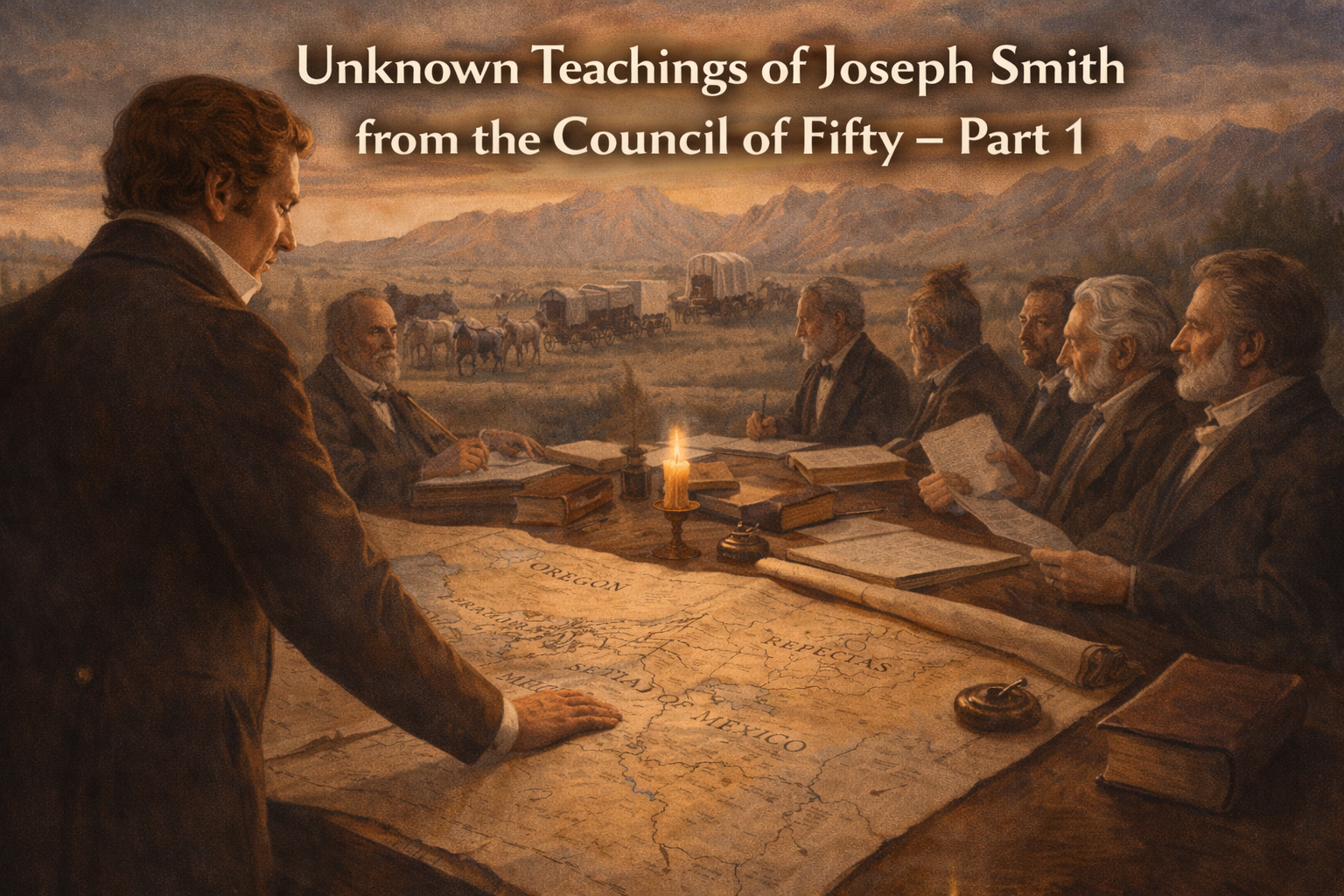
Introduction: Purpose and Context of the Council of Fifty (1844)
The Council of Fifty was an organization created by Joseph Smith in March 1844. Its purpose was tied to decisions Joseph made in late 1843, when he concluded that the Latter-day Saints would eventually need to leave the United States due to ongoing persecution. Possible destinations included:
- The Republic of Texas
- Oregon Territory
- Mexico
The objective was to settle in an area without existing white settlement and establish a community where the Saints could build a political structure aligned with what they understood as the “Kingdom of God on earth.” This government was intended to operate until the anticipated Second Coming of Jesus Christ.
Wisconsin Pineries and Early Move-West Discussions
Latter-day Saints working in the Wisconsin pineries, where lumber for the Nauvoo Temple was harvested, expressed frustrations with persecution. They petitioned Joseph Smith for permission to settle in Texas. Joseph expanded this into a comprehensive relocation and governance plan.
Formation, Membership, and Responsibilities of the Council
The Council eventually included roughly fifty members plus clerks. Responsibilities included:
- Supporting Joseph Smith’s 1844 presidential campaign
- Exploring relocation possibilities outside the United States
- Drafting a constitution for a future Latter-day Saint settlement
- Preparing a governmental structure for the anticipated Kingdom of God
Minutes were kept by William Clayton and remained unpublished for over a century.
Joseph Smith’s Teachings to the Council of Fifty
1. On the Nature of Councils
Joseph taught:
- Every member should speak honestly, good or bad.
- He rejected superficial agreement.
- Councils should find truth through extended discussion.
- Governance often fails because leaders do not “agree to disagree long enough” to separate the useful from the useless.
- He compared council work to refining gold.
2. On Committees and Revelation
A committee drafting a constitution expressed concern. Joseph taught:
- Councils must exhaust their own wisdom before recognizing revelation.
- They should bring their best effort so Joseph could correct or expand it.
- He said:
“Let the committee get all the droppings they can from the presence of God… and if it needs correcting… I am ready to give it.”
3. On Unity After Decisions
Joseph instructed:
- Members should not later criticize what they agreed to.
- Do not accept something until you understand it, but once accepted, unity is required.
4. On Religious Liberty
Joseph emphasized:
- The U.S. Constitution lacked enforcement mechanisms protecting minority religion.
- Future settlements must uphold absolute freedom of conscience.
- Nauvoo already protected Jews and Muslims.
- Some Council members were not Latter-day Saints—purposefully.
- Salvation requires agency:
“God cannot save or damn a man except he acts, chooses, and worships for himself.”
He condemned intolerance and urged rejection of bigotry.
5. On His View of People
Joseph taught:
- Integrity matters more than belief differences.
- “If a man has integrity… he is my friend.”
- Weakness should be met with compassion:
“We ought to love a man more for his infirmity.” - Only principles of equal rights and universal freedom elevate the mind.
Historical Conclusion to Part 1
The Council of Fifty reflects Joseph Smith’s final months and his efforts to:
- Secure settlement outside U.S. jurisdiction
- Create a political order grounded in religious liberty
- Teach principles of governance, agency, and charity
These minutes contain some of Joseph’s most expansive teachings on government before his death in June 1844.
Porter Rockwell and the Council of Fifty – Part 2
1. Purpose of the Council of Fifty
Formed in March 1844 to locate a settlement outside the United States where the Saints could establish a government aligned with the “Kingdom of God.”
Saints consistently found that acceptance deteriorated as their numbers grew.
2. Why the Saints Looked Outside the United States
After experiences in:
- New York
- Ohio
- Missouri
- Illinois
leaders concluded that no U.S. jurisdiction offered long-term safety.
Options considered:
A. Republic of Texas
- Independent until 1845
- Abandoned after U.S. annexation
B. Oregon Country
- Jointly owned by Britain and the U.S.
- Abandoned once U.S. claimed full control
C. Mexico
- Included Utah, Nevada, California, Arizona, western Colorado, southern Wyoming
- Population extremely sparse
- Became primary destination by late 1845
3. Aftermath of Joseph Smith’s Assassination
Joseph and Hyrum were murdered in June 1844; no one was punished.
Brigham Young:
“The nation has severed us… we must find a place where we can live in peace.”
John Taylor:
“We have no more justice here than at the gates of hell.”
4. Appeals to State Governors
Letters sent to every governor:
- Some refused
- Arkansas governor sympathetic but powerless
- No state offered refuge
Brigham Young:
“We need to get out of the jurisdiction of the United States.”
5. National-Level Threats
Samuel Brannan reported federal officials discussed preventing the Mormon exodus or even destroying the Church.
Leaders saw this as a final confirmation: they must leave U.S. territory.
6. Anti-Mormon Violence in Illinois (1845)
Mobs burned:
- Homes
- Barns
- Grain fields
- Haystacks
Edmund Durfee was murdered.
St. Louis reporter:
“They include not only Mormons but all who favor the Mormon cause.”
Irene Haskell:
“No liberty left to celebrate.”
Zina Huntington Jacobs:
“Every brother armed with a gun to protect his family.”
7. Brigham Young’s Migration Strategy
Plan finalized:
- Go to Mexican California (Great Basin)
- Remote, defensible
- Outside U.S. jurisdiction
Brigham:
“If we can get 100 miles beyond the jurisdiction of the United States, we are safe.”
8. Porter Rockwell in the Council
Rockwell returned from Missouri prison in late 1843.
In council he said:
“I was a friend to Joseph Smith… I mean to avenge him.”
Joseph wrote in Book of the Law of the Lord:
“My soul loves him… let blessings and honor be his portion.”
9. Christmas 1843 (Historical)
Traditional American Christmas was simpler.
Joseph hosted ~100 people.
Porter Rockwell returned unexpectedly; Joseph embraced him happily.
Brigham Young and the Council of Fifty – Part 3
Hyrum Smith’s Teachings in Council
Hyrum referenced prophetic callings of Moses and Enoch, emphasizing faith and the scale of the Saints’ final dispensation work.
Joseph Smith’s Teaching on Daniel’s Prophecy
Joseph distinguished:
- Church of God → spiritual
- Kingdom of God → temporal government to protect rights
Kingdom must protect religious liberty for all faiths.
Government should not damn spiritually, but guarantee rights.
He criticized the Constitution for lacking enforcement.
Late 1845: Saints Prepare to Leave the U.S.
Orson Pratt (Times and Seasons, 1845):
- Called the Saints “Exiles from this wicked Nation.”
- Said they left “with joy.”
John Taylor likewise condemned U.S. failures.
Brigham Young’s Leadership and Revelation
Brigham believed:
- Joseph’s death was foreseen by God
- Ninety days of Joseph’s last year were hurried due to foreknowledge
- God would reveal where the Saints should settle
He said the “yoke of the Gentiles” was broken; no ties bound them to the U.S.
Selecting a Refuge
Brigham emphasized:
- Open debate
- Avoid fertile coastal regions too attractive to settlers
- Mountains offered isolation and safety
Ten thousand Saints in the mountains would be more secure than two hundred thousand on the coast.
Samuel Brannan and the Ship Brooklyn
Brannan urged settlement in California.
Brigham refused, predicting rapid American migration — confirmed by the Gold Rush.
Great Basin Settlement Strategy
Based on Missouri and Illinois experiences:
- Needed a majority
- Needed isolation
- Needed defensibility
Federal Interference After Settlement
Political efforts sought to dilute Mormon control.
Republican Party platform (1860):
End “the twin relics of barbarism — slavery and polygamy.”
Doctrine and Covenants 136 (Historical Context)
Received at Winter Quarters:
- Explained the nation had rejected the Saints
- Interpreted their expulsion as covenantal trial
- Gave instructions for the westward journey
Final Anti-Mormon Violence in Illinois
1845 escalations:
- Burning in Lima and Yelrome
- Forced refugee movements
- Escorts organized (Porter Rockwell, Return Jackson Redden)
Sheriff Backenstos and the Death of Frank Worrell
Backenstos attempted to enforce law.
Mob pursued him; he called to Rockwell for help.
Rockwell shot and killed Worrell.
Backenstos and Rockwell were indicted, demonstrating political hostility.
Sheriff Minor R. Deming was assaulted defending Saints and later died from strain.
Listen to the full podcast here:
https://www.youtube.com/@standardoftruthpodcastllc