
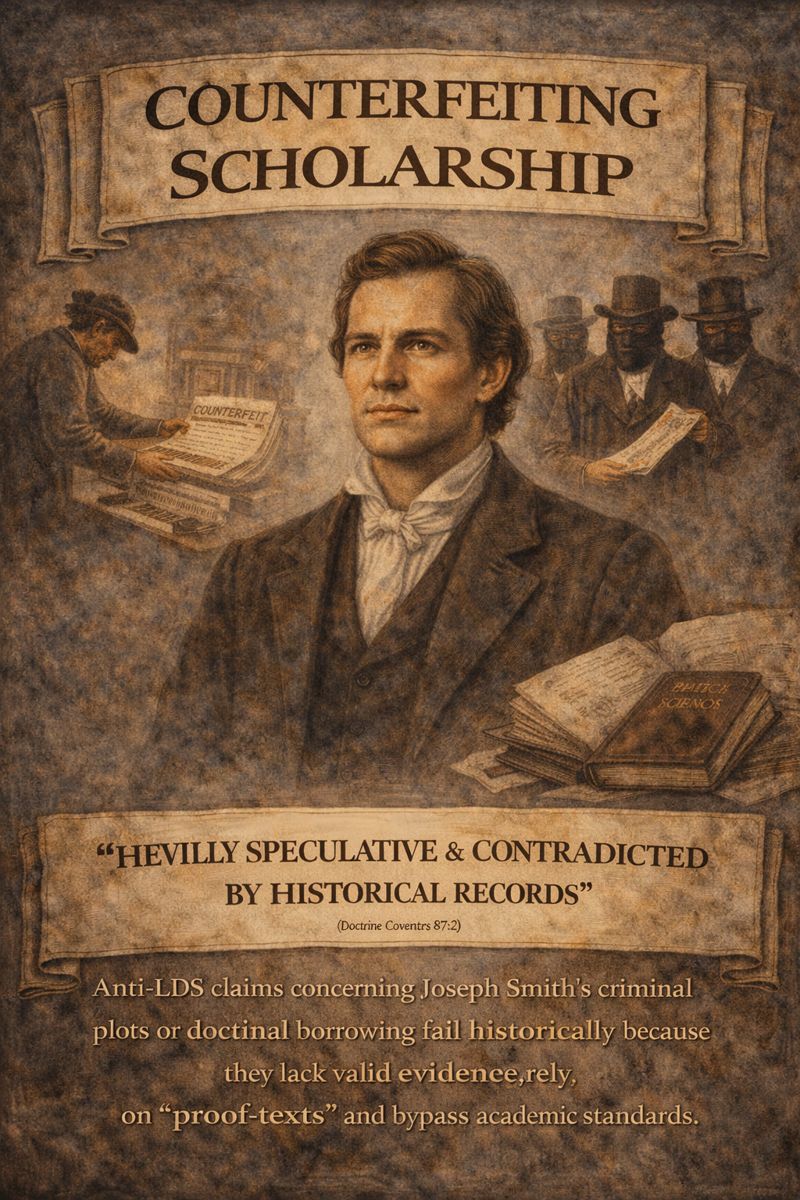
Counterfeiting Scholarship – Part 1
Introduction
These episodes analyze how historical claims about Joseph Smith and early Latter-day Saint history are often misused, misinterpreted, or built on weak methodology. They explain how legitimate historical scholarship works and contrast it with common problems found in anti-LDS arguments, especially those presented in a modern book alleging that Joseph Smith was connected to counterfeiting operations and borrowed doctrines from distant relatives.
Evaluating Historical Claims About Joseph Smith
Distinguishing Faith Arguments from Historical Arguments
Arguments about Joseph Smith can be:
Faith-based — dealing with belief and spiritual conviction
Historical — requiring evidence, context, methodology, and academic standards
Historical claims must be supported by:
Primary sources
Contextual interpretation
Training in historical method
Peer-reviewed scholarship
Claims presented as “fact” without this framework are not valid historical conclusions.
Expertise vs. Enthusiasm
Why Interest ≠ Expertise
To make credible historical arguments, one generally needs:
Formal academic training (usually a PhD in history)
Specialization in 19th-century American religion or related fields
Peer-reviewed research
Experience working with archival manuscripts
Many criticisms of Joseph Smith come from individuals with:
No historical training
No experience with primary documents
Backgrounds in unrelated fields
Strong opinions but weak methodology
This distinction protects against interpretive mistakes and unsupported claims.
Peer Review and Academic Publishing
How Scholarly Work Is Vetted
Reliable historical research goes through:
Double-blind peer review
Evaluation by experts in the same specialty
University press publication
Books that are:
Self-published
Published without peer review
Released by nonacademic presses
are not inherently wrong, but their claims require higher scrutiny because they have bypassed quality control.
Misuse of Primary Sources
Common Errors
Misinterpretations often occur when:
19th-century vocabulary is read literally
Transcriptions are used instead of original manuscripts
Context is ignored
Uncorroborated speculation is treated as fact
Example: Misreading of Emma Smith’s 1842 Journal Entry
History of the Church mistakenly stated that Emma delivered a baby on December 26, 1842.
The original journal (written by Willard Richards) actually reads:
“Sister Emma sick. Had another chill.”
A copyist misread “chill” as “child”, creating a long-standing historical error.
This illustrates why original manuscripts and context matter.
Counterfeiting and Conspiracy Allegations
Why These Claims Fail Historically
Some critics argue that:
Joseph Smith was part of a counterfeiting ring
Religious doctrines masked criminal behavior
Plural marriage existed to bind conspirators
The Restoration was an organized “secret combination”
Problems with these claims:
Heavily speculative
No documentary evidence
Built on phrases like “surely,” “obviously,” or “he must have…”
Contradicted by known historical records
Conspiracy narratives are not permitted in legitimate historical method.
Claims That Joseph Borrowed Doctrines from Relatives
Evaluating “Borrowing” Theories
To prove doctrinal borrowing, critics must show:
Actual evidence of contact
Doctrines present in the alleged source materials
Correct dating proving Joseph had access
Direct transmission, not coincidental similarity
Joseph Smith taught many doctrines unknown in surrounding culture, including:
Premortal existence
Eternal marriage
Theosis / exaltation
Embodied God
Degrees of glory
Sealing keys
Eternal progression
Assertions of borrowing require hard evidence—not proximity or speculation.
Counterfeiting Scholarship – Part 2
Problems With Anti-LDS Arguments
Why Many Faith Crises Begin With Bad History
Online content frequently:
Presents itself as authoritative
Lacks historical training
Selectively quotes sources
Uses secondary retellings instead of primary documents
Testimony comes from the Spirit—but historical claims require historical method.
The Book’s Central Argument
The book under review claims that:
Joseph Smith’s family was tied to counterfeiters
Joseph borrowed doctrines from a Dartmouth professor named John Smith
Ideas from Dartmouth influenced Mormonism
However:
These claims originate in a 2006 article
The article’s author was not a historian
The book repeats the article’s errors without new evidence
Genealogy Problems With the Dartmouth “Cousin” Claim
Why the Theory Collapses
The book asserts that Dartmouth professor John Smith was Joseph Smith’s second cousin three times removed.
But:
Genealogical records do not support this
The Dartmouth John Smith does not appear in the Smith family line
Joseph Smith Papers researchers found zero evidence of a relationship
Since the book depends on this connection, the argument collapses without it.
Plagiarism and Source Misuse in the Book
Documented Issues
Comparisons show:
Entire sentences copied nearly word-for-word from the 2006 article
No quotation marks
Improper use of footnotes
Unsupported statements
Lack of primary sources
This indicates:
Speculation
No archival research
Lack of academic rigor
No peer review
Misinterpretation of the Dartmouth “School of the Prophets”
The book claims Dartmouth’s religious classes inspired Joseph Smith’s School of the Prophets.
Historically:
“School of the Prophets” was a common early American term
Used at Yale and other seminaries long before Joseph Smith
Not secret, not unique, and not evidence of borrowing
Sidney Rigdon Authorship Theory
The book claims:
Rigdon secretly worked with Joseph Smith in 1827
He helped write the Book of Mormon
A “Gold Bible Company” existed
Historical Evaluation
No contemporary evidence supports Rigdon meeting Joseph before late 1830
“Gold Bible Company” is an invented term
Sources used are late, antagonistic, or unreliable
Mainstream historians—LDS and non-LDS—reject the theory
Plural Marriage Misrepresentations
The book repeats a rumor that Joseph Smith demanded William Law give him his wife.
But:
William Law explicitly denied this rumor in writing
His apostasy centered on doctrinal disagreement, not personal offense
Misrepresentation of Nauvoo Violence
The book claims the mob killing Joseph and Hyrum was justified because Joseph “resisted arrest.”
In reality:
Joseph had submitted to legal arrest
He was jailed and awaiting trial
The mob was illegal, armed, masked, and without authority
This justification is historically indefensible.
Historical Method vs. Anti-Mormon Speculation
Legitimate historians:
Use primary sources
Distinguish fact from possibility
Avoid sensational claims
Avoid psychological speculation
Follow established methodology
Anti-LDS writers often:
Overstate certainty
Use conjecture
Cite weak or late sources
Ignore context
Publish without peer review
Thus, their claims cannot be accepted as historical fact.
The Source of Testimony
While historical study matters:
A testimony of Joseph Smith comes from the Holy Ghost
Spiritual confirmation surpasses intellectual debates
The Book of Mormon remains the central test:
Read
Pray
Ask God
Receive personal revelation
🎧 Listen to the full podcast:
https://www.youtube.com/@standardoftruthpodcastllc