
D&C 135
How Historians Examine the Past
Historians study the past through written and spoken sources, seeking to understand what most likely occurred. This task becomes significantly more complex when sources involve oral traditions or accounts of miraculous events. Because miracles fall outside natural probability, historians cannot confirm or deny them using standard historical tools.
Instead of evaluating the supernatural element, historians focus on:
- When the account was first recorded.
- Who reported the event.
- How the report compares with other existing sources.
Oral History and Reports of Miraculous Experiences
In many families and religious communities, miraculous experiences are passed down only through oral tradition. When no written record from the original participant exists, historians face important limitations.
What historians can do
- Identify the earliest written version of the story.
- Compare details across different retellings.
What historians cannot do
- Prove or disprove the miracle itself, because supernatural claims cannot be evaluated by naturalistic historical methods.
A common criticism is that miraculous events written long after they occurred must be unreliable. Historians, however, note that delayed recording is typical in many religious contexts.
Examples include:
- Joseph Smith’s earliest written account of the First Vision, recorded twelve years after the event.
- Martin Luther and other religious figures who documented spiritual experiences years later without historians questioning their sincerity.
Limits of Historical Method in Religious Settings
Historical method is restricted to explanations grounded in natural causation. Therefore, historians cannot determine whether a miraculous event actually took place.
Instead, historians analyze:
- Whether the individual consistently reported the experience.
- Whether contemporaries left written references to the claim.
- Whether the narrative changed significantly over time.
Just as historians cannot prove or disprove the resurrection of Jesus Christ, they likewise cannot verify or invalidate miraculous Latter-day Saint experiences. They can only analyze the testimonies and sources left behind.
Accuracy and Distortion in Oral Tradition
Oral tradition often preserves sincere memories, but details can shift over generations. Several patterns appear frequently:
- Family traditions placing ancestors at historical events they could not have attended.
- Accounts where the emotional truth is preserved but factual detail becomes distorted.
A well-documented example within Latter-day Saint history involves several families who believed they descended from Joseph Smith’s plural marriages. DNA research later showed that these specific family lines were not descended from him, demonstrating how sincere oral tradition can diverge from verifiable historical evidence.
Historical Case Study: The Authorship of Doctrine and Covenants 135
Doctrine and Covenants 135—the tribute announcing the martyrdom of Joseph and Hyrum Smith—offers a clear example of how traditions form and how historians evaluate them.
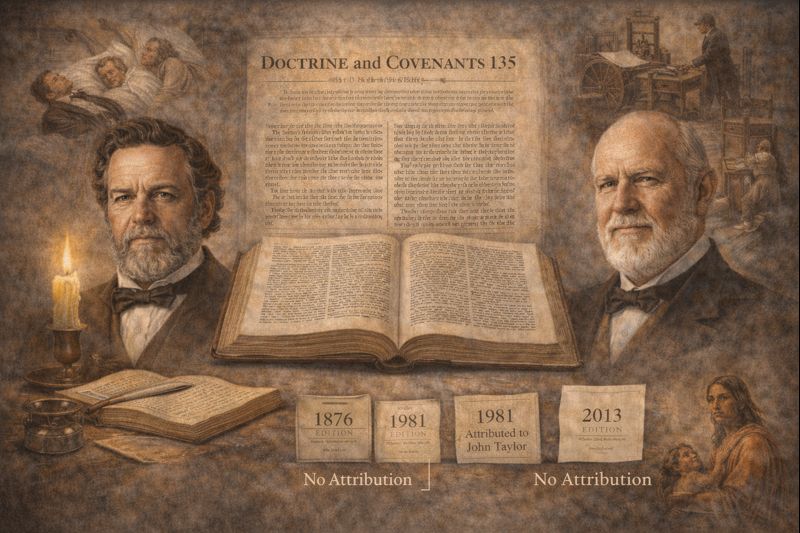
Publication History of D&C 135
1844 Edition
The tribute was included at the end of the Doctrine and Covenants shortly after the martyrdom.
No author was listed.
1876 Edition
The book was reorganized under Brigham Young and Orson Pratt.
Again, no author was named.
1921 Edition
The heading gave historical context referencing History of the Church, volume 6.
No attribution was given.
1981 Edition
For the first time, the heading stated that Elder John Taylor wrote the tribute.
This reflected a later tradition rather than early documentation.
2013 Edition
The attribution to John Taylor was removed.
The heading now explains only that the document was included in the 1844 edition being prepared at the time of the martyrdom.
Why the Attribution Changed Over Time
The earliest known statement linking the document to John Taylor appears in 1922, when President Heber J. Grant said in General Conference, “I have understood” that Taylor wrote it.
This wording shows:
- A personal assumption or oral tradition.
- No reference to documentary evidence.
Importantly:
- No accounts from 1844 claim Taylor authored the tribute.
- Taylor himself, though he often spoke about the martyrdom, never identified himself as the author.
- Other Nauvoo figures—such as Willard Richards or William Clayton—also had direct knowledge of the events and access to the printing office.
Modern editors, including those working with the Joseph Smith Papers, concluded that there is no definitive evidence identifying John Taylor as the author. Because all editions before 1981 were neutral, the 2013 edition restored that original neutrality.
Historical Principles Illustrated by This Case
The uncertainty surrounding the authorship of Doctrine and Covenants 135 highlights several core principles of historical methodology:
- When early records are silent or ambiguous, historians avoid making definitive claims.
- When later traditions introduce ideas unsupported by early sources, these are identified as traditions, not established facts.
- Lack of evidence for a claim does not mean the claim is false, but it does mean historians cannot assert it as fact.
Conclusion: What This Reveals About History and Tradition
The analysis of oral tradition and the authorship of Doctrine and Covenants 135 demonstrates:
- The distinction between religious belief and historical investigation.
- The limits of historical method in evaluating miraculous events.
- The ways oral traditions can evolve over time.
- The importance of careful source analysis in understanding scriptural texts.
This example illustrates how faith and history can coexist while serving different purposes—one addressing spiritual meaning, and the other seeking to understand the past through documented evidence.