
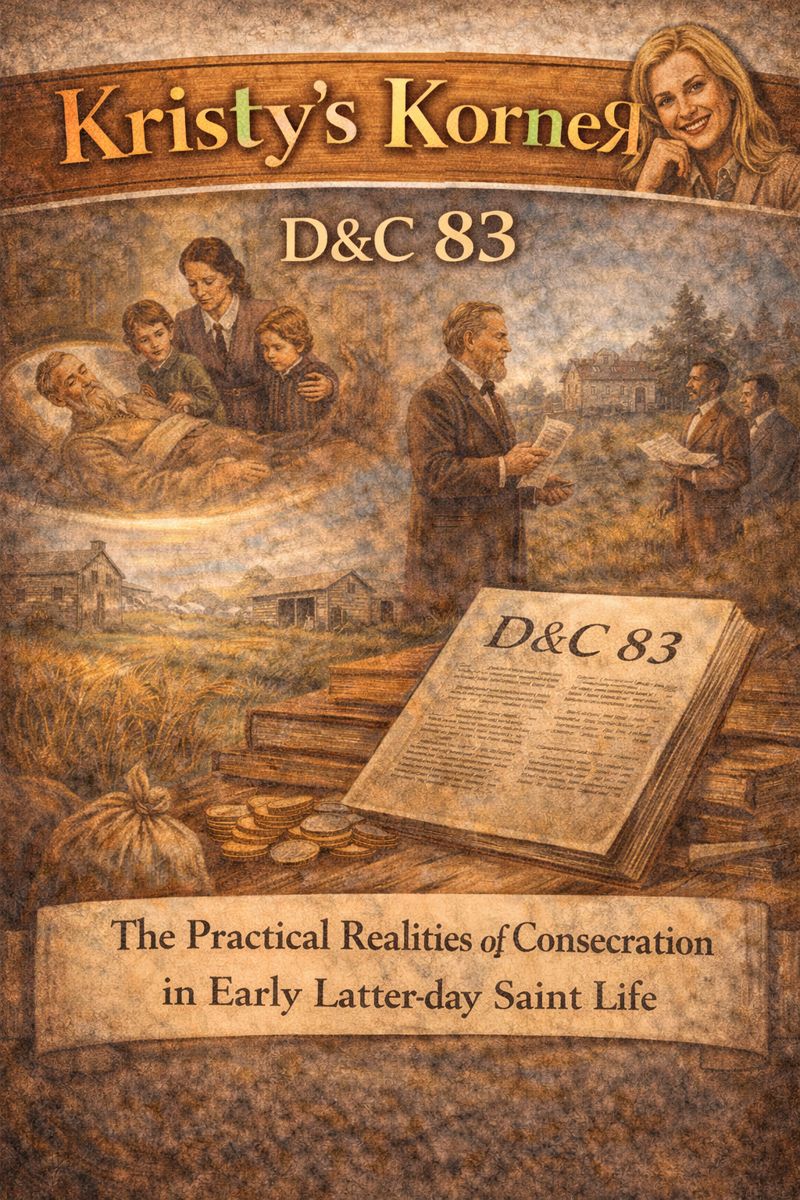
D&C 83
The Practical Realities of Consecration in Early Latter-day Saint Life
Doctrine and Covenants 83, received in April 1832, emerged from real questions confronting the early Latter-day Saints as they lived the law of consecration. Since Doctrine and Covenants 42 had already established consecration as a governing economic system, members needed clarity regarding what happened to stewardships—properties assigned to individuals—when death, hardship, or changes in family circumstances occurred.
Under consecration, land and goods were deeded to the Church and then redistributed to individuals as stewardships. These stewardships did not constitute private ownership. Rather, members used and benefited from the land as long as they remained faithful, while any “surplus” was to be returned to the bishop to support the poor and build the community. Because families depended on these stewardships for survival, the question of what happened when a husband died naturally arose early in Church settlements.
The 1832 Joseph Knight Jr. Stewardship Deed as Historical Background
One of the clearest surviving examples of a consecration-era stewardship is the October 1832 deed issued to Joseph Knight Jr. by Bishop Edward Partridge. This document reveals how consecration functioned in practice. Bishop Partridge leased Knight a parcel of land to manage as a steward within the Church of Christ. Knight agreed to improve and cultivate the property, pay taxes, and consecrate any surplus resources beyond his family’s needs to the bishop for the benefit of the Saints.
The deed emphasized that Knight’s right to the land existed only while he remained faithful and retained his membership. If he were cut off from the Church, he was required to return the property and compensate the Church for any loaned equipment. This arrangement shows how consecration preserved both communal ownership and individual responsibility.
The document also addressed family provisions. Should Joseph Knight Jr. die, his wife—so long as she remained a member—retained rights to the stewardship under the same conditions. If both parents died, their children retained access to the land for their support until reaching legal adulthood. Bishop Partridge, acting as the Church’s agent, pledged to provide for the widow and children as circumstances required.
The Revelation in Doctrine and Covenants 83
Against this lived background, D&C 83 provides divine instruction that widows and children retain a rightful claim upon Church support. Their welfare was not optional charity but a covenant obligation tied to consecrated resources. The revelation affirmed that children rely first on their parents, but when parents lack means—or when death removes a provider—the Church must supply necessities through the Lord’s storehouse.
This doctrinal clarification aligned perfectly with practices already emerging in Missouri, where stewardships were governed by deeds like that of Joseph Knight Jr. D&C 83 thus anchored consecration in concrete family reality, ensuring that widows, orphans, and the poor were central to the economic structure of the early Church.