
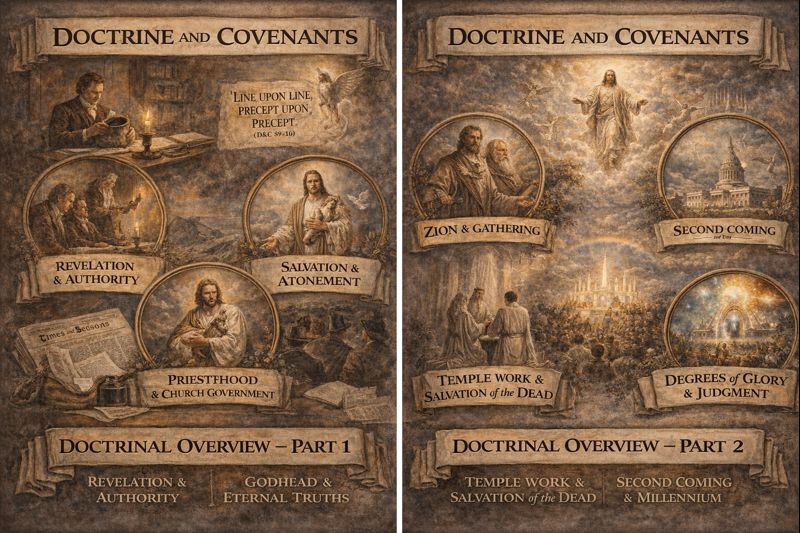
Revelation and Prophetic Authority
The Principle of Continuing Revelation
The Doctrine and Covenants describes revelation as ongoing. God reveals His will to guide the Church. Revelation may occur through visions, dreams, impressions of the Holy Ghost, and angelic messengers. The phrase “line upon line” reflects gradual spiritual instruction.
Prophetic Stewardship and Authority
Only the President of the Church receives revelation for the entire Church. Individuals may receive revelation only within their assigned spheres of responsibility. Prophets act as authorized interpreters of God’s will. Their instructions are binding for Church governance.
Canonization and Scriptural Preservation
Revelations are to be written, preserved, and published for the benefit of the Church. Canonical revelations serve as doctrinal standards. The Doctrine and Covenants affirms the need for record keeping, accuracy, and the distribution of revelations among the Saints.
The Godhead and Eternal Truths
Nature of the Godhead
The Father, the Son, and the Holy Ghost are distinct beings. God the Father and Jesus Christ possess glorified bodies of flesh and bone. The Holy Ghost is a personage of spirit.
Attributes of God
God is unchanging, eternal, omniscient, and perfect. His works proceed according to law and order. His justice and mercy operate together in the administration of salvation.
Role of Jesus Christ
Christ is the Redeemer, Creator, and Mediator. His atonement provides resurrection, repentance, and exaltation. Salvation is made possible through His sacrifice.
Salvation, Atonement, and Grace
Requirements for Salvation
Salvation requires faith, repentance, baptism, receiving the Holy Ghost, and enduring faithfully. These ordinances are mandatory for entry into the kingdom of God.
Nature of the Atonement
The atonement of Christ includes His suffering for sins, pains, infirmities, and mortal weakness. Through Him, all individuals are redeemed from physical death and offered redemption from spiritual death.
Judgment According to Works
Individuals are judged by their actions, desires, and intentions. Final judgment is just and reflects each person’s voluntary choices.
Priesthood and Church Government
Priesthood Orders and Offices
Two priesthood orders exist: Aaronic and Melchizedek. Each order contains defined offices. The Aaronic Priesthood administers outward ordinances. The Melchizedek Priesthood administers all spiritual ordinances and governs the Church.
Priesthood Keys
Priesthood keys represent the authority to preside and direct priesthood use. Keys are held by leaders responsible for governing the Church. The President of the Church holds all priesthood keys.
Administrative Duties
Offices such as apostles, seventies, bishops, high priests, elders, priests, teachers, and deacons have specific responsibilities involving teaching, ordinances, and governance.
Ordinances and Sacred Covenants
Baptism
Baptism by immersion is required for remission of sins and entrance into the Church. It must be performed by proper priesthood authority.
Confirmation and the Holy Ghost
Confirmation confers the gift of the Holy Ghost and is performed by laying on of hands. This ordinance is essential for spiritual guidance and sanctification.
Priesthood Ordination
Ordination requires proper authority and worthiness. It enables individuals to perform sacred ordinances.
Sacrament Ordinance
The sacrament renews baptismal covenants. Bread and water symbolize Christ’s body and blood.
Temple Ordinances and Eternal Marriage
Temple ordinances include washings, anointings, endowment, and sealing. Eternal marriage is required for exaltation.
Zion, Gathering, and Consecration
Zion as a People and a Place
Zion refers to the pure in heart and designated locations for gathering. Zion is to be built through unity, righteousness, and covenant keeping.
Gathering of Israel
The gathering involves missionary work, conversion, and the unification of covenant Israel. It prepares the world for the Second Coming.
Law of Consecration
The law emphasizes stewardship, equality, and sacrifice. Resources are administered for the good of all, and individuals are accountable for their stewardships.
Moral Laws and Commandments
Commandments Reinforced
The Doctrine and Covenants reiterates commandments against idolatry, murder, adultery, theft, dishonesty, and profaning the Sabbath.
Law of Chastity
Sexual relations are limited to lawful marriage. Purity of thought and action is commanded.
Word of Wisdom
The Word of Wisdom prohibits alcohol, tobacco, and hot drinks. It encourages healthy living and moderation.
Ethical and Financial Conduct
Members must avoid debt, fulfill obligations, be industrious, and maintain honesty.
Temple Work and Salvation of the Dead
Vicarious Ordinances
Essential ordinances can be performed by proxy for the dead. This doctrine enables universal access to salvation.
Spirit World
The spirit world includes places of peace and instruction. Missionary work continues among those who did not receive the gospel in life.
Records and Genealogy
Accurate record keeping is commanded. Genealogical work is required for temple ordinances.
Second Coming and Millennium
Signs of the Last Days
Events preceding the Second Coming include wars, upheavals, natural disasters, and global proclamation of the gospel.
Christ’s Return
Christ will appear in glory, cleanse the earth, and begin His millennial reign.
The Millennium
During the Millennium, Christ reigns personally. Satan is bound, and the earth is renewed.
Degrees of Glory and Eternal Judgment
Universal Resurrection
All individuals will be resurrected regardless of righteousness or belief.
Celestial, Terrestrial, Telestial Kingdoms
The celestial kingdom is for those who receive the fullness of the gospel. The terrestrial kingdom includes honorable individuals who were not valiant. The telestial kingdom includes the wicked who eventually accept Christ.
Outer Darkness
Sons of perdition are assigned to outer darkness due to willful rebellion with full knowledge.
Missionary Work
Missionary Purpose
Missionaries preach the restored gospel, call individuals to repentance, and gather Israel.
Missionary Conduct
They travel with simplicity, rely on the Spirit, and teach by revelation.
Member Participation
All members are responsible for sharing the gospel and warning their neighbors.
Temporal Law, Stewardship, and Welfare
Stewardship
Individuals receive stewardships under the law of consecration and are accountable for their management.
Care for the Poor and Needy
Members must provide for the poor. Bishops oversee welfare support.
Financial Law
Members are taught to be self-reliant, avoid debt, and maintain integrity in temporal matters.
What is the main doctrinal purpose of the Doctrine and Covenants?
To provide modern revelation regarding Church organization, ordinances, priesthood, and the plan of salvation.
Does the Doctrine and Covenants define the Godhead?
Yes. It teaches that the Father, Son, and Holy Ghost are three distinct beings.
What ordinances are explained in the Doctrine and Covenants?
Baptism, confirmation, priesthood ordination, sacrament, washings, anointings, endowment, and sealing.
What does the Doctrine and Covenants teach about Zion?
Zion is both a people (the pure in heart) and a place of gathering.
Does the Doctrine and Covenants teach degrees of glory?
Yes. It outlines celestial, terrestrial, and telestial kingdoms, plus outer darkness.