
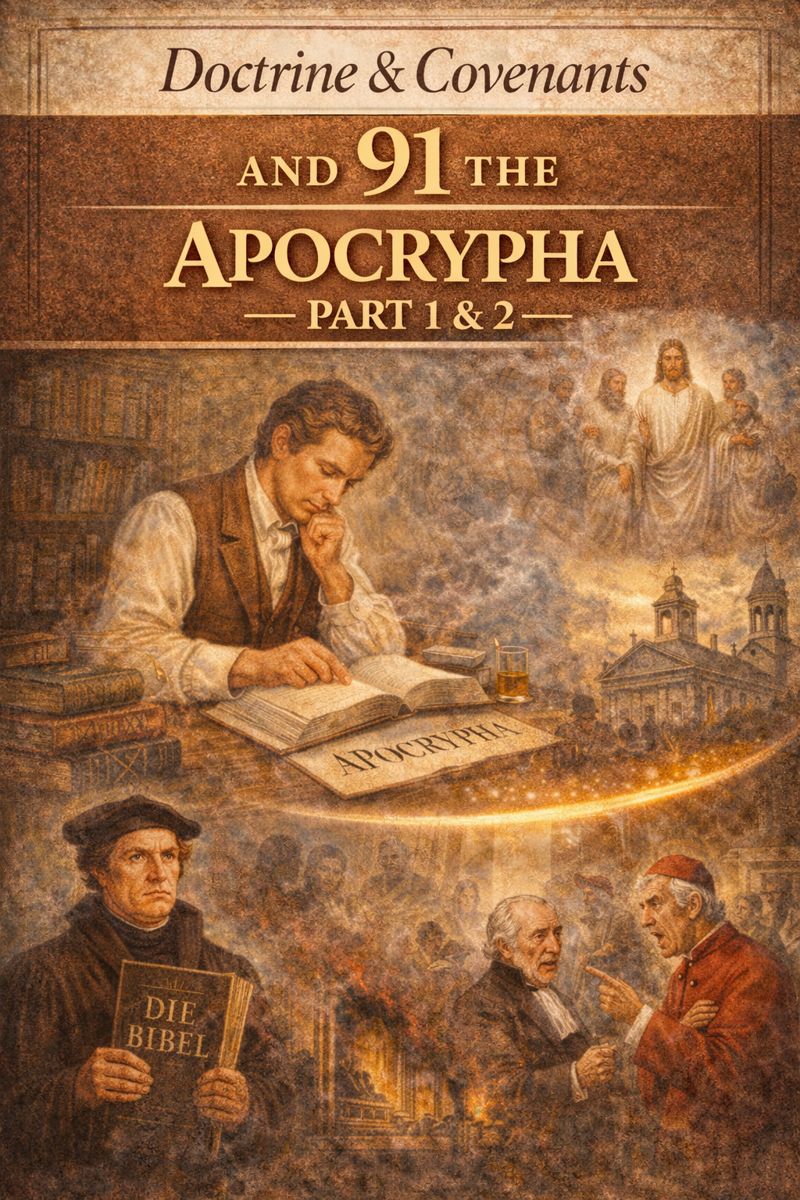
Doctrine & Covenants 91 and the Apocrypha (Part 1)
Joseph Smith’s Translation Work and the Setting of the Revelation
Doctrine and Covenants 91 was received on March 9, 1833, during the period when Joseph Smith was actively engaged in his Bible translation project. The revelation followed immediately after D&C 90, which instructed Joseph to finish translating the prophets. At the time, Joseph worked from a King James Bible printed by H. & E. Phinney in 1828—one of the last widely distributed American editions to include the Apocrypha.
Understanding the Apocrypha in Jewish and Christian History
The Apocrypha consists of several Jewish writings preserved in the Septuagint, the ancient Greek translation of the Hebrew scriptures, widely used during the time of Jesus and the early Christian church. Although the Hebrew Bible ended with Malachi, the Septuagint contained additional books such as Tobit, Judith, Wisdom of Solomon, Ecclesiasticus, Baruch, additions to Daniel and Esther, and 1–2 Maccabees. These writings circulated broadly in antiquity and were included in the Latin Vulgate, the foundational Bible of Western Christianity for more than a thousand years.
Reformation-Era Debate Over the Apocrypha
During the Protestant Reformation, Martin Luther included the Apocrypha in his German Bible translation, but separated it from the canonical books. He wrote that the writings were not equal to scripture but were still “useful and good to read.” Over the next several centuries, Protestant attitudes hardened. Many theologians condemned the Apocrypha outright, viewing it as a source of Catholic doctrine—especially purgatory—which Protestants opposed.
Nineteenth-Century Controversies and the Removal of the Apocrypha from Protestant Bibles
In the 1820s, Bible societies in Britain and the United States fiercely debated whether the Apocrypha should be printed in missionary Bibles. By 1826–1827, most major societies resolved to exclude it entirely, leading to its widespread removal from English-language Protestant Bibles. Joseph Smith’s 1828 Phinney KJV was therefore unusual in still containing these books.
Anti-Catholic Sentiment and Public Perception of the Apocrypha
Early nineteenth-century America was marked by strong anti-Catholic sentiment, especially during the Second Great Awakening. Many Protestants viewed the Apocrypha as evidence of Catholic corruption. Writers such as William Craig Brownlee argued that the Apocrypha contained errors, contradictions, and doctrines foreign to the Bible.
Why Joseph Smith Sought Revelation About the Apocrypha
Joseph had been commanded to complete his translation of the Bible, and because his edition included the Apocrypha, he needed to know whether these writings required translation or revision. His inquiry was therefore practical, scriptural, and timely, especially given the ongoing Protestant controversies surrounding these books. This inquiry resulted in the revelation now known as Doctrine and Covenants 91.
Doctrine & Covenants 91 and Latter-day Saint Views of the Apocrypha (Part 2)
Early Latter-day Saint Use and Attitudes Toward the Apocrypha
Early Latter-day Saints encountered the Apocrypha through Joseph Smith’s 1828 Bible and did not share the intense Protestant hostility toward these writings. Having already accepted the Book of Mormon as scripture, early converts recognized that God could preserve sacred writings beyond the traditional biblical canon. Church newspapers and leaders used apocryphal material, occasionally quoting from it in sermons and publications.
The Appeal of 2 Esdras in Early Latter-day Saint Thought
Among apocryphal texts, 2 Esdras (also called 4 Ezra) captured particular interest. It includes vivid apocalyptic visions, prophecies of the Messiah, descriptions of Zion, and a dramatic narrative about the lost ten tribes traveling to a distant land to serve God more faithfully. Early Saints saw parallels between these themes and their own millennial expectations, gathering traditions, and restoration beliefs. Sidney Rigdon even quoted directly from 2 Esdras during the dedication of the land of Zion.
The Revelation on the Apocrypha: Doctrine & Covenants 91 (March 9, 1833)
Joseph Smith asked whether he should translate the Apocrypha as part of his Bible translation. The revelation declared that the Apocrypha contained many truths, but also many errors introduced by uninspired additions. It instructed that translation was unnecessary; those guided by the Spirit would benefit from reading the Apocrypha, while those lacking the Spirit would not.
Reactions to the Revelation
Doctrine & Covenants 91 satisfied neither major religious faction of the time. Protestants wished Joseph Smith had denounced the Apocrypha altogether, aligning with their increasingly strict rejection of the texts. Some early Latter-day Saints, by contrast, hoped Joseph would translate the Apocrypha and produce new scripture. The revelation instead mirrored Martin Luther’s early position: the writings had value, but not canonical authority.
The Brewsterite Movement and Claims of Restored Apocryphal Writings
The Brewster family of Kirtland and Nauvoo later claimed that their son James Brewster received new revelations restoring lost apocryphal scripture. They published these writings and sought acceptance from Joseph Smith. He publicly rejected the revelations, declaring they were not from God. The Brewster family and followers formed a schismatic group that newspapers of the period used to criticize the Church.
The Decline of Apocrypha Awareness in Later Latter-day Saint History
After 1828, most American printings of the KJV no longer included the Apocrypha. As a result, later generations of Latter-day Saints became less familiar with these writings simply because they rarely encountered them. Although never canonized, the Apocrypha continued to be recognized as historically valuable.
Modern Latter-day Saint Perspective
Modern Church reference materials summarize the Apocrypha as containing helpful historical and spiritual material, bridging the gap between the Old and New Testaments. Doctrine & Covenants 91 remains the authoritative guide: the Apocrypha contains truth mingled with error, and those who read it with the Spirit will discern its value.
Listen to the full podcast here:
Season 5, Bonus Episode 9 – Kristy’s KorneЯ Rerelease of D&C 91 – Part 1
Season 5, Bonus Episode 10 – Kristy’s KorneЯ Rerelease of D&C 91 – Part 2