
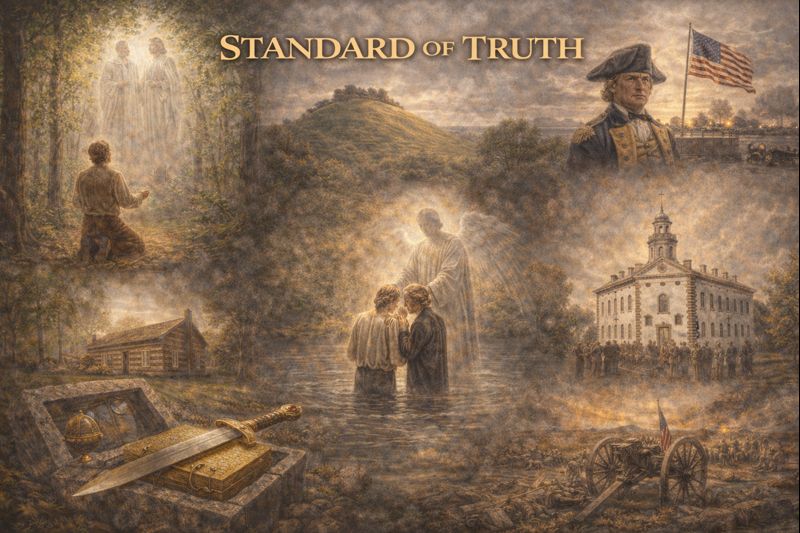
A Journey Into the Early World of the Restoration
The tour carried its participants across the foundational landscape of the Restoration, beginning in the quiet woodlands of upstate New York and extending through the early gathering places of the Saints. The first stop, the Sacred Grove in Palmyra, remains inseparably linked to Joseph Smith’s 1820 vision, the moment he later described as the appearance of God the Father and Jesus Christ. The land itself was originally cleared by the Smith family as they attempted to establish their farm, and its stillness today invites reflection on the event that marks the opening chapter of Latter-day Saint history.
Nearby stand the homes in which the Smiths lived during the years of Joseph’s earliest visions. Both the log home and the later frame house preserve the memory of hardships endured and revelations received. According to historical accounts, the gold plates were hidden repeatedly within these structures—under floorboards, within walls, and near hearthstones—as Joseph sought to protect them from determined attempts to seize them. These small domestic spaces therefore witnessed the unfolding of one of the most consequential events in American religious history.
The Hill Cumorah and the Weight of Scripture
From the Smith homes the travelers moved to the Hill Cumorah, traditionally identified as the hill where Joseph Smith stated he received the plates from Moroni in 1827. It is a place layered with meaning both for the Book of Mormon narrative and for the early chapters of Joseph’s prophetic calling. For many tour participants, the hill represents the connection between ancient record keepers and the young prophet who brought their writings to light.
Harmony, Pennsylvania: Translation and Priesthood
The journey then carried them south to Harmony, Pennsylvania, today known as the Priesthood Restoration Site. It was in these quiet surroundings that Joseph and Emma lived during critical months of the Book of Mormon translation. Here, according to their testimonies, John the Baptist appeared and restored the Aaronic Priesthood, directing Joseph and Oliver Cowdery to baptize one another in the nearby Susquehanna River. A substantial portion of the Book of Mormon text was translated in this place, making the secluded site a cradle of Restoration scripture.
Fayette and the Birth of the Church
Continuing northward once more, the group reached Fayette, New York, where the Whitmer family’s home served as a vital hub during the final stages of preparing the Book of Mormon for publication. It was also here, on April 6, 1830, that the Church of Christ—now The Church of Jesus Christ of Latter-day Saints—was formally organized. The Whitmers’ hospitality and faith ensured that the young movement had a protected space in which to grow.
Kirtland: Revelation, Temple Worship, and a New Community
From New York the tour turned west to Kirtland, Ohio, a center of extraordinary spiritual and organizational development between 1831 and 1838. The Kirtland Temple, completed and dedicated in 1836, stood as a symbol of sacrifice and consecration. Within its walls early Saints recorded visions, manifestations, and the reception of priesthood keys that shaped the future of the Church. Newly opened historic sites, including the Joseph Smith home in Kirtland, offered the travelers a deeper sense of the Prophet’s daily life during this transformative period.
Gettysburg: A Glimpse Into National Turmoil
Although not a Latter-day Saint site, Gettysburg provided essential historical grounding. The 1863 battle marked a pivotal moment in the American Civil War, its fields still echoing with sacrifice and national conflict. Standing there, participants recognized the larger historical framework in which the early Saints lived—the same nation torn by political division, social upheaval, and questions of liberty and identity.
Fort McHenry and the Story of a Nation
The tour concluded in Baltimore at Fort McHenry, where the defenders’ resistance during the War of 1812 inspired Francis Scott Key to write “The Star-Spangled Banner.” Here, American history again intersected with the world that produced the Restoration. Participants reflected on how the early national story—its wars, migrations, and ideological struggles—formed the social environment in which Joseph Smith’s revelations emerged.
Interwoven Histories
By the journey’s end, travelers expressed a deeper awareness of how inseparably the Restoration is tied to the broader American experience. The social forces of the early 19th century, the religious ferment of the Second Great Awakening, the pressures that drove migration, and the conflicts that reshaped the nation all played roles in shaping early Latter-day Saint life. The tour revealed not only sacred spaces but also the historical world in which those sacred events unfolded.
Listen to the full podcast here:
Season 4, Bonus Episode 7 – Standard of Truth Tour, the People Cry Out