
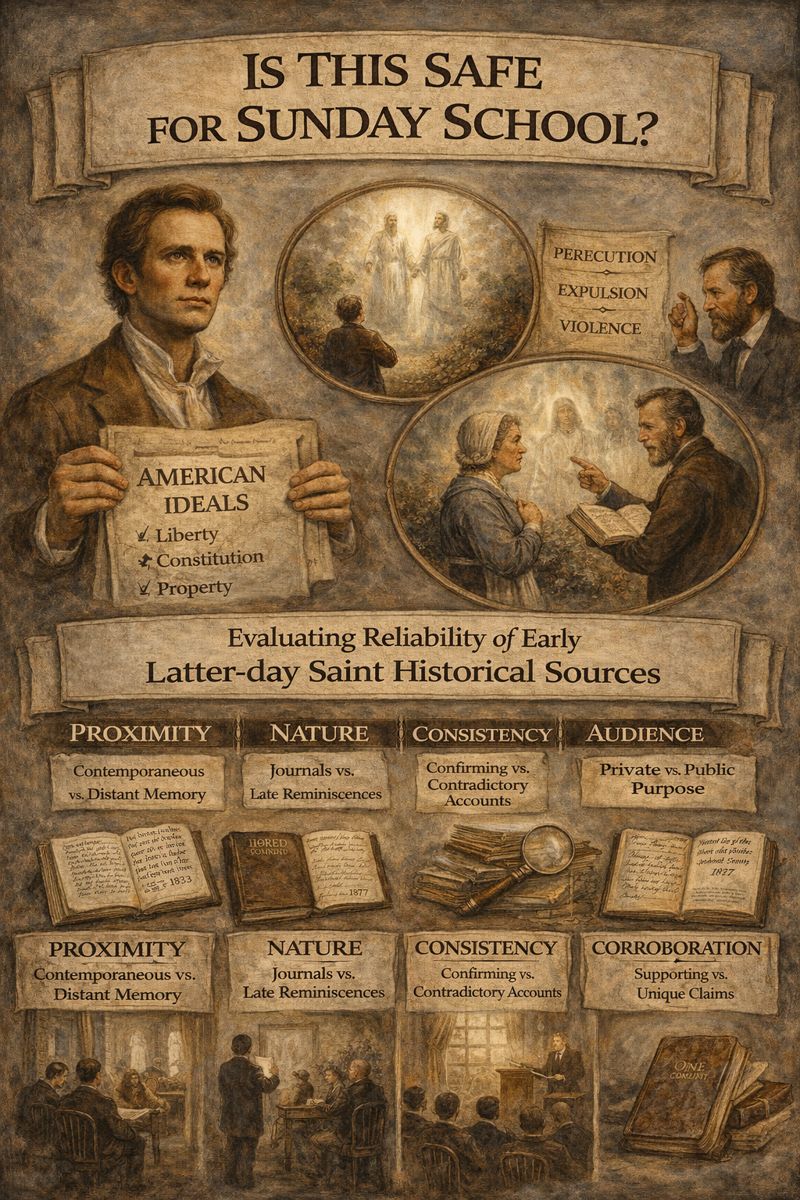
Evaluating Safety and Reliability of Early Latter-day Saint Historical Sources
Historians distinguish between what can be verified through evidence and what belongs to the realm of faith. Religious claims often involve miraculous events that lie outside the limits of historical methodology, which relies on documents, eyewitness accounts, and material evidence. For example, Christians universally affirm the resurrection of Jesus Christ, yet historians cannot verify the resurrection itself; they can only confirm that followers of Jesus sincerely testified of seeing Him. The same principle applies to Latter-day Saint history: historians can confirm what people said, wrote, and claimed, but cannot prove supernatural events.
Joseph Smith’s First Vision and Historical Documentation
Joseph Smith’s First Vision falls into a category of historically strong documentation because it appears in multiple firsthand accounts authored by Joseph Smith himself, along with numerous secondhand and thirdhand retellings. This range of sources allows historians to confirm that Joseph consistently described a vision across many years, even though the miraculous event cannot be proven through secular methods.
Mary Whitmer’s Angelic Visitation
Mary Whitmer’s reported angelic visitation offers a different kind of historical evidence. The account comes primarily from later statements by David Whitmer, who said his mother saw an angel showing her the plates. Mary Whitmer did not leave her own written account. Historically, it is certain David Whitmer testified to this story, but the supernatural event remains unverifiable.
These distinctions illustrate how historians separate the existence of a claim (which is historically documented) from the miraculous nature of the event (which is a matter of belief).
The 1833 School of the Prophets Vision
A unique case is the 1833 School of the Prophets vision, where a contemporary record exists. Minutes from March 18, 1833—recorded by Frederick G. Williams—state that after prayer and sacrament, “many of the brethren saw a heavenly vision of the Savior and concourses of angels.”
This document confirms that participants at the time believed they had witnessed a shared spiritual manifestation. Later reminiscences from Zebedee Coltrin and John Murdock expand on these events, but the contemporary minutes anchor the core claim historically.
Evaluating Later Reminiscences and Memory Reliability
Historians also evaluate the reliability of later reminiscences, which can become less dependable as memory fades or theological interpretation shapes retellings.
The Veil Quotation Attributed to Joseph Smith
A useful example is the popular quotation attributed to Joseph Smith: “If you knew what was behind the veil, you would commit suicide to get there.” This statement is not found in Joseph Smith’s writings. Instead, it appears in an 1877 journal entry by Charles L. Walker summarizing something he heard Wilford Woodruff say about what Woodruff remembered Joseph saying decades earlier. Walker even qualified it as only “something like this.”
The chain of transmission—thirdhand and decades removed—indicates low historical certainty and highlights how easily teachings can be reshaped over time.
Criteria Used by Historians to Analyze Sources
To analyze sources responsibly, historians apply several criteria:
- Proximity to the event, with contemporary documents being more reliable than later memories
- Nature of the source, such as journals, letters, official minutes, or published sermons
- Consistency across multiple accounts, which strengthens historical confidence
- Intended audience, affecting tone and emphasis
- Corroboration, determining whether other sources support the claim
These factors help establish the historical weight of an account.
Conclusion: Faith, History, and Responsible Evaluation
In conclusion, miraculous religious claims—whether in Christianity generally or in the Latter-day Saint tradition—cannot be historically proven. However, historians can verify who made specific claims, when they made them, how close they were to the events, and how reliable their accounts appear when compared with other evidence.
This careful method allows historians to distinguish between contemporary documented experiences like the 1833 School of the Prophets vision, later family stories such as Mary Whitmer’s visitation, and thirdhand reminiscences like the veil-related quotation attributed to Joseph Smith.
Listen to the Full Podcast
Listen to the full podcast here: