
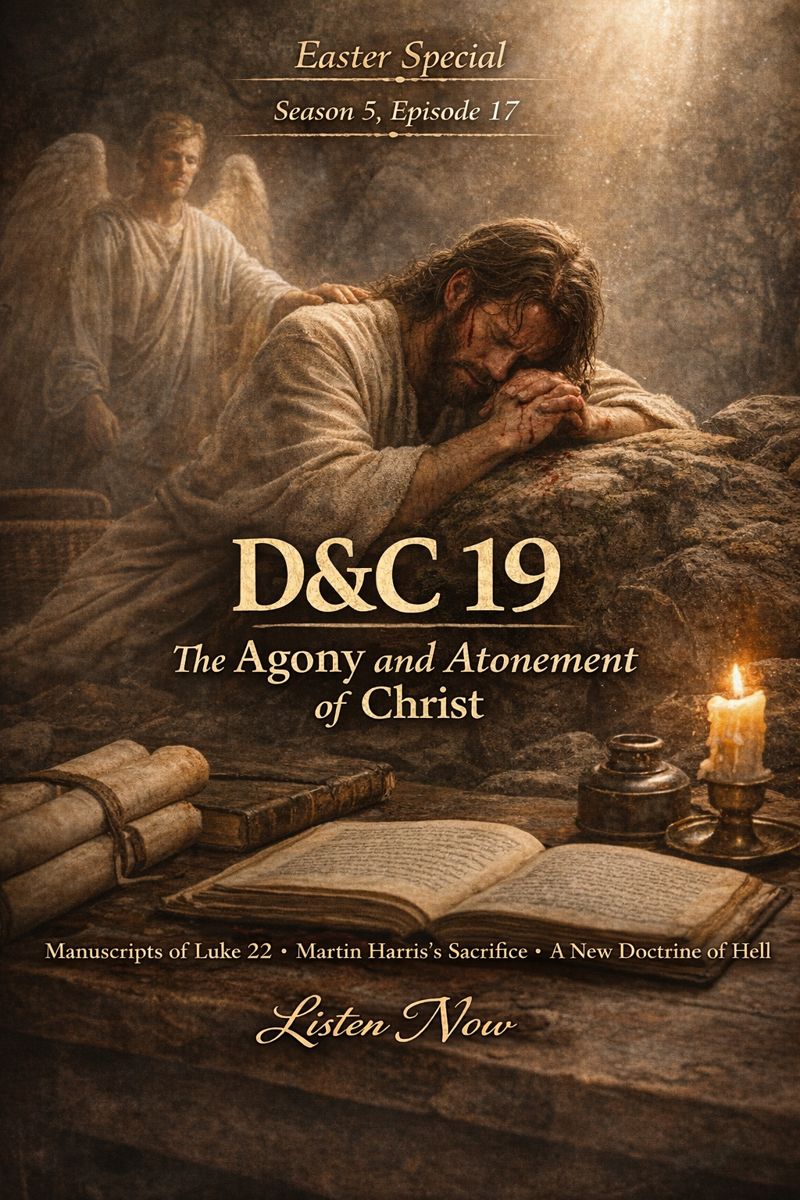
Easter Special
The Historical Setting of Doctrine and Covenants 19
The earliest complete text of what is now Doctrine and Covenants 19 appeared in the 1833 Book of Commandments, preserving passages that are missing from the earliest manuscript copies. The revelation itself dates to 1829, a decisive moment in the unfolding Restoration when Joseph Smith and Martin Harris were preparing for the printing of the Book of Mormon. The original heading in the Book of Commandments appears to reflect the language of the revelation more directly than later standardized headings, offering a glimpse into early Latter-day Saint scriptural publishing practices.
Martin Harris and the Crisis of 1829
By the time Section 19 was received, Martin Harris had already endured divine rebuke for the loss of the 116 pages in 1828. His struggle was not only spiritual but financial, for the burden of funding the Book of Mormon’s printing fell heavily on him. The revelation speaks in a voice familiar to 19th-century American Protestants, echoing fears of eternal damnation and divine wrath common throughout the religious culture of the early republic. Harris stood at the intersection of those anxieties while facing the enormous cost of bringing forth the new scripture.
The Religious World of Early America
Early Americans were shaped by Protestant theology that stressed eternal punishment—“everlasting fire” from Matthew 25, the torments of the rich man in Luke 16, and the terrifying imagery of Revelation’s bottomless pit. Joseph Smith and those around him emerged from this environment, and it becomes clear that the language of Section 19 interacted directly with those fears. In contrast stood the Universalists, a minority movement contending that all souls would eventually be saved. While they had traction in New England, most churches rejected them, and their ideas hovered at the edges of the religious world Joseph inhabited. Modern Unitarian Universalism bears little resemblance to that early movement.
A Turning Point in Latter-day Saint Doctrine
Section 19 introduced teachings unlike anything in the Book of Mormon and contrary to prevailing Protestant thought. The revelation reframed “endless” and “eternal” punishment not as descriptions of unending duration but as names of God’s punishment—divine, not temporal, terms. This doctrinal shift paved the way for later revelations, most notably Doctrine and Covenants 76 (1832), which dramatically expanded the Restoration’s understanding of salvation, judgment, and degrees of glory.
Early Christian Manuscripts and the Agony in Gethsemane
As the Easter discussion unfolded, the episode turned toward ancient manuscripts of Luke 22:43–44, which describe Jesus being strengthened by an angel and sweating “as it were great drops of blood.” These verses are absent from important early Greek manuscripts such as Codex Vaticanus and Codex Alexandrinus, but they appear in later copies of Codex Sinaiticus, sparking scholarly debate over whether Luke originally wrote them or whether they represent early Christian additions.
Despite manuscript variation, several second-century Christian authors quoted these verses, demonstrating that the tradition existed centuries before the manuscripts that omit them.
Justin Martyr, writing around AD 155, referred to Jesus’ bloody sweat.
Irenaeus, around AD 180, used the passage to defend the reality of Christ’s suffering against Gnostic claims that Jesus experienced no true physical pain.
Hippolytus, writing in the early third century, brought the same passage into his arguments against Modalism, which taught that the Father and Son were the same being. These citations show that early Christians relied on Luke’s description of Christ’s agony to defend fundamental doctrines about His nature.
Early Christian Heresies and Their Relevance
The manuscript and patristic evidence matter because early Christianity was the site of intense theological debate.
Gnostics often denied that Christ possessed a real physical body or suffered physically. Some Gnostic texts even depict a divine Christ watching the crucifixion from afar. Modalists, such as Noetus, taught that God was a single person appearing in different modes, implying that the Father Himself suffered on the cross. Early Christian writers invoked Luke’s portrayal of Christ’s suffering to rebut these teachings and to defend both His humanity and His separate identity from the Father.
Section 19 and Its Place in Early Latter-day Saint Publication
By June 1829, the Book of Mormon translation was finished, but printing could not begin until the necessary funds were secured. Section 19 appears to have been pivotal in Martin Harris’s agonizing decision to mortgage his 151-acre farm. When the 1833 Book of Commandments was published, this revelation took its place among the earliest written expressions of the Restoration, capturing the spiritual tension, doctrinal development, and financial burden that accompanied the bringing forth of the Book of Mormon.