
Lesser Known Heroes from Church History: Eliza Dana Gibbs, Part 1
Introduction
This episode turns to the life of Eliza Dana, later known as Eliza Dana Gibbs, a woman whose writings open a window into the spiritual wrestlings, doctrinal questions, sacrifices, and revelatory experiences that shaped many early Latter-day Saint converts. Her life reveals the inner world of a sincere seeker of truth who, long before hearing of Joseph Smith, struggled deeply with Christian theology, cried out for light, received visions, and eventually embraced the restored gospel at tremendous personal cost. The lesser-known figures of the Restoration often show us the Restoration’s power most intimately, and Eliza’s own words preserve the layered story of her conversion.
Early Religious Life and Doctrinal Crisis
Eliza grew up in New York, deeply shaped by the Methodist tradition that surrounded her. When she was about twenty years old she joined the Methodist Church formally, hoping to find peace in its teachings as her mother had. Yet within a few years she found herself in spiritual turmoil. The doctrine that tormented her was the traditional teaching of eternal punishment—an unending hell for the vast majority of humanity. She recorded that this idea was “too horrible to contemplate.” Even though she believed the Bible seemed to teach it, she could not reconcile it with any idea of a just or loving God. She asked herself how Christ, who desired the salvation of all, could preside over a plan where nearly all His children were fated to an eternity of suffering. Torn between belief and revulsion, she wrote that she almost ceased to be a Christian altogether and came close to identifying herself as an “infidel,” meaning essentially an atheist. But the alternative doctrine—complete annihilation after death—filled her with despair. The conflict left her praying “unceasingly” for God to reveal Himself, for assurance that He lived, and for evidence of life after death.
A Vision Answering Her Crisis
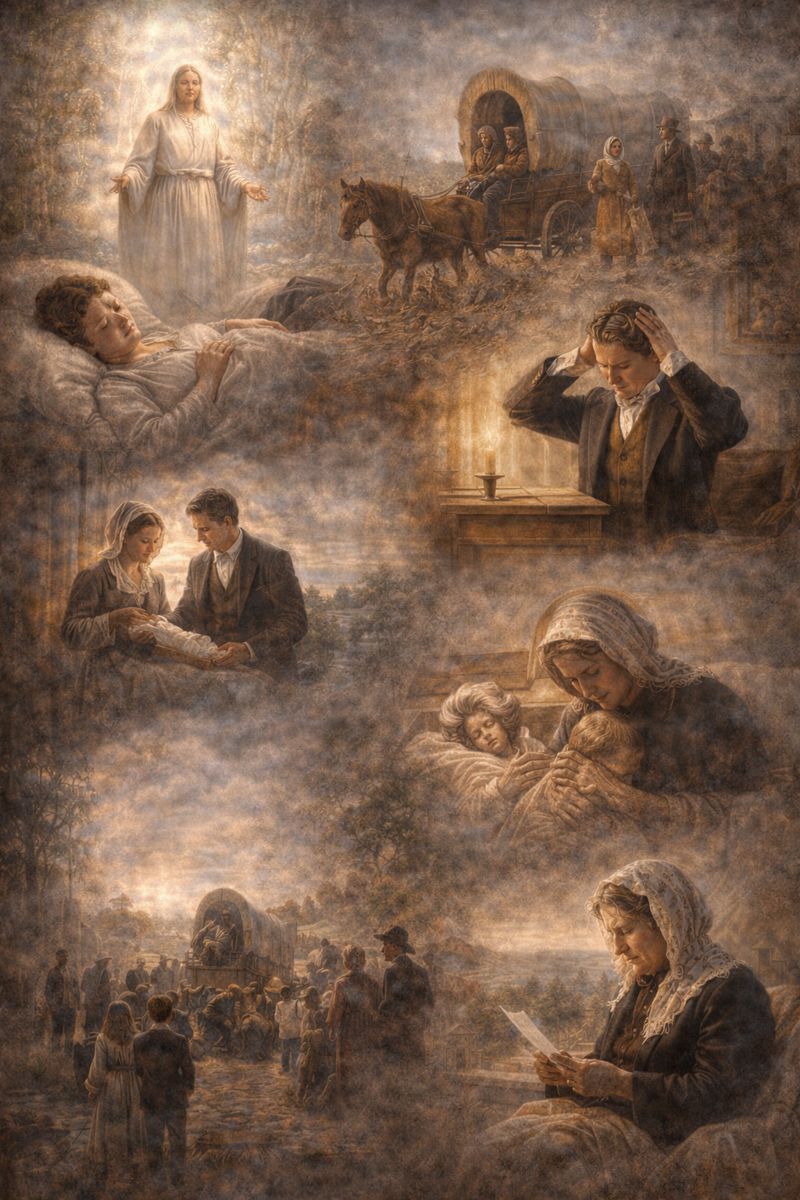
As these questions weighed on her, she became seriously ill with what nineteenth-century Americans called “consumption,” typically tuberculosis. Preparing herself for death, she suddenly experienced a profound vision. She described being enveloped in a brilliant white light and beholding a heavenly figure clothed in white whose face shone with a peaceful radiance. The presence was filled with such celestial sweetness that all fear vanished. The vision lasted only moments, but it transformed her entire outlook. Every doubt about the existence of God disappeared instantly. Her fear of death dissolved. She felt wrapped in a peace she had never known. Believing that the vision was meant to prepare her for her impending death, she anticipated the rest and joy of the afterlife she had briefly tasted. But instead of dying, she recovered—an outcome she accepted with mixed emotions, for she longed for the peace she had momentarily experienced.
Introduction to the Latter-day Saint Message
Several years later, during the winter of 1837, a young Latter-day Saint named Elijah Austin traveled from Canada seeking work and boarded with Eliza’s family. He introduced them to the message of the Restoration. Eliza immediately recognized in his teachings the very principles she had discovered through years of private study and prayer. By this time she had read the New Testament seven times and the Old Testament once. She had wrestled with doctrines, pleaded for revelation, and rejected traditional Christian interpretations that contradicted her sense of divine justice. Because of this spiritual preparation, the teachings of the restored gospel resonated instantly. She recorded that she accepted them the very first time she heard them.
Baptism and Family Opposition
In early 1837, missionaries John E. Page and James Blakeslee held meetings in the area. Eliza, her sister Mary, and several others attended. After earnest prayer and study, Eliza and Mary chose to be baptized around April 1. Their decision was met with fierce resistance. Their brother George and a family acquaintance argued that the baptism would disgrace the family, bring social rejection, and even threaten the life of their already ill mother. Eliza and Mary were forced to choose between their spiritual convictions and family harmony. Eliza wrote that while the decision broke her heart, she knew the gospel was true and must follow God regardless of the consequences. She left her mother “in the hands of God” and entered the waters of baptism with profound sorrow. But immediately after her confirmation she felt an overwhelming peace—an unmistakable witness that the Lord approved. Contrary to predictions, her mother recovered, and while searching the scriptures in an effort to refute the restored gospel, she instead discovered that the scriptures supported it. She was baptized later that summer.
Journey to Nauvoo
In April 1844, Eliza married William Gibbs. Soon afterward she and her extended family began the long journey to Nauvoo. Heavy spring rains made the roads nearly impassable, and the company waited for weeks before they could proceed. As they traveled they received shocking news: Joseph Smith and Hyrum Smith had been murdered. Eliza described the grief that swept through their group—even among travelers who had never met the Prophet in person. When they reached Nauvoo they entered a city wrapped in mourning.
Life in Nauvoo and a Miraculous Healing
Shortly after arriving, Eliza fell dangerously ill, likely with malaria, known then as “the ague.” She suffered violent fever and intense head pain. Apostle Orson Pratt administered to her, and she recorded that before he had lifted his hands from her head, her pain disappeared. The fever did not return. To her, this healing was unmistakably divine.
Family Tragedy
Even as she recovered, sorrow soon returned. Her sister Mary, who had joined the Church with her, died after several weeks of illness. Mary’s infant died shortly afterward. Her surviving toddler, Eliza Ann, was taken in by Eliza and William and raised as their own. These losses, though devastating, deepened Eliza’s commitment to the gospel and to the community of Saints.
Lesser Known Heroes from Church History: Eliza Dana Gibbs, Part 2
Introduction
This second installment continues the life of Eliza Dana Gibbs, a woman whose experiences illuminate the immense burdens, private revelations, and unwavering devotion that characterized thousands of early Latter-day Saint converts but were rarely preserved in such vivid detail. Her story unfolds across decades of persecution, migration, illness, loss, and spiritual resilience. It is a window into the interior life of a woman who remained faithful through circumstances that would have crushed many others, and whose preserved writings allow us to hear the voice of the ordinary yet extraordinary Saints whose sacrifices sustained the early Church.
Life in Nauvoo After Joseph Smith’s Death
When Eliza arrived in Nauvoo in 1844, she entered a city plunged into mourning following the murder of Joseph and Hyrum Smith. She herself had never met the Prophet, yet the collective grief and fear that permeated Nauvoo shaped the first years of her life among the Saints. Illness soon swept through her family. Though she became dangerously ill, likely with malaria, she experienced a miraculous recovery after Orson Pratt administered to her. Her sister Mary was not so fortunate. After weeks of suffering she died, followed shortly by her infant child. Mary left behind a toddler, Eliza Ann, whom Eliza and her husband William took into their home and raised as their own daughter. Thus, even as Eliza was newly gathering with the Saints, sorrow and responsibility settled heavily upon her.
Persecution and Forced Exodus from Illinois
The winter of 1845–1846 brought escalating violence to the Latter-day Saints in Illinois. While mobs burned homes and destroyed crops throughout outlying settlements, waves of displaced families crowded into Nauvoo seeking refuge. Eliza’s family lived in a small, unfinished dwelling with no insulation. Winter storms blew through the cracks in the walls, and her elderly mother sat huddled near the fire, wrapping her arms around Eliza’s infant son to keep him warm. As brutal as this was, Eliza recognized that many Saints suffered worse, especially those forced to flee across the frozen Mississippi River during the bitter nights of February 1846 with nothing but tents or wagons for shelter.
Fleeing to Iowa and Continuing Persecution
Eventually Eliza and her family crossed the river into Iowa, settling in the town of Bonaparte. Yet Illinois was not the only place where violence followed them. In Iowa, mobs engaged in cruelty similar to what the Saints had experienced in Missouri: hanging men until unconscious and then cutting them down, plunging them into river ice holes to nearly drown them, and repeatedly arresting Saints on fabricated charges. One justice of the peace openly declared that he intended to imprison every Mormon brought before him. William Gibbs, Eliza’s husband, was falsely accused of theft and locked in an unheated log jail for eight winter weeks. The emotional strain made Eliza gravely ill. Only when a writ of habeas corpus brought the case before a district judge in Iowa City—who found no evidence whatsoever—was William finally released.
Personal Revelation and Preservation of Family
During her years in Nauvoo, Eliza had received a patriarchal blessing from John Smith, Joseph Smith’s uncle, promising that she would have power to preserve the lives of her children. She would cling to that promise years later when her son Josiah fell dangerously ill. With unwavering confidence in the blessing, she prayed for his life, and she later recorded her belief that his survival came directly through the fulfillment of that prophetic promise.
Delayed Migration West
As the main body of Saints migrated west in 1846 and 1847, Eliza and her family remained behind, held back by poverty, illness, and the declining health of her mother. Her mother died in 1854, and only then—after years of saving and preparing—was Eliza able to begin the long journey to the Salt Lake Valley.
Journey to the Salt Lake Valley in 1857
In 1857, Eliza and her family traveled to Iowa City in hopes of meeting her returning missionary brother and crossing the plains with him. They missed him, but joined a Danish wagon company whose members spoke almost no English. Their captain urged them to travel with the company, and so they began their trek westward during one of the tensest moments in Utah history. The United States Army, under Colonel Albert Sidney Johnston, was marching toward Utah Territory in what became known as the Utah War. Eliza’s company traveled through the vast plains in a constant state of anxiety, fearing the army might overtake them. They eventually reached the Salt Lake Valley before the troops arrived.
Relocation During the Utah War
Hardly had they settled in Salt Lake City when Church leaders ordered the general evacuation of northern Utah in case the federal army attempted to occupy the capital. Eliza and her family obeyed the call and moved south to Fillmore, largely because her adopted daughter Eliza Ann was living there. From the first day, Eliza found Fillmore “repugnant,” yet she remained there for love of her daughter.
Death of Eliza Ann in 1864
Tragedy struck again in February 1864. Eliza Ann gave birth to a daughter but died only hours later; the infant soon followed. Eliza, who had moved to Fillmore solely to remain close to her, described herself as desolate. She had already disliked the town, but now it held for her only sorrow and loss.
Correspondence with Brigham Young in 1862
Two years before Eliza Ann’s death, Eliza had written a long poetic tribute to Brigham Young, which she sent to him in 1862. She expressed unwavering loyalty and compared his leadership favorably against the destructive legacy of earthly military conquerors. She apologized for the imperfections of her poem, noting that she composed it amid the constant demands of household labor.
Death of Her Daughter Madora and Letter to Wilford Woodruff
Years later, another daughter, Madora, died in childbirth along with her infant. Her husband, James Melville, and Eliza both wrote to Wilford Woodruff, who by then was President of the Quorum of the Twelve Apostles. Woodruff’s reply to Eliza offers a profound window into nineteenth-century Latter-day Saint teachings on the spirit world. He taught that spirits do not roam freely to comfort the living; they appear only by divine commission. Even righteous spirits prefer the spirit world and do not desire to return to mortality. Spiritual laws govern their actions, and little has been revealed about their precise workings. He reassured Eliza that her granddaughter would remain with her mother until the resurrection and urged that all temple work for their family be completed. He added that his wife, Phoebe Woodruff, had nearly died once and briefly observed her own body from outside it, returning to mortality solely because her family needed her.
Final Years and Death
Through every displacement, every illness, every tragedy, and every departure of those she loved, Eliza Dana Gibbs remained faithful. She died in Deseret, Utah, at age eighty-six. A notice published at her death declared that she had come to Utah during the Utah War and had been a diligent worker in the Church ever since. She left, it said, “a host of relatives and friends to mourn her loss.” Her story is one of tenacity, spiritual depth, and quiet heroism. She stands as a representative of the countless early Latter-day Saint women whose sacrifices were largely unrecorded yet absolutely essential to the survival and flourishing of the Church.
Listen to the full podcast here:
https://www.youtube.com/@standardoftruthpodcastllc