
Introduction
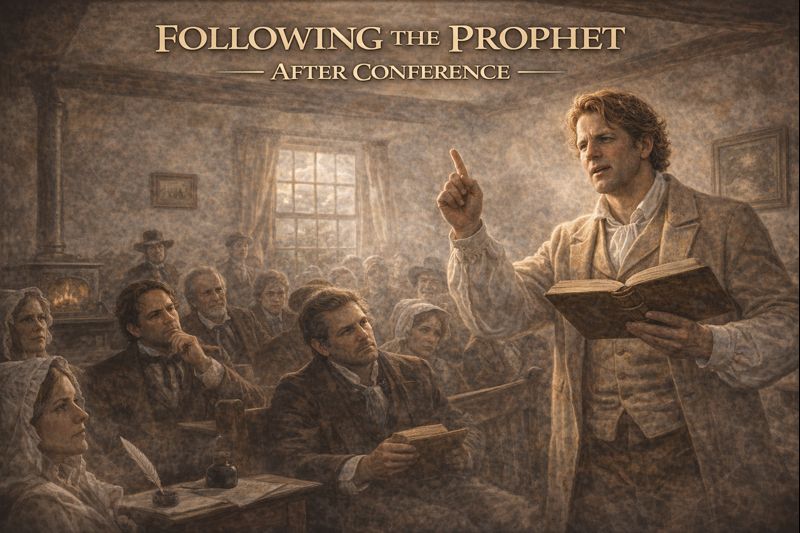
This bonus episode draws on a revealing moment in early Church history: a letter Joseph Smith wrote in 1833 addressing members who rejected or disputed revealed doctrine—particularly the revelation now known as Doctrine and Covenants 76. By examining how early Saints reacted to prophetic teachings, the episode highlights enduring patterns seen again in the modern Church when some members struggle with counsel from General Conference.
Historical Background: The Reception of “The Vision” (D&C 76)
In February 1832, Joseph Smith and Sidney Rigdon received a revolutionary revelation describing the afterlife in detail. Known then simply as “The Vision,” it introduced doctrines radically different from traditional Christian teachings:
It revealed three degrees of glory—celestial, terrestrial, and telestial.
It rejected the mainstream idea of eternal, endless hell for the majority of humanity.
It presented salvation as more expansive, merciful, and universal than anything found in contemporary theology.
Because of these dramatic departures, the revelation provoked strong reactions among early Saints.
Early Responses Among the Saints
Wilford Woodruff embraced “The Vision” immediately. He viewed its doctrine as unmistakable evidence that Joseph Smith was a prophet.
Brigham Young’s reaction was very different. He later admitted that the revelation shocked him. It contradicted much of what he had believed. But instead of rejecting it, he chose to ponder, pray, and ultimately accept the doctrine after receiving spiritual confirmation.
These two responses—immediate acceptance versus thoughtful struggling—illustrate natural variations in how disciples respond to new revelation.
The 1833 Letter from Joseph Smith
A year after the revelation, Joseph Smith wrote to a branch of the Church in New York to address a problem involving a member named Ezra Landon.
Landon rejected “The Vision” outright.
He discouraged others from believing it.
When Orson Pratt attempted to read the revelation, Landon threatened to physically remove him from the meeting.
A council of high priests confronted Landon. While he momentarily pretended to submit, he ultimately refused to teach or accept the revelation.
Joseph’s letter addressed the issue directly.
Joseph Smith’s Teachings in the Letter
Joseph Smith explained that:
The Church cannot fellowship those who reject God’s revelations while claiming to be faithful members.
Calling “The Vision” merely a “vision”—as if it were not a revelation—was a deliberate attempt to undermine prophetic authority.
Rejecting revelation is a spiritual danger that “ensnares the souls of the Saints.”
Joseph insisted that God had given the revelation, and therefore members were required to receive it with humility and faith.
Discipleship: Wrestling vs. Rejecting
The episode emphasizes an important doctrinal distinction:
Private spiritual wrestling is normal and healthy.
This includes:
Feeling unsure
Studying and pondering
Struggling to reconcile new doctrine with prior beliefs
Seeking personal revelation
Waiting patiently for understanding
Public contradiction of revelation is spiritually destructive.
This includes:
Declaring prophetic revelation to be false
Using Church membership to undermine trust in prophets
Teaching others to reject revealed doctrine
Latter-day Saint theology expects disciples to receive new truths they do not yet fully understand. That is part of continuing revelation.
Application to Modern General Conference
Just as early Saints struggled with D&C 76, many modern members experience challenges when General Conference teachings conflict with personal assumptions, political views, or preferred emphases.
The episode notes familiar patterns:
Some members resist prophetic teachings that contradict expectations.
Some express frustration that certain topics are addressed too much or too little.
Some publicly contradict or criticize the prophets’ counsel.
Recent conference messages from President Russell M. Nelson and others have focused on:
The centrality of temple covenants
The unique necessity of priesthood keys
The divine purpose of the Church in enabling exaltation
The universality of salvation except for the sons of perdition
Like “The Vision,” these teachings require discipleship, humility, and spiritual effort to fully grasp.
Brigham Young’s model is offered again as the ideal:
Do not reject new revelation—wrestle, study, pray, and seek understanding until the Spirit confirms truth.
The John Johnson Home and D&C 76
The episode also highlights the sacredness of the John Johnson home in Hiram, Ohio, where Joseph and Sidney received the revelation.
There, the heavens opened.
The vision was spoken aloud as it unfolded.
It stands as one of the most expansive and awe-inspiring revelations of the Restoration.
Visitors often describe a profound spiritual sense in the home, recognizing the magnitude of what occurred there.
Church History Tour Scholarship Announcement
The episode concludes with an announcement of a Church history tour (Baltimore, Palmyra, Kirtland, Cleveland) taking place June 3–10.
An anonymous donor has offered to cover:
Lodging
Ground transportation
Roughly half of the meals
Participants must pay for airfare and remaining meals, and must be available on the exact dates.
Listeners are invited to nominate individuals who would greatly benefit from such a trip but who could not ordinarily afford it.
Conclusion
The core message of the episode is clear and consistent from 1833 to today:
God continues to reveal truth through living prophets.
Not all revelation is easily or immediately understood.
Members are called to sustain prophets even as they seek personal understanding.
Public rejection of revelation leads others astray; humble discipleship leads to deeper spiritual knowledge.
The Restoration began with a question and a willingness to follow revelation. It continues the same way now.
Listen to the full podcast here:
https://www.youtube.com/@standardoftruthpodcastllc
Season 4, Bonus Episode 5 – Thoughts on Following the Prophet After Conference