
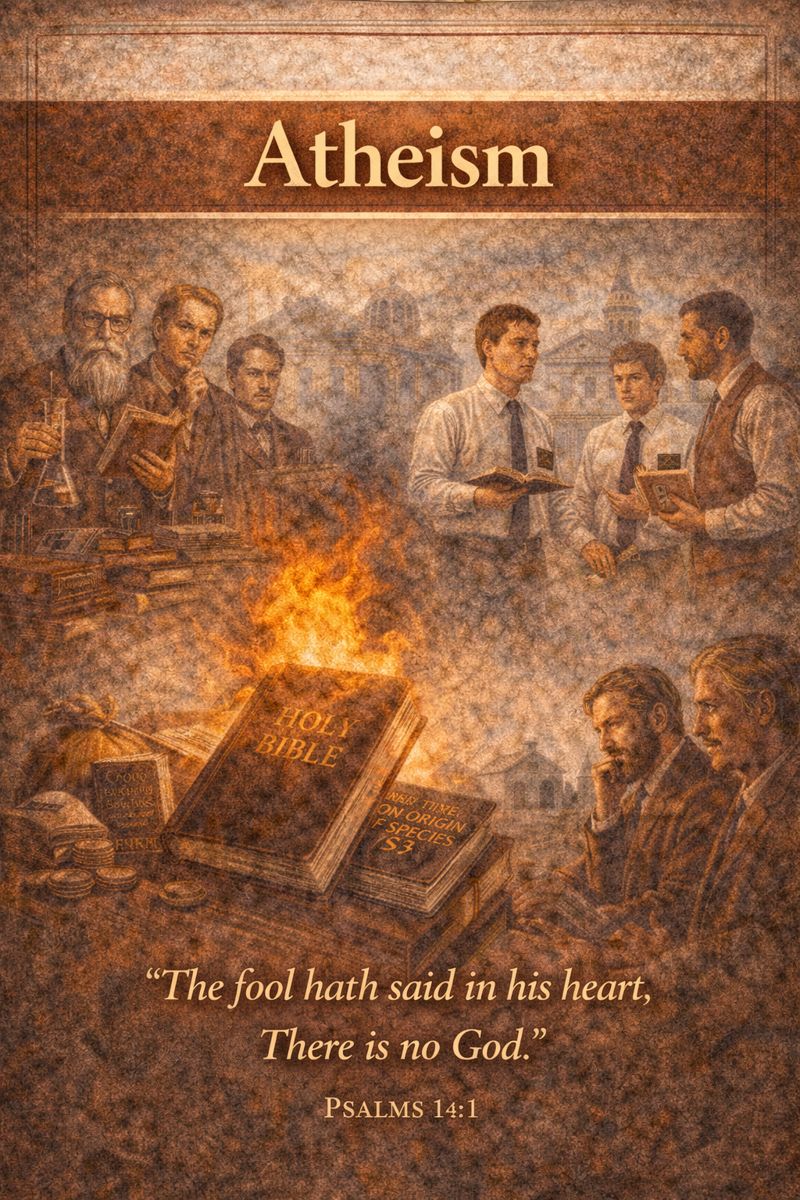
Atheism part 1 (D&C 87–88)
The Historical Setting of Doctrine and Covenants 84
Doctrine and Covenants 84 was received in Kirtland, Ohio in September 1832, a period marked by both spiritual outpouring and severe opposition. Joseph Smith had recently returned from Hiram, Ohio, where he experienced the vision recorded in Doctrine and Covenants 76, followed shortly after by violent persecution, including being dragged from his home and tarred and feathered.
The revelation appears to have unfolded over the nights of September 22 and 23. Contemporary sources indicate that Joseph received it in Newel K. Whitney’s store, likely in either the small “translating room” or the gathering space later used for the School of the Prophets. This revelation became foundational in defining priesthood authority in the early Church.
The Development of Priesthood Terminology in Early Church Records
Although the Book of Mormon uses the term “priesthood,” early Latter-day Saint documents tended to describe ecclesiastical functions using the word “authority.” The precise terminology of “Aaronic” and “Melchizedek” priesthoods evolved gradually through revelation and administrative practice. Doctrine and Covenants 84 gave the first detailed explanation of the structure, lineage, and theological purpose of these priesthoods, distinguishing the “lesser” priesthood associated with the law of carnal commandments from the higher priesthood that holds the power of godliness.
Teachings on Light, Truth, and Human Nature in D&C 84
The revelation contains significant doctrinal statements about human nature. It teaches that truth is light, that light is spirit, and that this spiritual light enlightens every person who enters the world. These teachings directly challenge the dominant Calvinist doctrine of total depravity, which held that human beings are incapable of choosing good without irresistible divine intervention. Latter-day Saint doctrine instead affirms that every person possesses the Light of Christ, giving all humanity the innate ability to discern good from evil.
This idea echoes passages in the Book of Mormon, especially Moroni 7, which teaches that the Spirit of Christ is given to every human being and enables all people to judge between good and evil.
Christmas Hymns in Nauvoo and an 1843 Historical Anecdote
In December 1843, an episode recorded in Joseph Smith’s history describes a late-night Christmas serenade. English convert Letitia or Lettice Rushton, who was blind, came to Joseph Smith’s home at 1 a.m. with her children and their spouses. They sang “Mortals Awake! With Angels Join,” a hymn included in the 1835 Latter-day Saint hymnbook.
Only two Christmas-related hymns appeared in that hymnbook: “Mortals Awake” and “Joy to the World.” Many now-familiar Christmas songs did not yet exist or were sung to different melodies. Interestingly, “Joy to the World” originally celebrated Christ’s first coming, but W. W. Phelps modified the text to emphasize the Second Coming, reflecting early Latter-day Saint focus on millennial expectations.
Joseph Smith described the singing as producing “a thrill of pleasure,” and blessed the family. Hyrum Smith remarked that the music was so beautiful he momentarily believed a group of angels had arrived.
The Witnesses and Early Latter-day Saint Visionary Experiences
Historically, the testimonies of the Three and Eight Witnesses form one of the most unusual features of early Latter-day Saint history. The Three Witnesses described seeing an angel, the plates, additional sacred objects, and hearing the voice of God declaring the translation correct. The Eight Witnesses reported physically handling the plates and examining their engravings.
Additional early Saints also described sacred manifestations. Oliver Cowdery recorded multiple angelic visitations shared with Joseph Smith. Sidney Rigdon witnessed the heavenly vision described in Doctrine and Covenants 76 alongside Joseph. Numerous individuals at the Kirtland Temple dedication reported seeing angels and other spiritual manifestations, including what they described as “cloven tongues of fire.”
One of the most significant historical features of these accounts is that even after conflicts, excommunication, and separation from the Church, the witnesses did not retract their testimonies. Their statements come from 19th-century documents written close to the events themselves, unlike many ancient Christian manuscripts that survive only in much later copies.
Bart Ehrman and Issues of Biblical Manuscript Transmission
New Testament scholar Bart Ehrman has emphasized that the surviving New Testament manuscripts are copies of copies, often centuries removed from the originals, containing numerous variations. Interestingly, Ehrman notes that Latter-day Saint students tend to be less troubled by these issues because their theology already incorporates:
the belief in a Great Apostasy,
the fallibility of scriptural transmission, and
the necessity of modern revelation.
These beliefs naturally prepare Latter-day Saints for the idea that biblical texts have undergone historical change.
Joseph Smith as a Presidential Candidate in 1844
Joseph Smith formally entered the 1844 U.S. presidential race. His candidacy is historically notable because he is the first presidential candidate to be assassinated. His death did not occur during campaign travel but rather as a result of escalating violence against Latter-day Saints in Illinois.
Persecution Against Early Latter-day Saints
The early Latter-day Saints endured sustained persecution. In 1838, Missouri Governor Lilburn W. Boggs issued the Extermination Order, mandating that Latter-day Saints be expelled from the state or exterminated. Mob violence continued for years, culminating in the murders of Joseph and Hyrum Smith in Carthage Jail in June 1844.
Historical Standards for Reliable Scholarship
Historians emphasize two fundamental rules:
first, sources cannot be ignored simply because they contradict a preferred position;
and second, claims cannot be fabricated—every assertion must be supported by evidence.
These principles highlight the flaws in anti-Latter-day Saint literature such as Mormonism Unvailed, which both omitted contradictory evidence and printed demonstrably false accusations. Modern historical methods expose such works as unreliable.
Atheism (Part 2)
The Historical Setting of Doctrine and Covenants 87
Doctrine and Covenants 87 was recorded by Joseph Smith on December 25, 1832. The revelation predicted a future war that would begin in South Carolina, expand into national division between the Northern and Southern states, involve foreign nations such as Great Britain, and ultimately result in widespread destruction and global conflict. The language reflects an expectation of massive military upheaval unprecedented in early American prophetic writings.
National Conditions in 1832: The Nullification Crisis
At the time the revelation was recorded, the United States faced the Nullification Crisis. South Carolina declared that it could nullify federal tariff laws it considered unconstitutional. Although national tensions were real, the crisis centered on tariffs, not slavery, and most contemporary Americans expected the dispute to be resolved peacefully through political compromise.
President Andrew Jackson responded forcefully against nullification, while John C. Calhoun defended South Carolina’s position. The crisis eventually eased with the Compromise Tariff of 1833. No major public figure in 1832 predicted a future civil war or national bloodshed over slavery.
Earlier Disunion Threats in U.S. History
Prior to the Civil War, several regional disputes raised the possibility of national division, though none escalated into armed conflict. The Whiskey Rebellion involved farmers resisting a federal excise tax between 1791 and 1794. The Hartford Convention of 1814–1815 saw New England leaders discuss potential secession in protest of the War of 1812. These movements were motivated by economic or constitutional concerns rather than slavery. The Nullification Crisis of 1832 represented another moment of tension, but it did not involve an expectation of war.
South Carolina and the Civil War
Joseph Smith’s revelation specifically named South Carolina as the starting point of the coming conflict. Historically, South Carolina became the first state to secede from the Union in December 1860 and initiated the Civil War by firing on Fort Sumter in April 1861. The Confederacy also sought foreign intervention, particularly from Great Britain, aligning with elements of the prophecy.
Expectations Before and During the Civil War
Modern observers often assume that the war was inevitable, but most Americans did not expect the nation to dissolve violently. Even after secession, many believed the war would be brief. Before 1860, national compromises—such as those of 1820 and 1850—led many to expect continued political solutions rather than armed conflict.
Doctrine and Covenants 87 was included in the 1851 Pearl of Great Price, a decade before the Civil War, during a relatively calm period following the Compromise of 1850.
Latter-day Saint Interpretations of National Judgment
During the mid-19th century, many Latter-day Saints interpreted the Civil War as divine judgment upon the United States for allowing and participating in violence against the Saints in Missouri and Illinois. The Missouri 1838 Extermination Order, the Hawn’s Mill Massacre, the murders of Joseph and Hyrum Smith, and the forced expulsion from Nauvoo were repeatedly cited as examples of unpunished wrongdoing.
Religious Interpretations Beyond Latter-day Saints
Many Americans outside the Latter-day Saint community also viewed the Civil War as national punishment for moral failings. Abraham Lincoln’s Second Inaugural Address (1865) famously framed the war as divine reckoning for the institution of slavery. Thus, broader American religious thought aligned with themes present in Doctrine and Covenants 87.
Atheism (Part 3)
The Historical Context of Doctrine and Covenants 88
Doctrine and Covenants 88 was revealed December 27–28, 1832, during a formal meeting of early Church leaders in Kirtland, Ohio. Those present included Joseph Smith, Sidney Rigdon, members of the Smith family, and several other leading elders. The revelation was received in two segments, one late at night and one the following morning, reflecting the long and spiritually intense nature of the gathering.
Early Church Meetings and the Reception of Revelation
Early Latter-day Saint meetings often included structured spiritual exercises. During the conference in which D&C 88 was revealed, each participant prayed vocally in turn, expressing personal desires, dedication, and unity. Joseph Smith emphasized that revelation required focused minds and spiritual harmony.
After receiving the first portion of the revelation late at night, the group adjourned. They reconvened the next morning, again prayed vocally, and then received the remainder of the revelation. The meeting concluded with expressions of gratitude for the spiritual manifestations experienced.
Interpreting the Command to Build a “House of Learning”
Doctrine and Covenants 88 contains the command to establish a “house of learning.” In 1832, early Saints did not yet understand the full purpose of temples as later revealed in Nauvoo. Consequently, they interpreted the commandment as a directive to organize a school for Church leaders.
This instruction led directly to the creation of the School of the Prophets, which began meeting in early 1833. The school served as an environment for spiritual instruction, preparation for priesthood service, and theological education.
The Development of the School of the Prophets
The school met in the Newel K. Whitney store in Kirtland, primarily in the upper rooms used for meetings and the “translating room.” Participants were selected priesthood holders who gathered to study doctrine, pray, and prepare for missionary service. The School of the Prophets became a central institution in early Church history and served as the foundation for later temple-related instruction.