
Introduction
The episode continues answering listener questions related to Church authority, specifically how leadership titles functioned in early Latter-day Saint history and how these roles evolved after Joseph Smith’s death. Several emails revisited earlier discussions on the meaning of “general authorities,” the structure of the First Presidency during the Prophet’s lifetime, and how succession unfolded in the years following 1844. These questions provided the backdrop for the final portion of the narrative concerning George J. Adams, whose dramatic apostasy and later attempts to colonize the Holy Land illustrate both historical misunderstandings of priesthood authority and the wider religious climate of the mid–19th century.
Clarifying Questions About Church Authority
Listeners raised questions about differences between leaders in early Church history and how organizational roles were defined. In the early decades of the Restoration, titles and offices were less standardized than they are today. Some leaders held the role of general authority even though they were not members of the Quorum of the Twelve. They were often given significant responsibilities and operated under broad Church-wide jurisdiction as the needs of the developing Church required. These varied leadership patterns often seem unfamiliar to modern members whose experience reflects a more standardized structure.
The First Presidency in Early Church History
During Joseph Smith’s ministry, the First Presidency did not always consist of Apostles. Several counselors—including Sidney Rigdon and others—served without being members of the Quorum of the Twelve. The modern pattern, where members of the First Presidency typically come from the Twelve, is a later development and not a doctrinal necessity. Because generations of Latter-day Saints have grown up seeing only Apostles in that presidency, the idea of a non-Apostle counselor seems foreign, even though it was common and fully acceptable during the foundational years of the Church.
The Office of Presiding Patriarch
The episode also notes the existence of the office of Presiding Patriarch, referenced in Doctrine and Covenants 124. For much of the Church’s history, this priesthood office was filled by descendants of the Smith family and played a significant role. The last patriarch emeritus stepped down due to age, after which the office simply remained unfilled. This does not indicate its abolition; rather, it reflects the Lord’s pattern of calling individuals as needed. The office still exists but has no current occupant.
Returning to the Narrative of George J. Adams
The episode returns to the story of George J. Adams, whose spiritual and doctrinal trajectory provides a cautionary example of how misunderstandings about priesthood keys can lead to apostasy. Earlier episodes described Adams’s claim to be the “13th Apostle” and the corrective doctrinal letter written by his brother Elias, who explained that after Joseph Smith’s death, authority and priesthood keys rested with the Quorum of the Twelve. Elias cited both scripture and historical precedent, demonstrating clearly where legitimate leadership had been placed.
After leaving the Church and aligning himself first with James Strang and then breaking from him, George J. Adams founded his own religious movement known as the “Church of the Messiah.” His teachings became increasingly millenarian and apocalyptic, especially during the turmoil of the American Civil War. That period of national conflict—marked by massive casualties and deep social instability—gave rise to widespread apocalyptic expectations across many religious groups. Adams’s rhetoric fit squarely within that environment.
George Adams’s Holy Land Colony
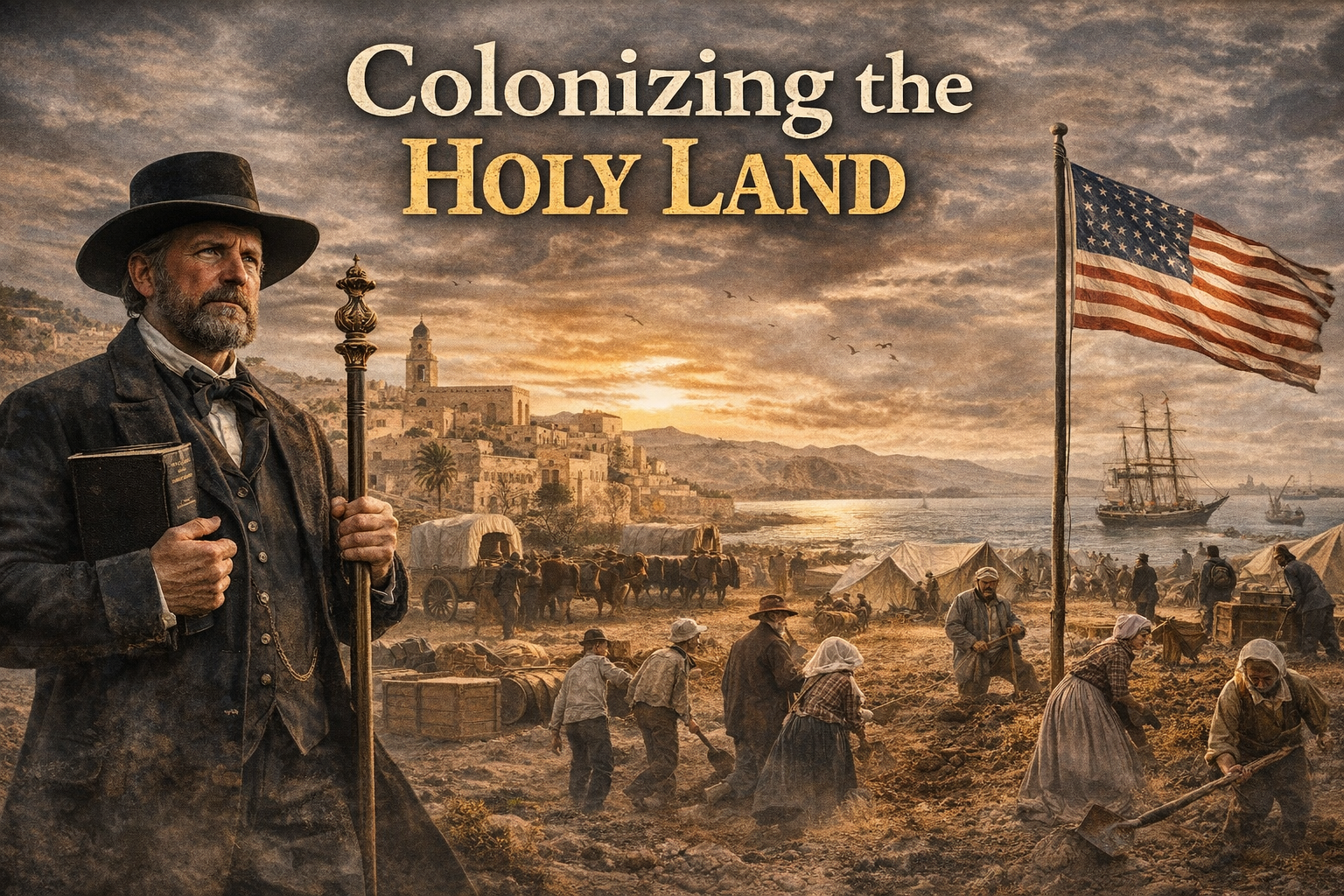
Adams began teaching that true believers should gather to the Holy Land to prepare for the Second Coming of Christ. Acting on this belief, he traveled to the Ottoman Empire in 1866 and negotiated the purchase of roughly ten acres near Jaffa in Palestine. He then brought 156 followers to settle the land, intending to establish a religious community that would serve as the vanguard for millennial events.
The reality, however, proved harsh. The land purchased by Adams was agriculturally poor and incapable of sustaining the settlement. The colonists were unprepared for the demands of farming in that environment, lacking both tools and resources. Their food supplies quickly dwindled. Making matters worse, Adams had previously required his followers to turn over their money to him, leaving the entire company financially vulnerable as conditions deteriorated. Hunger soon threatened the colony’s survival.
United States Government Intervention
The collapsing settlement became an international affair when word reached American diplomats that a group of U.S. citizens in Palestine were starving. The U.S. government, under President Andrew Johnson and Secretary of State William Seward, intervened to rescue the survivors. Funds were allocated to transport the colonists back to the United States, and by 1867 the entire colony had collapsed. The failed mission became an example of how charismatic but misguided religious leadership—especially when paired with millennial urgency—could result in real-world disaster.
George Adams’s story illustrates how a misunderstanding of the nature of priesthood keys and prophetic authority can lead to spiritual and practical consequences. His Holy Land colony demonstrates how apocalyptic speculation, unchecked by proper doctrinal grounding, can have devastating effects. His reliance on Latter-day Saint imagery while rejecting Latter-day Saint authority shows how the Restoration’s teachings were sometimes adapted and distorted by those outside the Church following Joseph Smith’s death.
Preview of the Next Doctrinal Topic
The episode concludes by previewing the next discussion topic: Joseph Smith’s teachings about the United States Constitution. The coming episode will explore the Prophet’s deep reverence for the Constitution, his conviction that it was divinely inspired, and the tension early Latter-day Saints experienced when governmental institutions repeatedly failed to protect them. The discussion will address the complex and evolving relationship between the Saints and American political structures throughout the 19th century.