
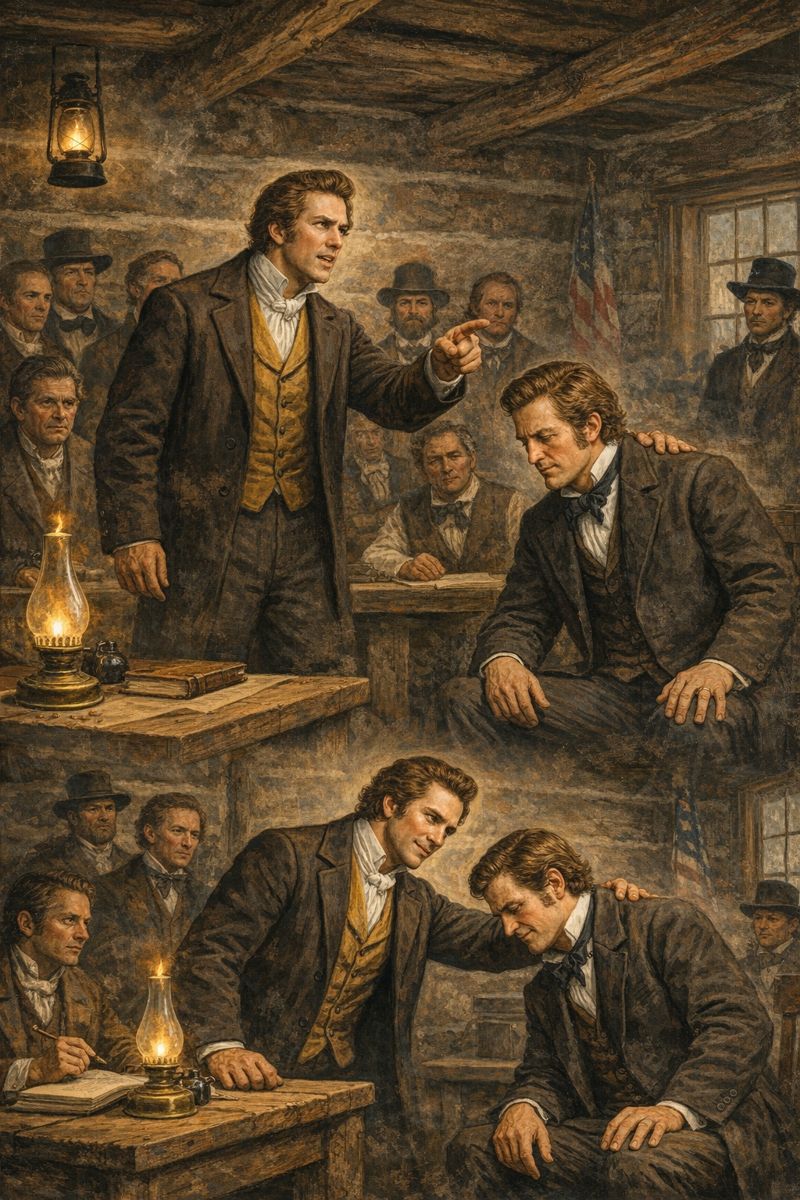
Background on Brigham Young’s Devotion to Joseph Smith
Brigham Young is one of the clearest historical examples of complete loyalty to Joseph Smith. His writings, journals, and published sermons consistently show:
He did not test Joseph’s revelations against prior scripture.
If Joseph Smith taught something—difficult or new—Brigham accepted it as revelation from God.
He initially struggled with Doctrine and Covenants 76, but did not reject it.
After the collapse of the Kirtland Safety Society, Brigham momentarily wondered whether Joseph might not be a prophet, but instantly reaffirmed his testimony and later expressed deep regret for even thinking it.
Brigham’s records reveal a lifelong pattern of unwavering loyalty to Joseph Smith, including statements near the end of his life expressing longing for Joseph and affirming him as the Prophet of the Restoration.
The Story of Joseph Smith Publicly Rebuking Brigham Young
A narrative occasionally retold in Church settings claims that Joseph Smith publicly rebuked Brigham Young, who responded humbly:
“Joseph, what do you want me to do?”
Joseph then reportedly embraced him, saying:
“You passed, Brother Brigham.”
This story appears in various talks and articles, but does not appear in any contemporary historical document from Joseph Smith’s lifetime.
The Source of the Story: President Hugh B. Brown → Truman G. Madsen
The earliest known publication of this story appears in an April 1976 New Era article by Truman G. Madsen as a tribute to Elder Hugh B. Brown.
Important details:
Hugh B. Brown’s wife, Zina, was Brigham Young’s granddaughter.
The story appears as family tradition, passed down orally in the Young family.
Madsen reports that Elder Brown shared the story privately.
The version Brown shared matches the narrative repeated today.
This is the earliest documented appearance of the story — a 20th-century family reminiscence, not an 1840s record.
Truman G. Madsen’s Later Retelling (Joseph Smith Lectures)
In his later Joseph Smith lecture series, Madsen retold the story, adding clear disclaimers:
He emphasized that no contemporary record exists.
He called it “family lore,” not documented history.
He warned: “So far as I know, it was never recorded.”
Despite Madsen’s careful disclaimers, others later repeated the story as if it were historical fact, often omitting his warnings.
Do Any 1830s–1840s Sources Record This Event?
No. There is:
No mention in Brigham Young’s journals
No mention in Joseph Smith’s journals
No mention in Wilford Woodruff’s journals
No council minutes
No sermons
No published accounts
No eyewitness diaries
This does not prove the event never happened — only that historians cannot document it.
Evaluating Family Traditions and Reminiscences
Historians treat late reminiscences carefully because:
Memory changes over decades.
Repeated retelling reshapes events.
Details may become symbolic rather than factual.
Family stories often preserve values rather than literal moments.
However, such traditions are not automatically false — they simply cannot be used as primary evidence.
What the Story Illustrates (Regardless of Its Historical Certainty)
Even if the event cannot be verified, the story matches what is historically known of Brigham Young:
His devotion to Joseph Smith
His humility
His eagerness to submit to prophetic leadership
His lifelong belief that Joseph’s teachings defined truth
Examples of Verified Historical Statements
Brigham on Joseph as Prophet
Brigham declared:
“It is the test of our fellowship to believe and confess that Joseph lived and died a prophet of God in good standing.”
Council of Fifty (1844)
When someone implied Joseph had erred, Brigham immediately rebuked the remark:
“No man can ever speak against Joseph in my presence.”
Brigham’s Grief at Joseph’s Death
Multiple journals confirm Brigham wept through the night after learning of Joseph Smith’s murder.
The verified record overwhelmingly demonstrates Brigham’s profound loyalty.
Conclusion
There is no contemporary historical evidence that Joseph Smith publicly rebuked Brigham and received the reply, “What will you have me do?”
The story originates from Brigham Young family tradition.
It was shared publicly by Elder Hugh B. Brown, Brigham’s grandson-in-law.
Truman G. Madsen passed it on, adding explicit warnings that it was not recorded in Joseph’s time.
The story matches Brigham’s known character, but cannot be treated as a verified historical incident.
It should therefore be regarded as faith-promoting family tradition, not established documentary history.