
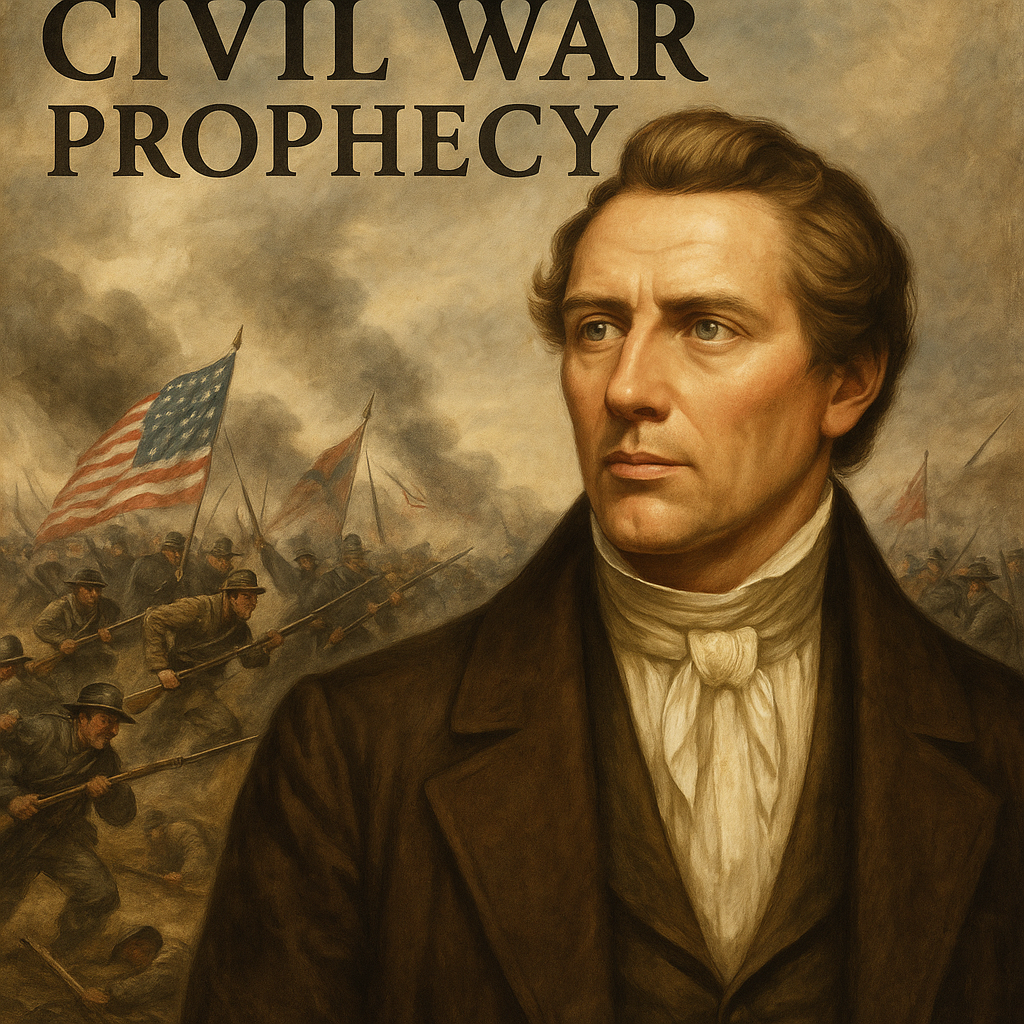
The Revelation (Doctrine and Covenants 87)
Doctrine and Covenants 87 is a revelation given to Joseph Smith on December 25, 1832, while the church was in Kirtland, Ohio.
This was shortly after previous revelations identifying Jackson County, Missouri, as the location of Zion.
The revelation prophesies:
- Wars would shortly come to pass, beginning at the rebellion of South Carolina, and would eventually result in the death and misery of many souls.
- The Southern states would be divided against the Northern states.
- The Southern states would call upon other nations, including Great Britain, for help; other nations would also be drawn in, and war would be poured out upon all nations.
- After many days, slaves would rise up against their masters and be marshaled and disciplined for war.
- “Remnants” left in the land would also marshal themselves and vex the Gentiles.
- Through war, bloodshed, famine, plague, earthquake, thunder, and lightning, the inhabitants of the earth would feel the judgments of God until a “full end” of all nations was decreed.
- The revelation also states that the cry and blood of the saints would cease to come up before the Lord to be avenged, and admonishes believers to stand in holy places until the day of the Lord comes.
Transmission and Publication History
Although received in 1832, this revelation was not included in the 1835 or 1844 editions of the Doctrine and Covenants.
One likely reason is that publicly circulating a revelation predicting a devastating U.S. civil war could have increased antagonism toward the church.
The text was, however, known among church leaders and was eventually published in the Pearl of Great Price in 1851, a collection that gathered various Joseph Smith texts not then in the Doctrine and Covenants.
Missionary and apostle Parley P. Pratt referred to and publicized the prophecy.
Later, the revelation from the Pearl of Great Price was moved into the Doctrine and Covenants as Section 87.
Context: Latter-day Saint Persecution and “The Blood of the Saints”
The line about “the cry of the saints and the blood of the saints” being avenged takes on meaning in light of later events, though these had not yet occurred in 1832.
Key Events That Followed
Jackson County, Missouri (1833):
- Violence against Latter-day Saints began in earnest in July 1833.
- A key flashpoint was an article by W. W. Phelps titled “Free People of Color.”
- Phelps invited free Black Saints to settle in Missouri, a slave state.
- Pro-slavery Missourians reacted violently, contributing to mob violence and expulsion.
Missouri 1838 and the Extermination Order:
- Governor Lilburn W. Boggs issued the extermination order.
- Haun’s Mill Massacre left men and boys murdered; no one was punished.
Nauvoo (1844) and the Murder of Joseph and Hyrum Smith:
- Joseph and Hyrum were murdered in Carthage Jail.
- Again, no convictions.
Expulsion from Nauvoo (1846):
- Anti-Mormon mobs burned property and killed members.
- The Saints fled west.
Migration to the West:
- Saints moved into Mexican territory, then became U.S. territory again after the Mexican–American War.
Utah Territory and Federal Conflict:
- Tensions escalated in the Utah War.
Given these experiences, many 19th-century Saints viewed D&C 87 as foretelling divine judgment on the United States.
U.S. Background: Tariffs, Nullification, and Slavery (1820s–1840s)
At the time of the prophecy, the nation was arguing primarily over tariffs and federal power.
Major Political and Social Issues
Tariff of 1828 (“Tariff of Abominations”):
- Strongly opposed in the South.
- Benefited Northern industry, harmed Southern consumers.
Nullification Crisis (1832–33):
- Led by South Carolina and John C. Calhoun.
- States claimed they could nullify federal laws.
- Andrew Jackson threatened military force.
Missouri Compromise (1820):
- Drew the 36°30’ line dividing future slave/free territories.
Abolitionism:
- Still a tiny minority in the 1830s.
Mexican–American War and New Territories (1846–1848):
- Massive new lands reignited the slavery expansion debate.
Presidential Elections 1840 & 1844:
- Issues focused on banking, tariffs, and expansion.
- Both 1844 candidates were slaveholders.
In 1832, a nationwide civil war over slavery was not widely expected.
Secession and the Outbreak of the Civil War (1860–1861)
Key Developments
Election of Abraham Lincoln (1860):
- Opposed expansion of slavery.
- Sparked Deep South secession.
First Wave of Secession:
- South Carolina seceded first (December 1860), followed by six more states.
Fort Sumter (April 1861):
- Confederate attack started open war.
- Lincoln called for 75,000 volunteers.
Public Expectations:
- Many believed the war would last only weeks.
- Civilians picnicked at the First Battle of Bull Run expecting a short conflict.
Scale and Casualties of the Civil War
- Lasted from 1861 to 1865.
- Approximately 620,000–700,000 deaths.
- Casualties in single battles exceeded later major conflicts such as D-Day.
Enslaved People and Black Soldiers in the War
The prophecy mentions slaves rising and being “marshaled and disciplined for war.”
During the Civil War:
- Enslaved people fled plantations en masse.
- They were classified as “contrabands” and helped Union armies.
- After the Emancipation Proclamation, Black regiments were raised.
- Tens of thousands fought in the U.S. Colored Troops.
Latter-day Saint Interpretation of the War
Many Saints interpreted the Civil War as divine judgment for:
- U.S. refusal to punish violence against Latter-day Saints.
- Failure of legal redress despite repeated petitions.
- The national sin of slavery.
Abraham Lincoln’s Second Inaugural Address
Lincoln stated:
- Both sides prayed to the same God.
- Slavery was the central cause.
- The war may be divine judgment.
He declared:
“Every drop of blood drawn with the lash shall be paid by another drawn with the sword.”
His views reflected themes similar to Latter-day Saint readings of D&C 87.
Historical Significance of D&C 87
D&C 87 is notable because it:
- Was recorded long before a civil war seemed likely.
- Identified South Carolina as the starting point.
- Predicted division between North and South.
- Referenced slaves rising for war.
- Envisioned international conflict.
- Became a key prophecy interpreted through later events.
Source:
https://www.youtube.com/watch?v=mltnW8fuPaw&list=PLqHDnOymluacdocGOgVnGR9VrkdUbcbP3&index=11
https://www.youtube.com/watch?v=mltnW8fuPaw&list=PLqHDnOymluacdocGOgVnGR9VrkdUbcbP3&index=11