
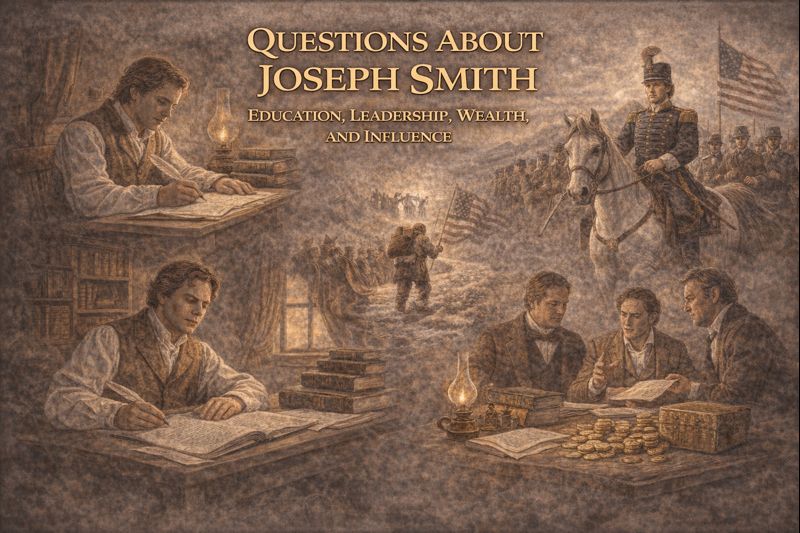
Joseph Smith’s Literacy and the Growth of His Intellectual World
Joseph Smith’s early life was marked by limited formal schooling. Neighbors and contemporaries such as Jonathan Hadley described him in 1829 as “very illiterate,” and the earliest surviving letters in Joseph’s own handwriting reveal inconsistent spelling and grammar—even misspelling his brother Hyrum’s name. Yet this lack of formal education did not reflect a lack of intelligence. Joseph possessed strong natural abilities for reasoning, memory, doctrinal synthesis, and long-form dictation, all of which became increasingly visible as he matured.
In Kirtland, he began a period of structured self-education. The School of the Prophets, funded and organized under his leadership, hired a Hebrew instructor, and Joseph pursued the language seriously enough to earn a graduation certificate. His personal library—initially small—grew into a wide-ranging collection that later scholars have described as surprisingly sophisticated for someone of Joseph’s background.
By the Nauvoo period, Joseph’s letters and public documents demonstrate a striking evolution. Although spelling inconsistencies persisted, his writing reveals a grasp of theology, law, government, and scriptural interpretation far beyond what his early critics would have imagined. This intellectual development was aided by his regular use of scribes. Most of Joseph’s later documents, including major political texts such as Views of the Powers and Policy of the Government of the United States, were produced through dictation, draft editing, and final approval. Though Joseph did not personally pen many of these writings, once he approved them—as was the practice of the period—they became “Joseph Smith documents” in every meaningful sense.
The Nauvoo Legion and Joseph Smith as Lieutenant General
The Nauvoo Legion was a legally recognized militia created by the Illinois legislature through the Nauvoo charter. Joseph Smith served as its Lieutenant General, a position unique in the United States at the time. Far from being a private army, the Legion functioned as a state-sanctioned militia with officers, uniforms, disciplinary courts, and formal military structure.
A substantial portion of surviving 1840s documents linked to Joseph Smith comes from Nauvoo Legion court-martial records. These cases illuminate not only the regiment’s size and regularity of drill but also Joseph’s seriousness regarding military order. He studied contemporary military tactics—likely influenced by Napoleonic-era manuals, common in American militia culture—and often employed patriotic rhetoric emphasizing loyalty to the United States. During a July 1841 review, Joseph publicly declared his willingness to “lay down [his] life for [his] country,” a statement reflecting the civic patriotism embedded in his leadership.
Zion’s Camp (1834) remains the closest historical moment to an actual battle under Joseph’s command. Although no engagement occurred, participants documented their belief that divine intervention prevented violence, including a sudden storm that dispersed hostile Missouri forces. Joseph’s military abilities in actual combat remain unknown, but his organizational leadership is well documented.
Did Joseph Smith Die Wealthy?
Persistent rumors suggest Joseph Smith died a millionaire or accumulated enormous wealth through Nauvoo economic activity. These claims collapse under examination. Joseph died deeply in debt.
Confusion often arises because Joseph’s name appears on numerous property deeds. But many of these holdings were not personal. The Nauvoo Temple, the Nauvoo House, and other public or ecclesiastical projects required land and financial instruments to be placed legally in Joseph’s name, even though they belonged to the Church. As a result, when Joseph died, his estate was encumbered with mortgages and obligations that extended well beyond his personal means. Some debts associated with Joseph’s property interests continued to be settled by Church leaders into the 1850s.
Rather than a wealthy man, Joseph died financially strained, carrying the burdens of both civic and religious projects that had been placed upon him.
Modern Christian Universalism and Latter-day Saint Influence
A notable feature of modern American spirituality is the widespread belief that “almost everyone goes to heaven.” The trend appears stronger in contemporary culture than in traditional Christian doctrine. Historically, most Christian denominations insisted on explicit belief in Jesus Christ as a requirement for salvation. Statistically, billions of people—Hindus, Muslims, Buddhists, Confucianists, the non-religious—do not meet that criterion.
So why do many modern Christians express universalist instincts?
Part of the answer lies in changing cultural attitudes. Many identify as “spiritual but not religious,” preferring individualized belief systems that emphasize fairness, divine love, and broad salvation while minimizing doctrinal boundaries. Sermons in many churches increasingly center on comfort, hope, and God’s compassion, often without highlighting traditional teachings about eternal judgment.
Did Joseph Smith cause this shift? Only indirectly, and on a very limited scale. The Latter-day Saint population is far too small to reshape national Christian theology. Yet Joseph’s teachings provide the most coherent and expansive framework of universal salvation in modern Christianity—degrees of glory, salvation for the dead, eternal families, and a premortal life. Many Christians instinctively embrace versions of these ideas—even when their denominations do not teach them—because they fit contemporary intuitions about fairness and divine love.
Thus, while Joseph Smith did not cause the modern universalist trend, his theological system articulates the worldview that many modern Christians have come to prefer.