
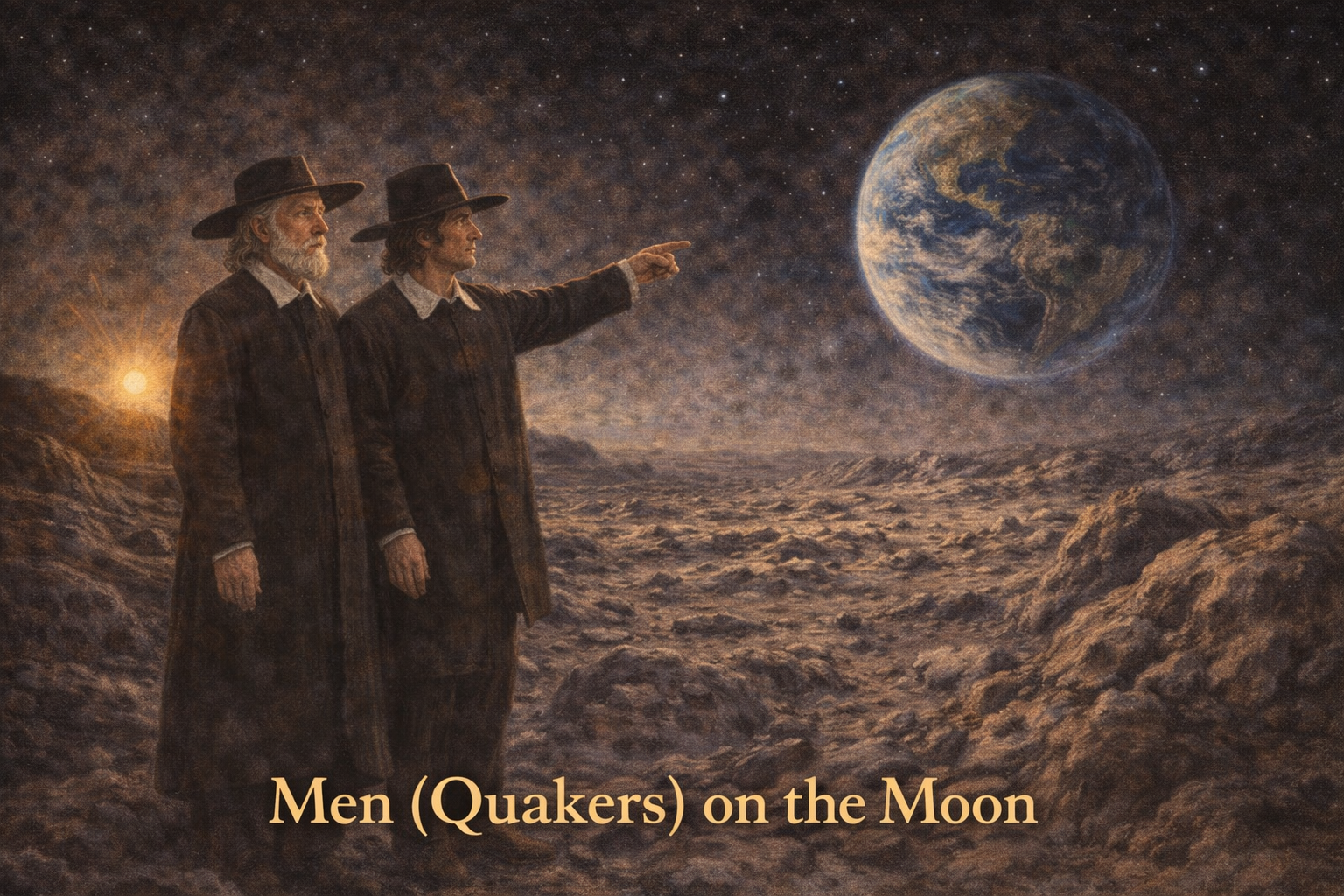
The “Men on the Moon” Question
A listener asked whether Joseph Smith ever taught that the moon was inhabited by people dressed “like Quakers.” The episode uses this question to illustrate how to evaluate historical claims about prophets and doctrine.
Many critical arguments follow a familiar pattern:
Assert: “Joseph Smith said X.”
Quote a late or secondhand source.
Conclude: “Therefore he was a false prophet.”
This approach typically ignores context, source distance, and the difference between revelation and personal speculation.
Latter-day Saints do not believe that prophets are infallible or omniscient. They receive revelation when God speaks; outside of that, they think and speak as mortal humans.
Source of the Claim: Oliver B. Huntington
The well-known “men on the moon dressed like Quakers” line comes from Oliver B. Huntington, a faithful Latter-day Saint who published an article in the Young Woman’s Journal in 1892, nearly half a century after Joseph Smith’s death.
Huntington wrote that:
As far back as 1837, he “knew” Joseph had said the moon was inhabited by men and women,
That they lived to nearly a thousand years,
That they averaged about six feet in height, and
That they dressed in a style similar to Quakers.
Important details about this source
It is not Joseph Smith’s own writing.
It is a late reminiscence written decades after the fact.
It is a single witness, with no independent contemporary corroboration.
Huntington’s Journal and Reliability Issues
Huntington’s diary from the 1880s–1890s includes a section where he records stories and memories he attributes to Joseph Smith and other early figures. This section has several characteristics:
Some stories are secondhand (“someone told me Joseph said…”).
Some details are historically inaccurate or conflict with other sources.
Some narratives clearly reflect devotional motives more than exact recollection.
Examples that raise questions about reliability include
Sacrament wine revelation – Huntington places a revelation about using water instead of wine for the sacrament in Kirtland, but Doctrine and Covenants 27 shows it occurred in Colesville, New York, earlier than he remembered.
Names of the Three Nephites – He confidently gives names for the Three Nephites (Jeremiah, Zedekiah, Cumenhai) even though 3 Nephi 28 explicitly leaves their names undisclosed.
Miraculous long-distance travel – He records a story of someone being carried hundreds of miles overnight; this is based on someone else’s retelling decades later.
These examples show that Huntington’s late reminiscences mix:
Memory and imagination,
Secondhand reports, and
Faith-promoting storytelling.
Because of this mixture, his journal is not a reliable basis for precise quotations of what Joseph Smith actually said.
Nineteenth-Century Beliefs About Inhabited Worlds
In the 1800s, many people—including some scientists—speculated that the moon or planets might be inhabited. This was not uniquely Mormon speculation; it was a wider cultural idea.
Within Latter-day Saint belief:
Scripture teaches that God created “worlds without number” (Moses 1).
Those worlds are inhabited by His children.
This made it natural for some Saints to wonder about life on other planets. But speculation about inhabited worlds is not the same as canonical revelation.
Crucially, there is:
No canonized revelation stating that the moon is inhabited, and
No contemporaneous sermon from Joseph making that claim as doctrine.
Do We Have Any Contemporary Statement from Joseph Smith?
No. There is:
No entry in Joseph Smith’s own journals.
No sermon in the History of the Church recording him saying this.
No letter, legal document, or early diary recording such a teaching.
No independent eyewitness account from Joseph’s lifetime that corroborates the Huntington story.
The only explicit “men on the moon” statement comes from Huntington’s 1892 reminiscence.
Given the time gap and the problems in that same source, historians do not treat this as solid evidence of an actual prophetic teaching.
What If Joseph Did Speculate?
Even if Joseph had informally speculated that the moon might be inhabited, that would not:
Turn the idea into revealed doctrine, or
Invalidate his prophetic calling.
Biblical prophets also shared the scientific assumptions of their time—regarding cosmology, medicine, and nature—without Christians concluding that their prophetic role was nullified.
Latter-day Saints understand that:
Prophets are inspired when God reveals His will.
Outside of direct revelation, they can hold tentative opinions, use current science, and even be mistaken.
Only what God actually reveals and confirms by the Spirit is binding doctrine.
Historical Conclusion about “Men on the Moon”
From a strictly historical standpoint:
The claim about Joseph Smith teaching that the moon is inhabited by Quaker-dressed people comes from one late, secondary source (Oliver B. Huntington, 1892).
Huntington’s reminiscences have demonstrable issues of memory and accuracy.
There are no contemporary Joseph Smith documents that support this statement.
No canonized revelation or official teaching presents this idea as doctrine.
Therefore:
There is no reliable historical evidence that Joseph Smith taught, as revelation, that the moon is inhabited by people dressed like Quakers.
Even if such a speculative comment was made informally, it would not be a measure of his prophetic calling, which rests on scripture, revelations, and the witness of the Holy Ghost—not on a late, third-hand anecdote.
The broader principle is that:
Claims about prophets must be tested against canon, contemporary records, and sound historical method,
Not based on isolated, late, secondhand stories that mix memory, folklore, and devotion.
FAQ
Q1: Did Joseph Smith teach that the moon was inhabited?
There is no contemporary evidence. The story comes from Oliver B. Huntington, written decades after Joseph Smith’s death.
Q2: Is Huntington’s account reliable?
It mixes memory, secondhand anecdotes, and devotional storytelling. Historians treat it as unreliable for precise quotations.
Q3: Did early Saints believe in life on other planets?
Some speculated, as did many 19th-century Americans. But speculation is not doctrine.
Q4: Would Joseph Smith’s private speculation invalidate his prophetic calling?
No. Prophets are not omniscient; they may express personal opinions that are not revelation.
Q5: Is the “moon men” idea official Church doctrine?
No. It was never canonized, taught officially, or supported by contemporary sources.