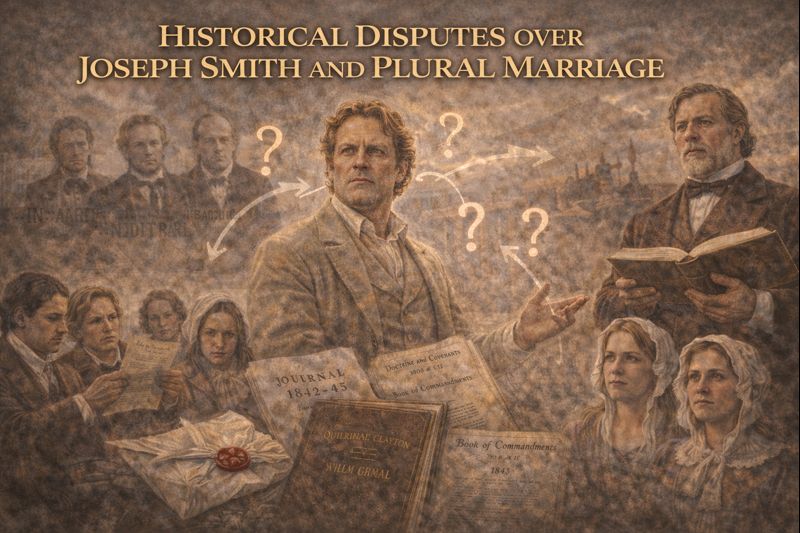
From the earliest decades of the Restoration, the question of who introduced plural marriage has been contested. Latter-day Saints have consistently taught that the principle was revealed to Joseph Smith and practiced under his direction in Nauvoo. In contrast, the Reorganized Church (RLDS, now Community of Christ) spent more than a century claiming that Joseph neither taught nor lived plural marriage, attributing its origin entirely to Brigham Young. Modern Community of Christ historians, however, now recognize the extensive nineteenth-century documentation linking Joseph Smith directly to the practice. The debate therefore rests not on ideology, but on which sources one accepts as credible.
Evaluating Sources in Latter-day Saint History
An essential skill in approaching any historical controversy is the ability to evaluate sources. This includes examining the author’s training, the method of publication, and whether the work has undergone academic peer review. In legitimate historical scholarship, manuscripts are submitted to qualified reviewers who evaluate whether claims are supported by verifiable documents. Unsupported assertions or arguments contradicted by primary sources do not survive this process. Because of this, peer-reviewed publications provide far stronger historical grounding than self-published writings that bypass scholarly scrutiny entirely.
Self-Published Claims and Modern Apostate Movements
The episode next addresses the problem of self-published religious claims. Without peer review or professional oversight, such works can promote inaccurate conclusions, especially when driven by ideological agendas. A modern example is the Denver Snuffer movement, sometimes called “Snufferite,” which rejects the authority of modern prophets and claims Joseph Smith taught a private set of doctrines unknown to the wider Church. Followers argue that the Church fell into apostasy after Joseph’s death and that later prophets—Brigham Young, John Taylor, Wilford Woodruff, and others—possessed no divine authority. These teachings rely heavily on reinterpretations of isolated documents, selective quotations, and historically unsupported assertions presented as “hidden truth.”
Documented Evidence of Joseph Smith’s Plural Marriages
Against such revisionist narratives stands an extensive historical record created by Joseph’s contemporaries. The journals of William Clayton—kept during Joseph’s lifetime in Nauvoo—contain explicit references to plural marriage. Numerous women later known as Joseph’s plural wives wrote their own accounts: Eliza R. Snow, Lucy Walker, Helen Mar Kimball, and others recorded their experiences in diaries, autobiographies, and legal testimonies. Many of these records exist in original nineteenth-century manuscripts preserved in archives, examined by professional historians, and repeatedly cited in academic studies. Their consistency across independent sources forms one of the strongest evidentiary foundations in early Latter-day Saint history.
The Claim That Section 132 Was Fabricated
Some groups argue that Doctrine and Covenants 132—the revelation on eternal and plural marriage—was composed after Joseph Smith’s death. The historical evidence, however, contradicts this. The revelation was dictated in 1843 and written down by William Clayton; multiple eyewitnesses described its creation before Joseph’s death in 1844. The surviving manuscript is written on period-appropriate paper with ink consistent with the 1840s. Furthermore, Joseph had taught the principle privately to several leaders and members prior to the written revelation. All reliable historians—LDS and non-LDS alike—acknowledge that the doctrine originated with Joseph Smith, not Brigham Young.
Post-Martyrdom Schismatic Claims
After Joseph Smith’s death, several individuals attempted to advance their own leadership claims. James J. Strang asserted that he possessed a letter appointing him as Joseph’s successor. James Emmett likewise claimed special instruction from Joseph. Both led breakaway groups that eventually collapsed. On February 27, 1845, the Quorum of the Twelve wrote to Saints confused by Emmett’s claims, warning that he acted contrary to prophetic counsel and that sincere people were being misled by false assertions of secret authority. These movements illustrate how charismatic figures have long attempted to draw disciples by invoking private revelation or alleged hidden teachings.
A Historical Pattern of Apostasy and “Secret Knowledge”
Throughout Church history, splinter movements have tended to follow a consistent pattern: denial of the current prophet’s authority, insistence on privileged access to hidden or superior revelation, and selective reinterpretation of historical records. Such individuals often present themselves as custodians of the “real” teachings of Joseph Smith, even when their claims contradict contemporary documents and the testimonies of Joseph’s associates. The continuity of this pattern—from the 1840s to the present—helps explain how and why these movements emerge and why they fail to align with verifiable historical evidence.
Continuity of Priesthood Keys in Latter-day Saint Doctrine
The episode concludes by reaffirming the Latter-day Saint belief in the continued transmission of priesthood keys. According to the historical and doctrinal framework of the Church, those keys passed from Joseph Smith to Brigham Young, then to John Taylor, Wilford Woodruff, and onward through each successive prophet to the present day. The Restoration narrative teaches that these keys will not be lost again. In this light, movements claiming secret knowledge or unauthorized authority stand outside the historical and doctrinal structure established by Joseph Smith himself.
Listen to the full podcast here:
https://www.youtube.com/@standardoftruthpodcastllc
Season 4, Episode 38 – Super Special Secret Source on Polygamy?