
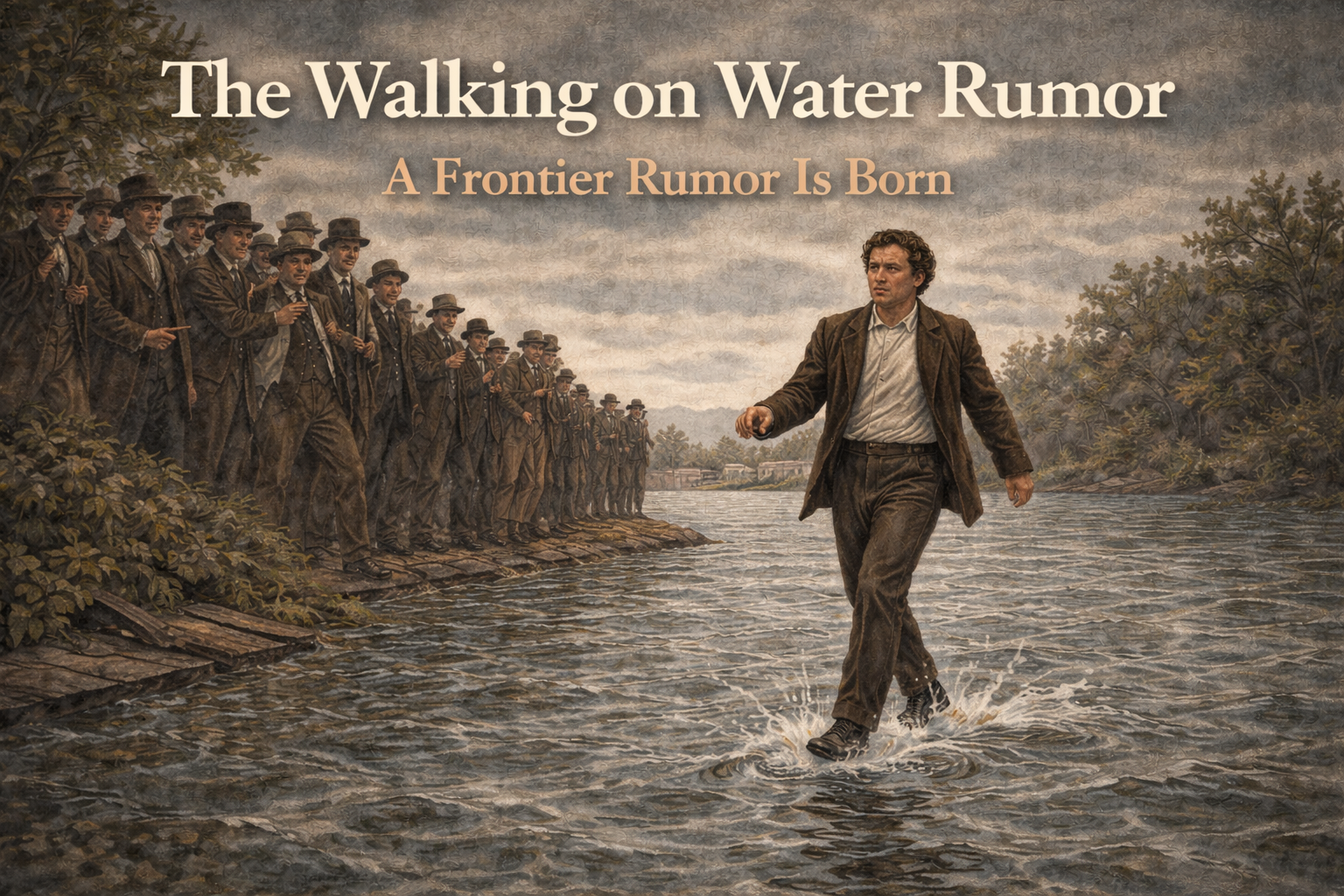
A Frontier Rumor Is Born
In April 1834, the Saturday Evening Post printed a brief story about an unnamed “Mormon preacher” in western New York who allegedly claimed he would walk on water. The article named no individuals, relied on secondhand hearsay from an unidentified source, and was itself a reprint. Even the editors admitted the account lacked verification and awaited confirmation that never appeared.
The story claimed that a preacher announced a public miracle, drawing a crowd to a pond where hidden planks beneath the water supposedly formed a secret walkway. According to the rumor, critics later cut the boards, causing the preacher to fall into the water during the attempted miracle. The tale ended by asserting—without evidence—that the incident led to the movement’s collapse in the area.
Nothing in the report offered a real date or location, and nothing in the recollections of early Latter-day Saints, or in local New York records, ever confirmed the drowning of a missionary. No “Mormon preacher” of any name died in such a manner. The tale bore every hallmark of 19th-century frontier satire—anonymous sources, dramatic moral lesson, and the familiar trope of preachers exposed through hidden planks, a narrative that long predated Mormonism and had been used mockingly against revivalist ministers of many denominations. Yet because newspapers in the 1830s routinely reprinted colorful stories without checking facts, this rumor spread swiftly across the United States.
The Church’s Immediate Response
The rumor circulated widely enough that in April 1834—within weeks of its first appearance—the Church responded through The Evening and the Morning Star. The Saints in Missouri and Kirtland had already seen something similar: a nearly identical fabrication had circulated years earlier in New England about a completely different preacher. This repetition strengthened their conviction that the new story was just another recycled attempt to ridicule a rising religious movement.
The Star’s rebuttal stressed practical impossibilities. The pond, if shallow enough for planks, would have been known by locals for its depth. A public drowning would have resulted in a coroner’s inquest, a burial, and a name—none of which existed. The editors explained that no elder or missionary had drowned, and no such event had occurred anywhere Latter-day Saints were preaching. From the perspective of those who lived in the region and knew every traveling elder personally, the claim was absurd from the outset.
How Joseph Smith’s Name Became Attached to the Legend
Although the 1834 rumor made no mention of Joseph Smith, later opponents found it useful to associate the tale with him. The first known publication explicitly naming Joseph appeared not in America but in England in 1838. This later retelling modified the story significantly: the supposed drowning vanished, the setting shifted from a pond to a river, and details were added to make the narrative fit the growing mythology surrounding the Mormon prophet. No sources were cited, and nothing corresponded to any known event in Joseph’s life.
Three decades later, in 1869, a county history from the Afton–Bainbridge region of New York expanded the legend again. This version included a named location, invented witnesses, claims that Joseph had attended school there, and dramatic scenes in which he supposedly stepped onto planks placed in a river and nearly drowned when they gave way. These late-19th-century county histories frequently mingled folklore with historical fact, and their retellings of old rumors served more as entertainment than as reliable documentation.
By the time Fawn Brody published No Man Knows My History in 1945, the story had already been shaped by multiple generations of hostile retellings. Brody herself admitted that the tale was “apocryphal,” yet repeated it anyway, blending the 1834 satire with elements from the 1869 local folklore. She offered no primary source demonstrating that Joseph Smith had ever attempted such a demonstration, but used the story symbolically to illustrate her interpretation of Joseph’s character. Modern historians, trained to distinguish documented fact from inherited rumor, do not treat such anecdotes as evidence.
Historical Reality and the Nature of Opposition
In its historical context, the walking-on-water story lacks any factual foundation: it has no verifiable date, location, identity, or contemporary record, and early editors and eyewitnesses doubted it. The later association with Joseph Smith reflects a common pattern in new religious movements, where hostile or satirical legends attach to prominent leaders. Similar stock stories were widely used in the 19th century to mock revivalists, and Mormonism inherited these rumors as it became a target of public suspicion.
From a doctrinal perspective, such opposition was foreseen. In Joseph Smith—History, the Lord warned that Joseph’s name would be spoken both for good and for evil among all nations. Sensational tales, whether believed or not, formed part of the environment in which early Saints lived. But the prophetic authority of Joseph Smith does not rest upon newspaper satire from 1834. Instead, it stands on the witness of the Book of Mormon, the testimony of the Holy Ghost, and the historical evidence of the Restoration’s fruits. No rumor—whether born of frontier humor, misunderstanding, or animosity—can displace the scriptural and spiritual foundations upon which Joseph’s calling rests.