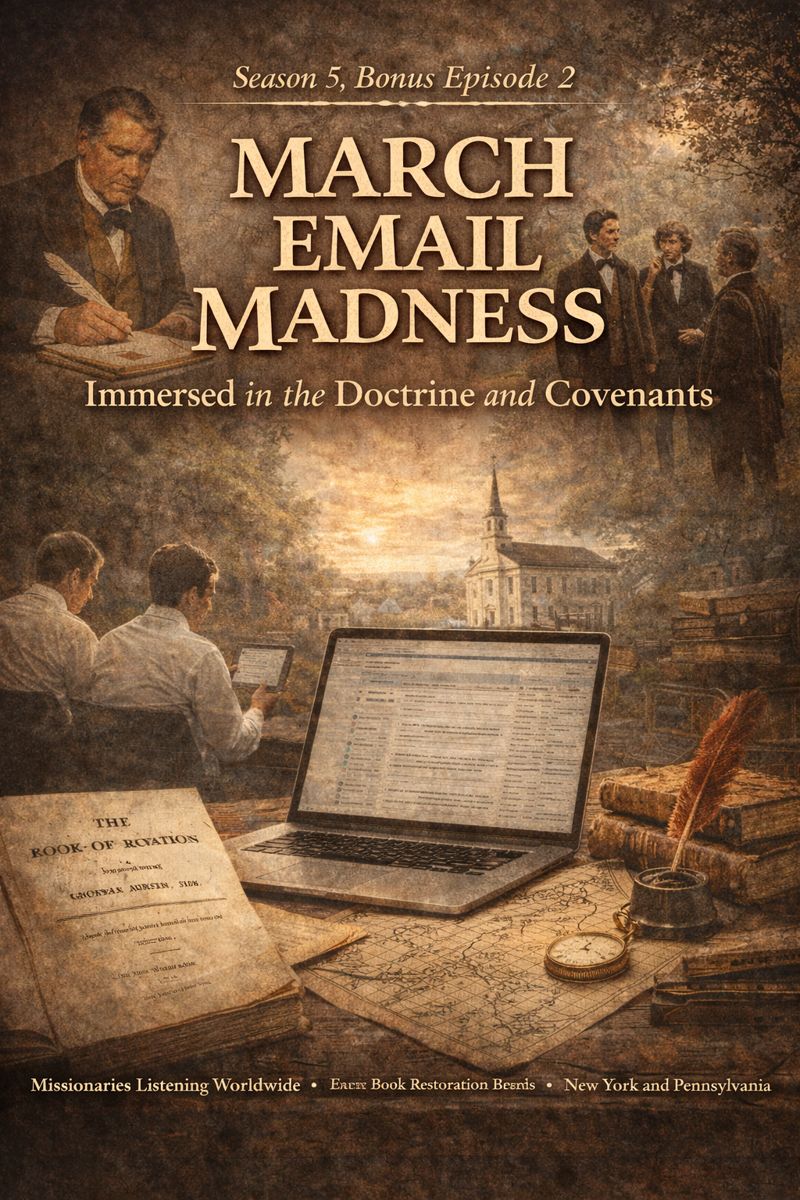
March Email Madness
A Season Immersed in the Doctrine and Covenants
As the podcast continues its deep dive into the Doctrine and Covenants, the hosts explain that most recent episodes have centered on early revelations received by Joseph Smith. These revelations—given in New York, Pennsylvania, Ohio, and beyond—form the backbone of Latter-day Saint scriptural history. Studying them in sequence has required intense historical work, driving the current focus of the show on the earliest years of the Restoration.
Missionaries Worldwide Accessing Historical Content
The episode notes that missionaries around the world have been listening to the podcast thanks to a shared Google Drive that distributes episodes throughout missions. Thousands of missionaries now access detailed historical and doctrinal explanations on:
The early Restoration
Joseph Smith’s experiences and revelations
Translation of the Book of Mormon
Historical foundations of the Doctrine and Covenants
Missionaries report that this historical context strengthens their teaching, improves doctrinal understanding, and deepens testimony as they serve.
Clearing Up a Local Pronunciation: “Boise”
One listener wrote in to clarify a common regional misconception: the city of Boise, Idaho is historically and locally pronounced “Boy-see,” not “Boy-zee.”
The original French spelling Boisé supports this pronunciation. The correction reflects the importance of respecting local linguistic history when discussing Latter-day Saint settlement regions in the American West.
Voices from the Priesthood Restoration Site in Harmony, Pennsylvania
Senior missionaries serving at the Priesthood Restoration Site wrote in to share their experiences at one of the most sacred locations in early Latter-day Saint history. Harmony (now Oakland Township), Pennsylvania is where:
Joseph Smith and Oliver Cowdery translated large sections of the Book of Mormon (1828–1829).
John the Baptist appeared on May 15, 1829 to restore the Aaronic Priesthood.
Peter, James, and John conferred the Melchizedek Priesthood shortly thereafter.
Several early revelations—later canonized—were received.
The hosts announce that the podcast’s historical tour will visit this site in August, underscoring its importance in the development of Restoration doctrine and authority.
Missionaries Reflect on History’s Power in Teaching the Gospel
Many of the emails highlighted in this episode come from missionaries describing the impact historical knowledge has on their work. Missionaries express that learning about:
The translation process of the Book of Mormon
The restoration of priesthood authority
The events surrounding early revelations
The lived experiences of Joseph Smith
…not only enriches their personal faith but also strengthens their ability to teach investigators and answer questions meaningfully.
Latter-day Saint Regional History in Idaho and Utah
A listener mentioned Mantua, Utah—a small Latter-day Saint pioneer settlement historically known for strict traffic enforcement. Mantua is part of the broader colonization of Cache Valley and northern Utah, an area settled by LDS pioneers in the mid-1800s. These recollections tie modern daily life to the deeper pioneer history that shaped entire communities across the Intermountain West.
Missionaries Serving in New York and Pennsylvania Historic Sites
Another set of emails came from missionaries currently serving in the Church’s official historic sites mission across New York and Pennsylvania. Their work involves caring for and interpreting foundational Restoration locations such as:
The Sacred Grove – where the First Vision occurred
Hill Cumorah – where Joseph Smith received the plates
Harmony, Pennsylvania – where translation and priesthood restoration unfolded
The Whitmer Farm in Fayette – where the Church was formally organized on April 6, 1830
Their day-to-day service reinforces the living connection between modern Latter-day Saints and the sacred events of the early Restoration.