
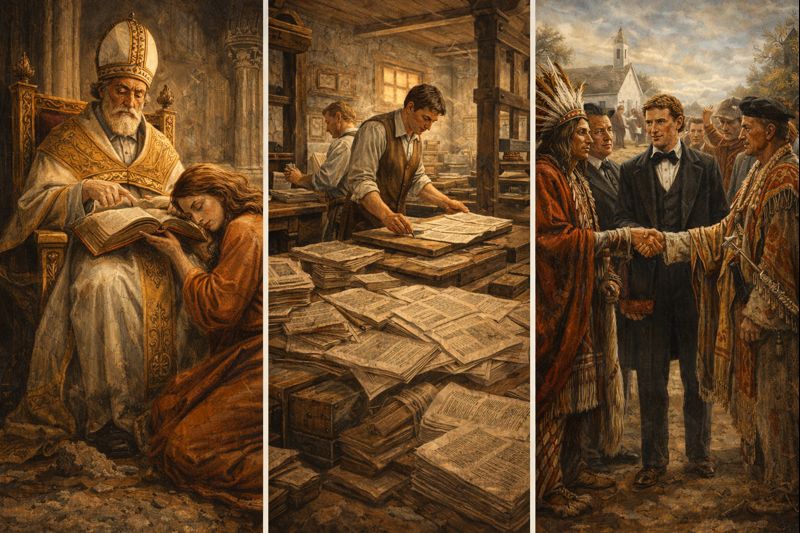
Printing and Distributing the Book of Mormon: 1830–1831
When the Book of Mormon finished printing in March 1830 at E. B. Grandin’s shop in Palmyra, New York, the work was far from over. The thousands of printed sheets still required binding, a lengthy process carried out by Luther Howard, who partnered with Grandin to complete the task. Because binding was slow and labor-intensive, copies were not produced all at once. Instead, they were prepared gradually, with only several hundred bound and available during the spring of 1830.
This means the common modern assumption that “all 5,000 books were stored together” is historically inaccurate. As the Saints began moving from New York toward Ohio, copies continued being bound and retrieved in stages. A February 1831 letter from Joseph Smith to Martin Harris confirms this: Joseph instructed Martin to travel to Ohio and to bring “all the books”—meaning all that were bound at that time—and not to sell them for less than 10 shillings (about $1.25). Harris made repeated return trips in subsequent years, retrieving additional bound copies for use among the growing church membership.
Joseph Smith and Native American Delegations in the Nauvoo Era
During the early 1840s, Nauvoo became a gathering place not only for Latter-day Saints but also for multiple Native American delegations who visited Joseph Smith. The most historically documented visit occurred on August 12, 1841, when a large group of Sac and Fox (Sauk and Meskwaki) people camped at Montrose, Iowa, then crossed the Mississippi River to meet the Prophet.
Among the visiting leaders were Chief Keokuk, Kishkekosh, Quashquame, and Appanoose. Joseph introduced them to his brother Hyrum and taught from the Book of Mormon regarding their ancient ancestors. Remarkably, Keokuk indicated he already owned a copy of the Book of Mormon, having received one earlier. The visitors were fed by Nauvoo residents and performed traditional dances before returning across the river.
Additional documented interactions followed:
In 1843, Joseph met with Potawatomi visitors, aided by interpreter Jonathan Dunham.
In May 1844, a delegation of Sac/Fox individuals—including a brother of Black Hawk—again visited Nauvoo for counsel, dance, and ritual exchange shortly before Joseph’s death.
How Mary Magdalene Became Mistaken for a Prostitute
The New Testament never identifies Mary Magdalene as a prostitute. She is described only as a faithful disciple from whom Jesus cast out seven devils (Mark 16:9; Luke 8:2). But in 591 AD, an interpretive shift occurred. Pope Gregory the Great, in a well-known homily, merged three separate women into one figure:
Mary Magdalene,
The unnamed “sinful woman” of Luke 7 who anoints Jesus’s feet, and
Mary of Bethany (sister of Martha and Lazarus), who anoints Jesus in John 12.
Gregory allegorized the “seven devils” as the “totality of vices” and declared the sinner of Luke 7 to be Mary Magdalene. This fusion, though unsupported by earlier Christian writers, rapidly became embedded in Western Christian tradition. From that point forward, Mary Magdalene was popularly understood as a repentant prostitute—even though Scripture never makes that connection. The identification originates specifically with Pope Gregory’s sermon, not with the biblical text.
Papal Succession and the Rise of Conclave Elections
Early Christianity developed a tradition that the apostle Peter served as the first Bishop of Rome, with later bishops—eventually called popes—continuing his line of ecclesiastical authority. During the turbulent early medieval period, rival claimants known as antipopes sometimes emerged, creating parallel successions.
One conflict in the late eighth century, involving Antipope Constantine II, contributed to reforms establishing that only cardinals could elect a pope. This principle evolved into the modern conclave system:
Elections occur inside the Sistine Chapel.
Only cardinals under age 80 may vote.
White smoke signals a successful election; black smoke signals continued deliberation.
The St. Malachy “Prophecies” and the Final Pope Tradition
A medieval document attributed to St. Malachy (12th century) lists cryptic descriptions of future popes. Although historically dubious and not accepted by the Catholic Church, the list became popular in later centuries, especially when a pope died, as some interpreters claimed it predicted a final pope before apocalyptic events. The fascination persists in popular culture but has no authoritative standing in Catholic tradition or scholarship.
Listen to the full podcast here:
Season 5, Episode 18 – The Pope and Mary Magdalene