
Podcast Introduction and Focus on Historical Questions
This episode of the Standard of Truth podcast opens with the familiar introduction to Dr. Garrett Dirkmaat and Dr. Richard LeDuc. The hosts frame the show as a blend of early Latter-day Saint history, original source analysis, and doctrinal context—approached with faith, expertise, and humor.
The episode moves through several historical questions, including the logistics of Book of Mormon printing, Joseph Smith’s interactions with Native Americans, and then devotes extended attention to traditions surrounding Mary Magdalene, followed by later Catholic claims about the papacy and prophetic speculation.
Book of Mormon Printing and Distribution (1830–1832)
The first question addresses what happened to the original 5,000-copy print run of the Book of Mormon in 1830.
Modern assumptions often imagine all 5,000 books completed and stacked for sale on March 26, 1830. In reality, printing at E. B. Grandin’s shop in Palmyra was slow and multi-staged. Typesetting, printing, drying, cutting, collating, and especially binding required considerable time.
Only a few hundred copies were likely fully bound and ready on the release date. The binder, Luther Howard, continued binding books for one to two years afterward. As each batch was completed, someone had to travel back to Palmyra, retrieve the newly bound copies, and transport them by wagon to wherever the Saints were gathering.
In February 1831, Joseph Smith wrote from Ohio to Martin Harris, instructing him:
- To come to Ohio without delay
- To bring, or cause to be brought, all the books he could
- Not to sell the books for less than ten shillings (about $1.25), more than a day’s wages for many laborers
This letter shows that nearly a year after printing began, Joseph still expected additional copies to be brought from Palmyra and distributed. Martin Harris made multiple trips east in the early 1830s, likely both to manage remaining property and to transport newly bound books west for missionary use.
Joseph Smith and Native American Visitors in Nauvoo
A listener asked about a mural in the Mesa Arizona Temple depicting Joseph and Hyrum Smith preaching to Native Americans and baptizing them. The hosts explain that while artists employ creative license, such scenes are grounded in strong historical precedent.
A major documented event occurred on August 12, 1841, when a large group of Sac and Fox Indians camped near Montrose, Iowa, crossed the Mississippi River, and visited Joseph Smith in Nauvoo.
Joseph introduced his brother Hyrum, taught from the Book of Mormon about their ancestors and promises made to them, and counseled peace between tribes and settlers. Chief Keokuk responded that he already possessed a Book of Mormon Joseph had previously given him and affirmed Joseph as a great and good man. The Saints fed the visitors, and the Native group performed traditional dances.
Additional records document other visits by Pottawatomie and Sac and Fox delegations, even during the final year of Joseph’s life. While specific murals are artistic compositions, they reflect real and recurring historical interactions.
Mary Magdalene: Prostitute, Wife, or Disciple?
A listener raised two widespread modern claims:
- That Mary Magdalene was a prostitute
- That Mary Magdalene was Jesus’s wife and had His children
The hosts note that the second claim gained popularity through Dan Brown’s The Da Vinci Code and has no basis in the New Testament. It relies on speculative readings of late, noncanonical texts.
The first claim—that Mary Magdalene was a prostitute—has a much older and more influential origin.
What the New Testament Actually Says About Mary Magdalene
The canonical Gospels state that Mary Magdalene:
- Had seven devils cast out of her (Luke 8:2; Mark 16:9)
- Followed Jesus and ministered to Him
- Witnessed the Crucifixion
- Was among the first witnesses of the resurrected Christ
The New Testament never identifies her as a prostitute.
Key distinctions in the text:
- The unnamed sinful woman in Luke 7 is never called Mary
- Mary of Bethany, sister of Martha and Lazarus, anoints Jesus in John 12
- Neither woman is explicitly described as a prostitute
Pope Gregory the Great and the Origin of the Prostitute Tradition
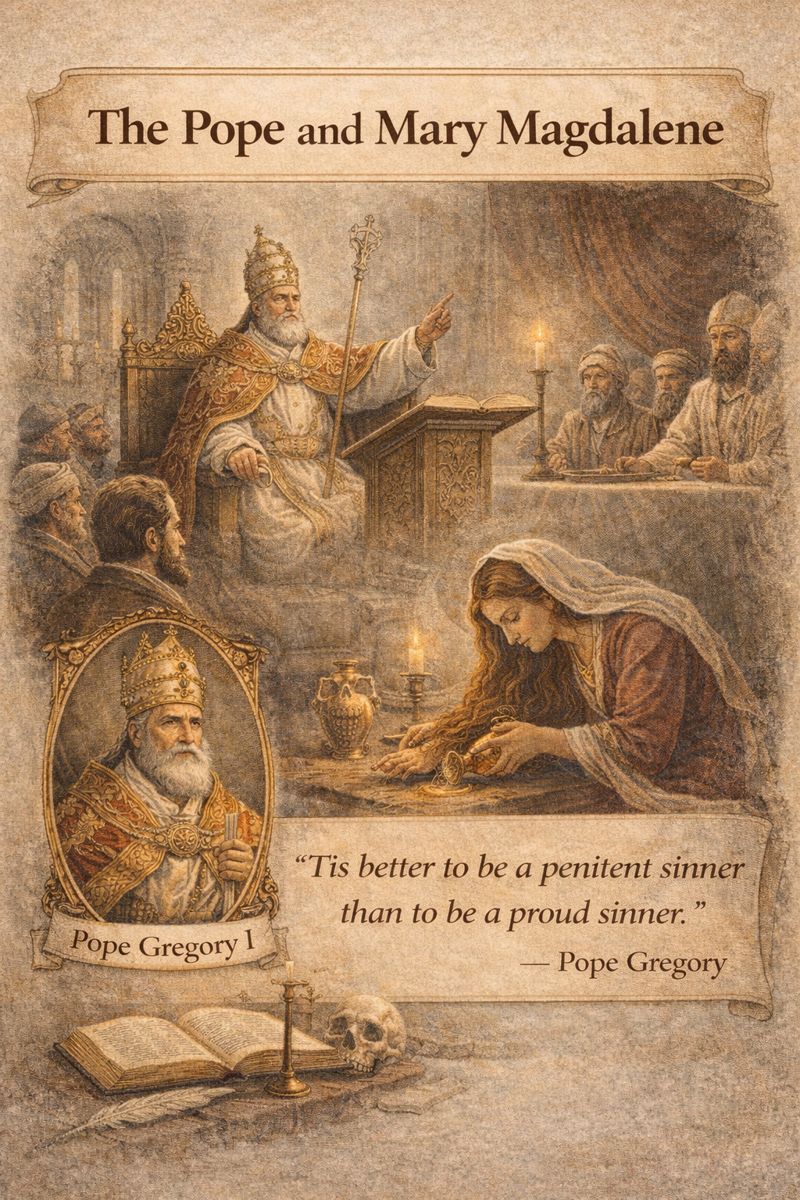
The turning point comes in 591 AD with Pope Gregory I (Gregory the Great). In a homily on Luke 7, Gregory:
- Identified the unnamed sinful woman with Mary of Bethany
- Then merged that figure with Mary Magdalene
He allegorized the seven devils as the fullness of vice, portrayed the ointment as perfume used for seduction, and framed the woman as a symbol of total repentance. Though the sermon emphasized Christ’s mercy, it unmistakably portrayed the merged Mary as formerly sexually sinful.
Because Gregory was pope, this interpretation spread throughout medieval Catholicism. Western art, preaching, and tradition increasingly portrayed Mary Magdalene as a penitent former prostitute.
Earlier Christian writers did not merge these figures. Gregory is the earliest major source for this conflation, which later communities inherited uncritically.
Why the Prostitute Label Is Historically Inaccurate
Scripturally and historically, the label does not hold:
- Mary Magdalene is a disciple healed of demonic possession
- Mary of Bethany is identified separately
- The unnamed sinner in Luke 7 remains unnamed
Only Gregory’s devotional interpretation merges them. Later tradition amplified this merger until it became assumed fact, despite lacking textual support.
Was Mary Magdalene Jesus’s Wife?
The idea that Mary Magdalene was married to Jesus:
- Appears nowhere in the canonical Gospels
- Arises from speculative readings of texts like the Gospel of Philip
- Was popularized by modern conspiracy literature
Neither early Christianity nor Latter-day Saint doctrine teaches that Jesus was married to Mary Magdalene or that He left a biological lineage. In Latter-day Saint teaching, she is honored as a devoted disciple and witness of the Resurrection.
Catholic Papal Succession and the Election of a Pope
The episode then connects tradition-making to the papacy. Catholic and Orthodox traditions claim a visible church with continuing authority. Protestant traditions generally deny such institutional continuity.
Historically:
- Bishops of Rome gradually gained preeminence
- Conflicts sometimes produced antipopes
- By the eighth century, reforms emphasized that only cardinals could elect a pope
Today:
- Cardinals under age eighty gather in conclave
- Voting continues until a majority is reached
- Smoke signals announce results to the public
St. Malachy’s Prophecy and End-Times Speculation
The hosts discuss the alleged Prophecy of St. Malachy, a medieval list claiming to predict future popes and the end times. Some modern readers attempt to link papal deaths to the Second Coming.
From a Latter-day Saint perspective, such speculation is problematic. It relies on late apocryphal material rather than revelation through living prophets holding priesthood keys. Sensational predictions distract from genuine spiritual preparation.
Doctrinal Takeaways from the Episode
Key conclusions emphasized in the discussion:
- Mary Magdalene should be remembered as a faithful disciple and witness of the Resurrection, not reduced to a later invented label
- Long-standing traditions can arise from interpretive choices and must be measured against scripture and revelation
- God’s mercy extends to all who repent deeply
- True authority and prophecy must rest on priesthood keys and living revelation, not on speculative or sensational traditions
Listen to the full podcast here:
(30) Season 5, Episode 18 – The Pope and Mary Magdalene – YouTube