
Mormon Battalion – Part 1
Early Latter-day Saint Migration Context
The calling of the Mormon Battalion is inseparable from the national and international tensions of the 1840s. Before Joseph Smith’s death, the Saints were already exploring options to leave the United States. Under Joseph’s direction, the Council of Fifty evaluated potential settlement locations outside U.S. boundaries, including Texas (while still an independent republic), the Oregon Territory, and northern Mexican regions.
Exploration of Potential Settlement Locations
Texas ceased to be an option when it was annexed by the United States. The Oregon Territory—comprising modern Oregon, Washington, Idaho, and British Columbia—was jointly occupied by the U.S. and Great Britain and sparsely settled. A few thousand fur traders and settlers lived there.
Border disputes between the United States and Great Britain remained unresolved until the Webster–Ashburton Treaty clarified northern boundaries. As these issues continued, the Saints considered Mexico’s northern frontier—known as Upper California—which included present-day California, Nevada, Utah, Arizona, and parts of Colorado and New Mexico. This entire region contained fewer than 7,000 Mexican or American settlers, with some towns such as Los Angeles numbering only 1,200 residents.
Demographic Tensions and the Gathering Principle
Wherever the Saints gathered, they became the dominant population. With roughly 20,000 Saints in Nauvoo—and thousands more immigrating from England—their presence drastically altered local demographics. Illinois settlements such as Carthage and Warsaw grew gradually, while Nauvoo grew explosively, creating political and social tensions.
Escalating Violence and Federal Inaction
After the murders of Joseph and Hyrum Smith, attacks on Latter-day Saints intensified. Properties were burned, lives were taken, and no legal protection was provided. Leaders in the Council of Fifty concluded that no justice could be expected within U.S. boundaries and that the Saints needed to establish a community beyond government hostility.
Brigham Young’s Leadership and Commitment to Joseph’s Plans
Brigham Young committed himself to preserving Joseph Smith’s doctrines—including plural marriage, temple ordinances for the dead, and teachings about divine progression. Joseph’s plan to leave the United States became central to Brigham Young’s leadership strategy.
The Decision to Leave the United States
By 1845, fleeing the country became both a prophetic mandate and a necessity for survival. Reports from Washington indicated potential federal opposition to the Saints’ westward movement. Combined with escalating local violence, these warnings contributed to the urgency of the exodus. This turbulent period set the stage for the federal call that would form the Mormon Battalion.
Mormon Battalion – Part 2
Reports of Federal Hostility
As the Saints prepared to leave Nauvoo in 1846, Samuel Brannan, presiding over the Eastern States Mission, sent alarming messages from Washington. He warned Brigham Young that senior federal officials planned to prevent the Saints from migrating and even spoke of their possible destruction. These alarming reports reached the Saints while they were already suffering extreme violence in Illinois.
Political Instability in the United States
Nationally, U.S. relations with Great Britain and Mexico were tense. Oregon was jointly claimed, and the annexation of Texas by the United States pushed Mexico toward war. The regions the Saints considered settling—Oregon or northern Mexico—lay directly within contested territory.
American politicians believed the large Latter-day Saint population could bolster U.S. claims in disputed areas, even though Illinois citizens opposed them locally.
Governor Thomas Ford’s Deception
Illinois governor Thomas Ford later admitted he deliberately lied to the Saints, telling them federal forces were on their way to arrest them. He used this falsehood to force an early departure from Nauvoo. President Polk refused Ford’s request to intervene militarily, but Ford did not share this with the Saints.
As a result, the Saints fled across the Mississippi River during dangerous winter conditions. Nearly a thousand died in Iowa, Council Bluffs, and Winter Quarters—more than died between there and the Salt Lake Valley.
Latter-day Saint Condemnation of the United States
Orson Pratt declared that the United States had offered the Saints “only death or banishment,” and that escaping the nation was a relief. Doctrine and Covenants 136 described the nation as having “driven you out.”
Context for the Coming Battalion Call
The call for the Mormon Battalion arrived during a period of immense suffering, uncertainty, and distrust toward the federal government. The Saints faced poverty, illness, and political misrepresentation, all of which shaped their response when federal officers appeared requesting volunteers.
Mormon Battalion – Part 3
Fear and Suspicion Toward the U.S. Government
As the Saints crossed Iowa in early 1846, they believed federal intervention was imminent. Many saw the U.S. as openly hostile because of persecution in Missouri and Illinois. They left Nauvoo in winter, months earlier than planned, under extreme distress.
U.S. Political Concerns and the Mexican-American War
Tensions over Oregon nearly led to war with Great Britain. Mexico warned that U.S. annexation of Texas would lead to conflict. The Saints’ potential settlements lay within critical geopolitical regions. Tens of thousands of Saints entering those regions could shift future territorial claims.
Jesse C. Little Meets President Polk
Brigham Young instructed Jesse C. Little to obtain aid for the Saints. Little met President Polk, who told him the Saints should be treated as U.S. citizens and asked if they would be willing to raise a battalion for the war with Mexico. Little wrote enthusiastically to Brigham Young about Polk’s trust.
Fear at Mount Pisgah
Before Brigham received the letter, U.S. dragoons arrived at Mount Pisgah, causing widespread panic. Many believed this was the army sent to destroy them. Wilford Woodruff initially suspected they were spies but learned they were sent to request volunteers.
Strategic Motives Behind the Battalion
Privately, Polk feared the Saints might join or aid foreign powers. He wanted them aligned with the United States. The Mormon Battalion would help secure American claims in the West.
Mormon Battalion – Part 4
Ongoing Fear and Hardship
The Saints continued to suffer as they moved west: harsh conditions, disease, and misinformation contributed to massive loss of life. Reports from Washington remained contradictory and unreliable.
U.S. Strategy and the Request for Soldiers
The United States needed troops for the Mexican-American War. Privately, President Polk wanted to prevent Saints from aligning with Britain or Mexico. He also instructed military leaders not to allow Mormon volunteers to comprise more than one-fourth of total forces.
Reaction of the Saints
Many Saints suspected the call for troops was a trap. Others feared refusal would justify government action against them. Brigham Young, lacking full information, nevertheless committed to raising the Battalion.
Formation and March of the Battalion
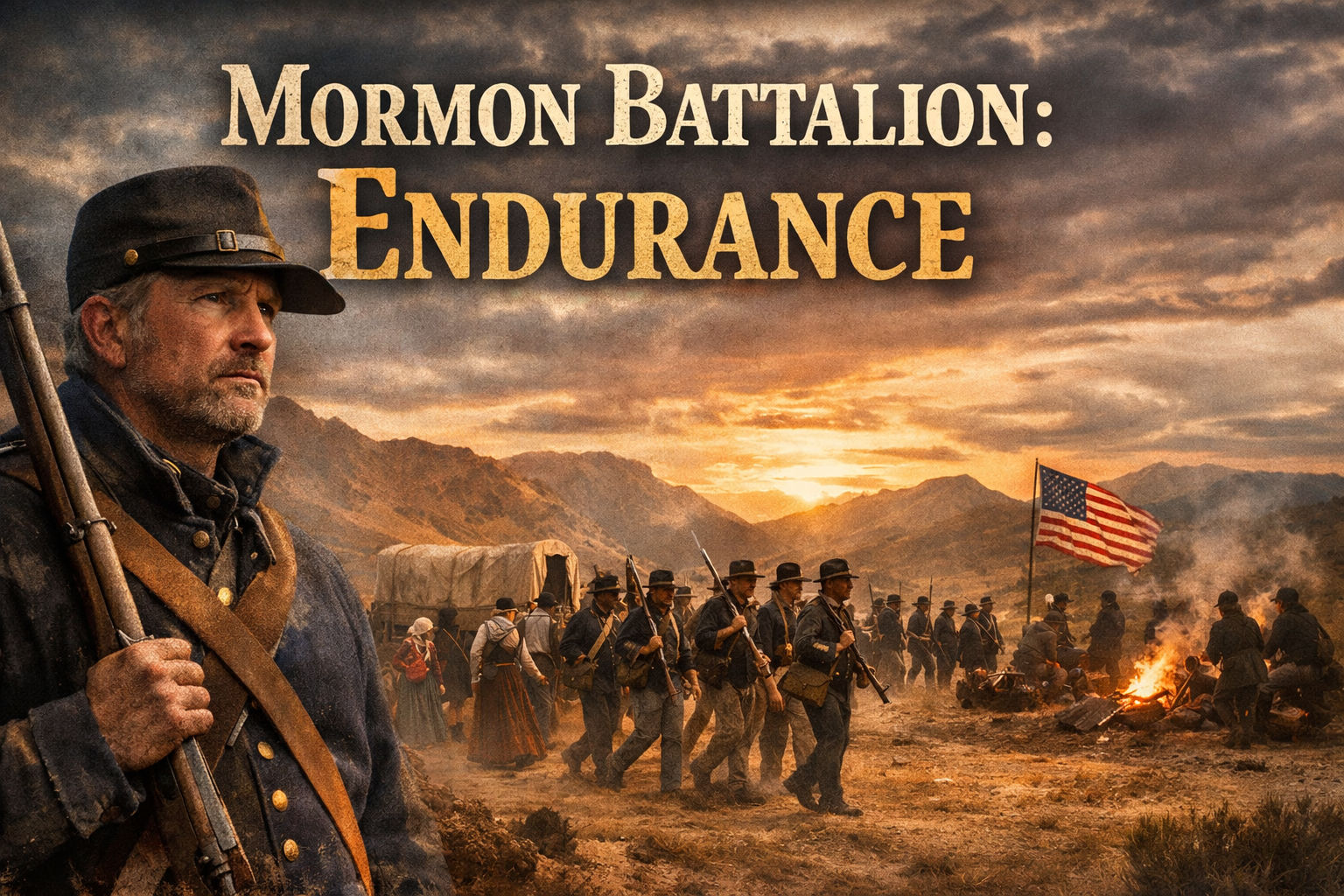
More than 500 men enlisted, with women serving as laundresses. Their wages supported the migrating Saints. The march to California—one of the longest in U.S. military history—occurred in a fragile political context. Though the Battalion saw no combat, disease claimed lives.
Aftermath and Doctrinal Context
Brigham Young later noted that the Battalion saved the Saints temporally by providing funds and political legitimacy. During the winter of 1846–47, Winter Quarters suffered division and disease, prompting Brigham Young to call for repentance and unity.
The service of the Mormon Battalion demonstrated obedience under extraordinary hardship and enabled the survival and migration of many Latter-day Saints.