
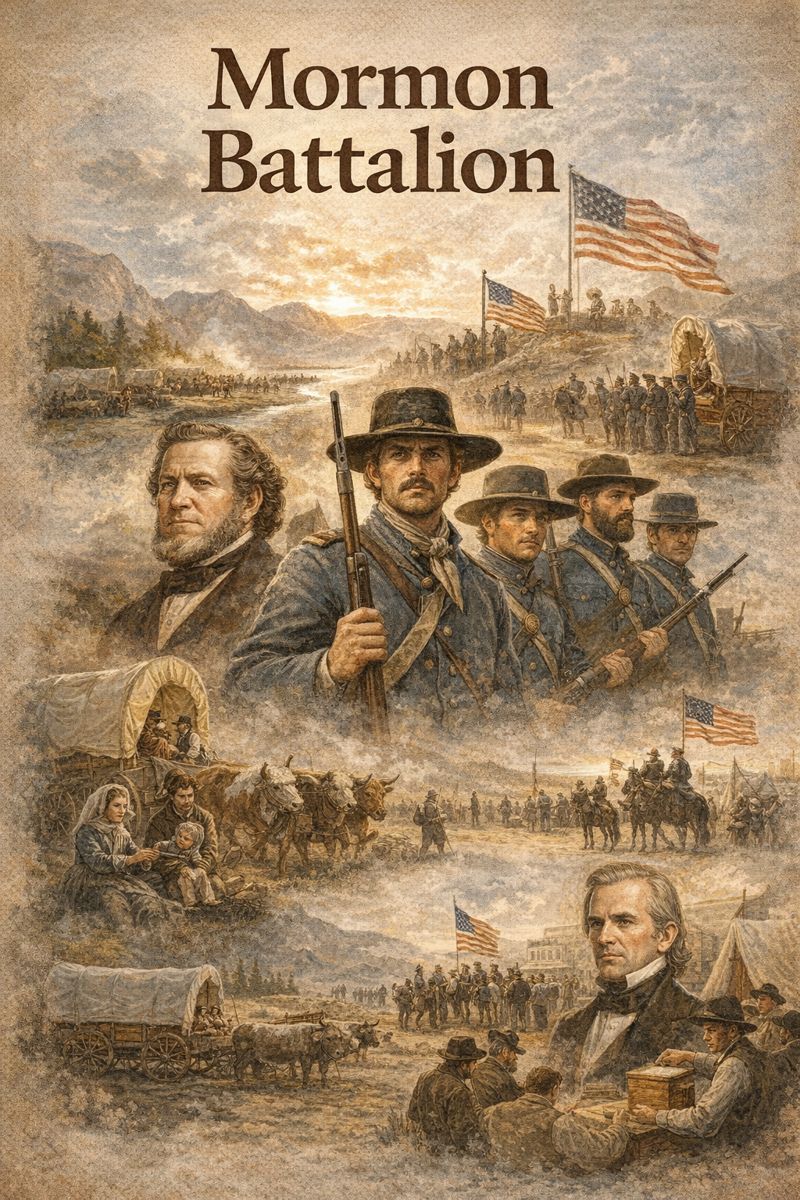
Dead and in Hell (Mormon Battalion) Part 1, 2 and 3 provides a comprehensive examination of the experiences faced by the Mormon Battalion during their arduous journey. The narrative delves into the challenges encountered by these individuals, highlighting their resilience and determination amidst adversity. Through meticulous research, the document sheds light on the historical significance of their contributions. This work serves as a vital resource for understanding the complexities of their story and the broader implications within American history.
Exodus, Federal Power, and the Political World of the Early Saints
Early Latter-day Saint Flight from the United States (1846)
By 1846, Latter-day Saints believed they were leaving the United States permanently. After violent expulsions from Missouri and Illinois—and the consistent failure of federal authorities to provide protection or redress—Church leaders concluded that remaining within U.S. borders meant continued persecution without remedy.
The Saints crossed Iowa Territory in stages, establishing temporary settlements such as:
- Garden Grove
- Mount Pisgah
- Council Bluffs
- Winter Quarters (on the Missouri River)
Their goal was the Rocky Mountains, then part of Mexico. This migration was not merely economic or agricultural; it was a deliberate attempt to place the Church beyond the reach of American officials who had ignored, enabled, or excused violence against them.
That expectation collapsed only two years later. The Mexican–American War ended in 1848 with the Treaty of Guadalupe Hidalgo, transferring vast western lands—including the Salt Lake Valley—to U.S. control. The Saints discovered that the refuge they had sacrificed to reach was once again under the authority of a government they deeply distrusted.
Fear of Federal Power and the Mormon Battalion
While camped along the Missouri River in 1846, rumors spread that the federal government might move from neglect to extermination. One report from a Washington contact claimed the Secretary of War had said the Mormons “must be exterminated from the earth.” In this climate, the appearance of U.S. troops near Mormon camps was terrifying.
Instead of violence, however, the federal government issued an unexpected request.
President James K. Polk authorized the recruitment of a battalion of approximately 500 Mormon men to serve in the Mexican–American War. Initially, the Saints were deeply suspicious. They were refugees with limited food, wagons, and livestock. Sending away hundreds of their strongest men seemed disastrous.
Brigham Young nevertheless urged compliance, promising that God would turn the sacrifice into a blessing. Ultimately, about 550 men enlisted—more troops than some U.S. states contributed to the war.
The outcome was crucial:
- Soldiers’ pay was sent directly back to Church leaders.
- The money funded wagons, livestock, food, and supplies.
- The poorest Saints were enabled to continue westward.
The battalion became an economic lifeline for the exodus.
Polk’s Hidden Motives and Continued Harassment
Later research into President Polk’s diary and correspondence confirmed Brigham Young’s suspicions. Polk viewed the Mormon Battalion as a means to:
- Keep the Saints under federal surveillance
- Prevent possible alliances with Mexico or Britain
- Ensure U.S. troops outnumbered Mormon men
- Maintain leverage for suppression if necessary
After the battalion departed, federal Indian agents and local officials quickly pressured the Saints to abandon Winter Quarters—despite earlier assurances of safety. To Church members, this confirmed that the Polk administration was not acting in good faith.
The Mexican Cession and the Stakes of the 1848 Election
With the Great Basin now under U.S. control, the Saints faced a sobering reality: their survival depended on federal recognition. Territorial governments were run by presidential appointees—governors, judges, secretaries, and Indian agents—who could veto local laws and make life unbearable.
Thus, the 1848 presidential election became existential.
Thousands of Saints were still living in western Iowa. Democrats, assuming Mormon loyalty, passed a special law expanding county boundaries so Mormon settlements could vote. Whigs courted the Saints aggressively, backing war hero Zachary Taylor.
Because of their experience with Polk and Democratic leadership, Brigham Young and other leaders endorsed Taylor and the Whigs—a major political shift.
The Iowa Election Scandal
When Mormon votes swung a key congressional seat to the Whigs, Democratic leaders reversed themselves. They declared their own voting law unconstitutional and demanded that all Mormon votes be thrown out.
The controversy escalated to Congress and remained unresolved for nearly two years. Ultimately, the votes were ruled legal—but only after the contested term had nearly expired.
For the Saints, this episode reinforced a painful lesson: political parties valued Mormon votes only when convenient. Principles were easily discarded when interests changed.
Progressive Revelation and Doctrine & Covenants 107
While these political events unfolded, Church organization continued to develop through revelation.
Doctrine and Covenants 107 is a composite text:
- Verses ~60 onward date to November 1831
- Earlier sections were revealed later and added in 1835
Early manuscripts describe bishops simply as high priests appointed to manage temporal affairs. Later versions introduced:
- Lineal descent from Aaron
- Distinct keys associated with the Aaronic Priesthood
- Alternative authority through the Melchizedek Priesthood
These additions reflect Joseph Smith’s expanding understanding of priesthood structure. The process mirrors the Joseph Smith Translation of the Bible—scripture treated not as static, but as capable of clarification and expansion through continuing revelation.
Preparing Youth for Difficult History
A major pastoral theme emphasized is “inoculation,” a term used by President M. Russell Ballard. Youth should learn challenging history in faithful, well-sourced contexts before encountering it in hostile settings.
Recurring issues include:
- Plural marriage
- Priesthood and temple restrictions
- Seer stone translation
- Multiple First Vision accounts
- Book of Abraham questions
- DNA and Book of Mormon peoples
When taught with context and sources, these issues can strengthen faith rather than undermine it. The Gospel Topics Essays and the Let’s Talk About series are highlighted as key tools in this effort.
Internal Political Conflict and Brigham Young’s Rebuke
Political tensions also erupted within Church leadership. In western Iowa:
- Orson Hyde promoted Whig politics
- Almon Babbitt promoted Democratic politics
Each launched rival newspapers attacking the other. Hyde eventually used ecclesiastical authority to disfellowship Babbitt.
When Brigham Young learned of this, he issued a sharp rebuke. He warned Hyde never to drag priesthood authority into “political gentile warfare.” Political disagreement, he insisted, must never become a test of fellowship. The Kingdom of God transcends parties and platforms.
Brigham Young’s Condemnation of James K. Polk (1847)
On July 25, 1847, shortly after arriving in the Salt Lake Valley, Brigham Young delivered a sermon recounting decades of persecution. He named officials who had harmed the Saints, including Missouri governor Lilburn Boggs and President James K. Polk.
Brigham declared that Polk would face divine judgment for his actions, particularly for calling the Mormon Battalion while Saints were starving on the plains. The language reflects the intense rhetorical style of 19th-century preaching and Brigham’s belief that God holds rulers accountable for the suffering they inflict on covenant people.
Thomas L. Kane and Strategic Neutrality on Slavery
Thomas L. Kane, a non-LDS ally, became a vital intermediary in Washington. He discovered that Polk intended to appoint only non-Mormons to govern the new territory—an arrangement Kane believed would guarantee renewed persecution. Acting independently, he withdrew the territorial petition rather than expose the Saints to hostile officials.
Kane also advised Church leaders to remain publicly neutral on slavery. Though personally anti-slavery, he warned that taking sides would invite retaliation from one section of the nation or the other. Survival and self-government required restraint.
Church Names, Kirtland Crisis, and the Move to Missouri
The Church’s name evolved during this turbulent period:
- 1830: The Church of Christ
- 1834: The Church of the Latter Day Saints
- 1838 (D&C 115): The Church of Jesus Christ of Latter-day Saints
Simultaneously, economic collapse during the Panic of 1837 and internal dissent in Kirtland forced Joseph Smith and loyal Saints to relocate to Missouri—setting the stage for renewed conflict and eventual expulsion.
Zachary Taylor, the “Mega-State” Plan, and Failure
President Taylor proposed bypassing territorial status by admitting California and New Mexico as massive states, hoping to avoid sectional conflict over slavery. Latter-day Saints cooperated in good faith, even as they prepared their own proposed State of Deseret.
The plan failed due to mismanagement by federal agents in California. The Saints were again left without secure status despite loyal cooperation.
The State of Deseret and Utah Territory
Church leaders revived the State of Deseret proposal, covering much of the interior West. Congress rejected it, instead creating Utah Territory in 1850 with reduced boundaries and federally appointed officials.
These decisions shaped decades of strained federal relations. For the Saints, the story of the Mormon Battalion, Iowa elections, broken promises, and imposed governance reinforced a sobering conclusion:
The kingdoms of this world are unstable.
Only the Kingdom of God endures.
Listen to the full podcast here:
Season 5, Episode 39 – Dead and in Hell – Part 1