
Introduction: Hell as a Central Theological Question
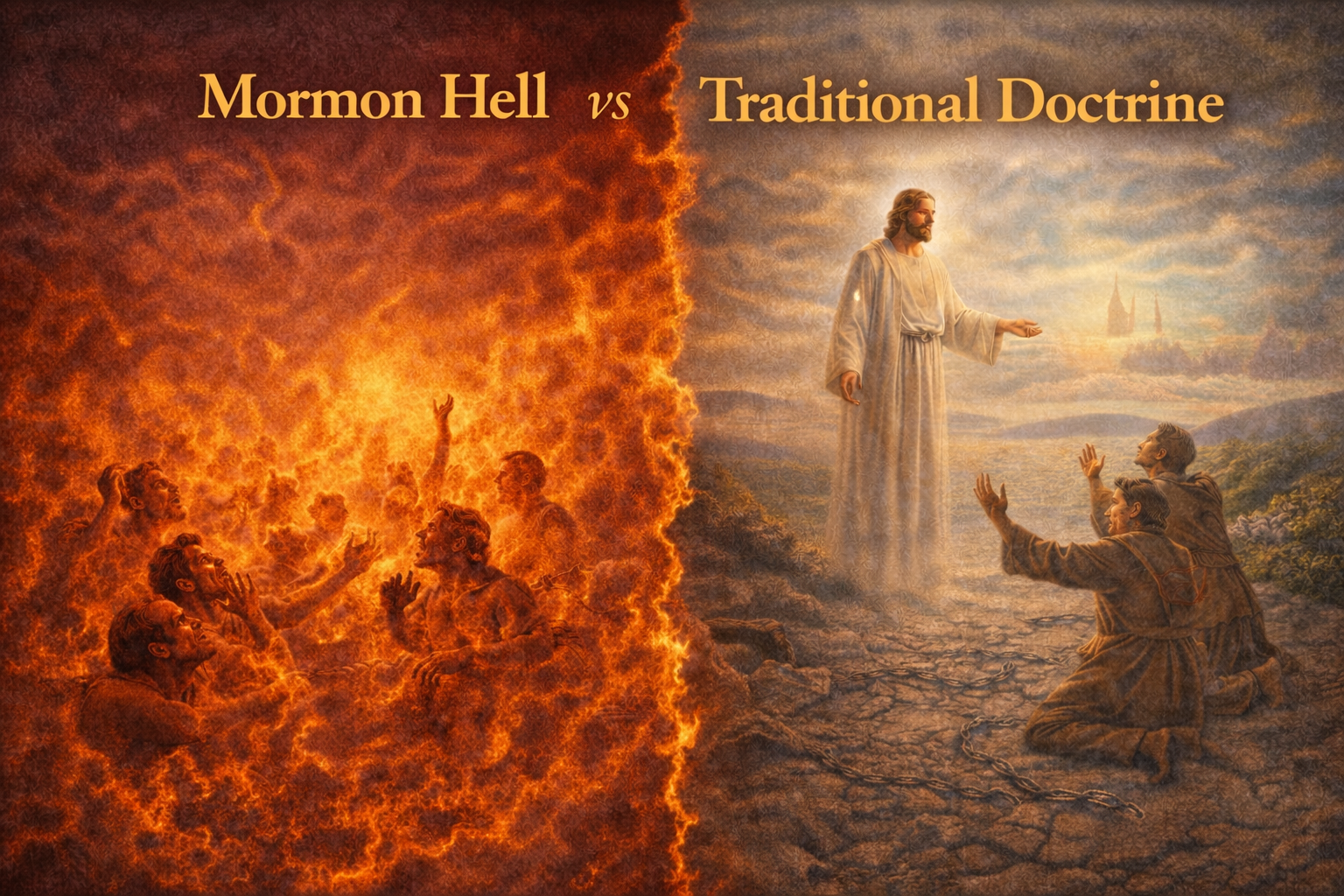
This episode examines the Latter-day Saint doctrine of hell and how it differs sharply from traditional Christian theology. For centuries, Christian thinkers—especially within Catholic and Protestant traditions—taught that every soul is created out of nothing at birth, that each soul has an immortal spirit, and that salvation depends entirely on accepting Jesus during mortality. According to these traditional systems, those who do not accept Christ in life are condemned to eternal torment with no end, no escape, and no mitigation. Under such a framework, God knowingly creates billions of His children who will suffer infinite and irreversible punishment forever. This created significant theological tension: How can God be both loving and all-powerful, yet create beings destined for endless suffering?
Some Christian groups attempted to solve this philosophical problem by developing annihilationism—the belief that the wicked are ultimately destroyed rather than tormented eternally. But Joseph Smith revealed a radically different understanding of hell, salvation, punishment, and divine justice. Latter-day Saint doctrine rejects both eternal torment and annihilationism and offers a unique perspective rooted in premortal existence, divine mercy, and eternal progression.
The Uniqueness of Latter-day Saint Doctrine on Hell
Latter-day Saint teachings differ from all other Christian denominations in several foundational ways. First, humans are not created from nothing. We existed eternally before mortal life, and thus God did not bring any spirit into existence knowing it would be consigned to everlasting torment. Second, salvation is far broader than in traditional Christian thought. Every soul who kept their first estate in premortal life and accepted Jesus there will ultimately be saved. Third, hell is not eternal. Doctrine and Covenants 19 teaches that “endless punishment” and “eternal punishment” refer to God’s punishment—meaning punishment that belongs to God, not punishment that lasts forever. Finally, every soul will eventually be redeemed except those who become sons of perdition. All others—no matter how wicked—will one day escape hell and inherit a degree of glory.
Joseph Smith’s Teachings from Doctrine and Covenants 19
Doctrine and Covenants 19, received in 1830 before the Church was formally organized, lays the doctrinal foundation for the Latter-day Saint understanding of hell. In this revelation, Christ teaches that He suffered so that humanity might not suffer if they repent. Those who refuse repentance must suffer, but that suffering is not endless in duration. Christ reveals the meaning of the terms “endless punishment” and “eternal punishment”: these phrases signify God’s punishment, not unending torment. Even this early in Joseph Smith’s ministry, the Lord distinguishes His doctrine from traditional Christian views of everlasting hell.
The Traditional Christian View Illustrated
The famous sermon Sinners in the Hands of an Angry God by Jonathan Edwards exemplifies mainstream American Christian belief in the 18th and 19th centuries. Edwards taught that God hates the sinner and that the sinner dangles over the fires of hell by a thin thread. The punishment is eternal, infinite in duration, and without hope of relief. After “millions of millions of ages,” Edwards emphasized, the suffering would not have diminished. Joseph Smith’s doctrine diverges entirely from this worldview. In place of eternal torment, Joseph taught a redemptive process governed by justice, mercy, and progression.
Doctrine and Covenants 76 — The Vision of the Degrees of Glory
The 1832 revelation now known as Doctrine and Covenants 76 further revolutionized the Christian understanding of the afterlife. This vision describes the telestial, terrestrial, and celestial kingdoms, revealing that every resurrected being receives a degree of glory except the sons of perdition. Remarkably, even the telestial glory surpasses all human understanding. The wicked suffer in hell until an appointed time. Once they have paid the price for their sins and accepted Christ, they are resurrected and inherit a kingdom of glory. The key doctrinal word in the vision is “until.” Hell is temporary for nearly all of God’s children. The radical nature of this teaching caused several early elders, such as Joseph Wakefield, to leave the Church because it contradicted their traditional Christian background.
Joseph Smith’s Nauvoo Teachings on Hell and Redemption
Joseph expanded these teachings during the Nauvoo period. He taught that only those who become sons of perdition—people who receive the Holy Ghost, have the heavens opened to them, gain a perfect knowledge of God and Christ, and then willfully rebel—will suffer punishment in the traditional eternal sense. Murderers, Joseph taught, cannot be forgiven in mortality and will suffer in hell until the resurrection. After they are resurrected, they inherit a degree of glory, though not exaltation.
Joseph also clarified biblical terms about the afterlife. He explained that the New Testament word “paradise” refers to the spirit world. Jesus spent time teaching the thief on the cross in this realm. Peter’s declaration that Christ preached to “spirits in prison” refers to the same state. Ordinances such as baptism for the dead are the means by which spirits are released from spiritual prison. Joseph taught that all saving ordinances were instituted before the foundation of the world and that no person can obtain salvation without them. Therefore, living Saints perform ordinances for the dead to enable their redemption and release from hell.
Joseph Smith’s Final Teachings on Hell (1844)
Shortly before his martyrdom, Joseph taught that Jesus Christ would save all except the sons of perdition. He declared that he had “no fear of hell” because the traditional Christian version of hell does not exist. Spirits suffer “until” they obey Christ. Ordinances for the dead allow redemption to occur even after mortality. Joseph repeatedly emphasized that hell is real, but it is temporary, and it ends when a soul chooses to obey Christ.
Brigham Young’s Acceptance and Teaching of the Doctrine
Brigham Young initially struggled to accept this doctrine because it challenged the religious ideas he grew up with. Over time, he embraced it completely and taught that it reflects God’s goodness, mercy, and kindness toward His children. He believed in a form of “universal salvation,” meaning that all will be saved except the sons of perdition. Even people who never heard of Christ in mortality will ultimately be redeemed. Brigham taught plainly: “All will be saved… except the sons of perdition.”
Summary: The Latter-day Saint View of Hell
Hell, in Latter-day Saint doctrine, is real and is a state or place of suffering caused by unrepented sin. It is temporary for all except the sons of perdition. It ends when individuals accept Christ and receive the ordinances necessary for salvation. It is not eternal in duration, not the permanent destiny of the wicked, and not equivalent to the traditional Christian doctrine of everlasting torment. The final state of mankind includes celestial glory for the faithful and terrestrial or telestial glory for others, with hell functioning only as a temporary condition of purification. This understanding makes Latter-day Saint theology completely distinct from all other Christian denominations.
Listen to the full podcast here: