
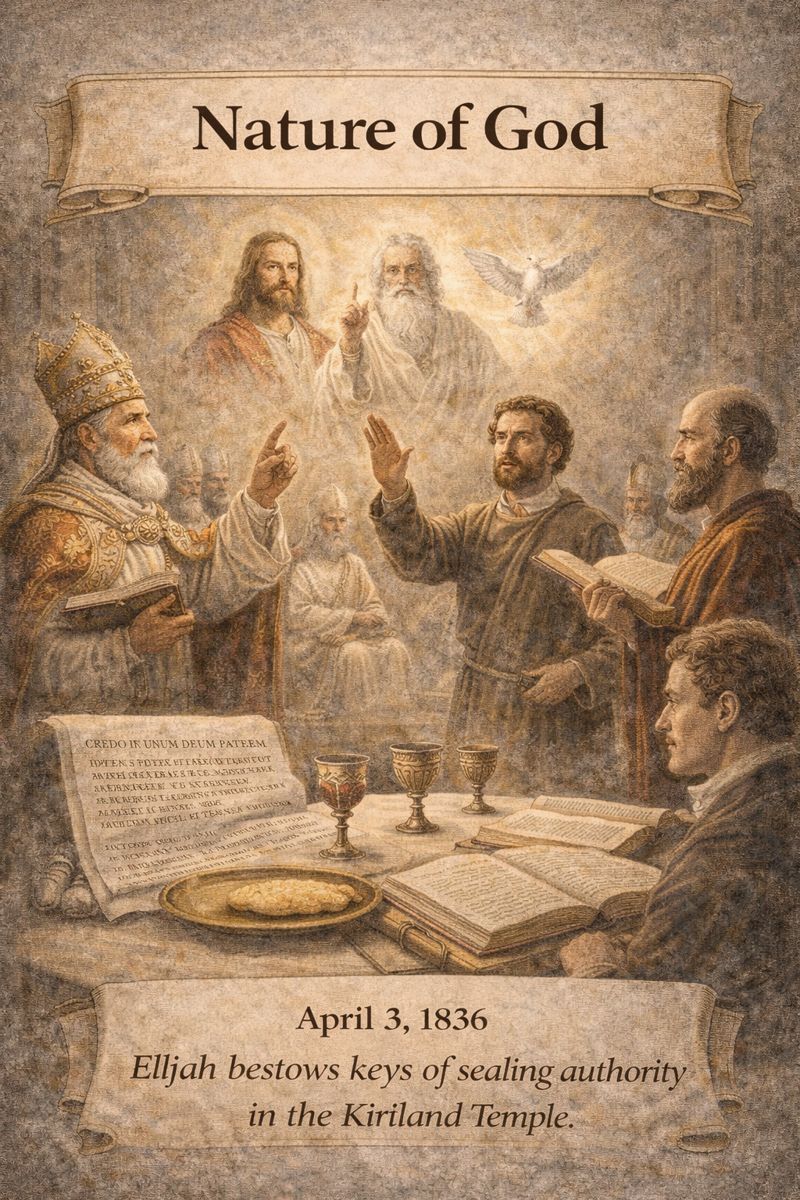
Nature of God
The Long Struggle of Early Christians to Explain God
This episode explores how the earliest followers of Jesus struggled for centuries to describe who God is, who Jesus is, and how the Holy Spirit relates to them. Early Christians inherited strict monotheism from Judaism while simultaneously proclaiming Jesus as divine, and this tension produced theological conflict throughout the first four centuries of Christian history. The process eventually led to defining what became mainstream Christian orthodoxy, but only after generations of disagreement, debate, and councils.
The Road to Nicaea and the Birth of Trinitarian Doctrine
The Council of Nicaea in AD 325 and the Council of Chalcedon in AD 451 established the Trinitarian model accepted by most modern Christian denominations. According to these creeds, the Father, Son, and Holy Spirit are one God, three distinct persons, sharing one substance or essence. These decisions did not arise in a vacuum—they were the culmination of centuries of argument over how to safeguard monotheism while affirming Christ’s divinity.
Long before Nicaea, Christians proposed multiple explanations. Some taught that God simply appeared in different modes as Father, Son, or Spirit—an approach called Modalism or Sabellianism. Others, like Arius, taught that Jesus was divine but created and therefore not co-eternal with the Father. Both positions were condemned as heresy by the emerging orthodox majority. These conflicts shaped the doctrinal world Joseph Smith later encountered—a Christian landscape already formed by centuries of councils, creeds, and philosophical explanations.
Modern Echoes of Ancient Debates
The Oneness Pentecostal movement, emerging in the early 20th century, revived a form of Modalism, teaching that God is a single person who reveals Himself differently as Father, Son, and Holy Ghost. This caused immediate friction with the Assemblies of God, who expelled Oneness adherents in order to preserve Trinitarian orthodoxy. Meanwhile, both Eastern Orthodoxy and Roman Catholicism hold to the Nicene tradition, though they diverged over historical issues such as the Filioque clause, which influenced the Great Schism.
These developments show that disagreements over the nature of God did not end in antiquity. They continued into the modern era and continue shaping Christian identity today.
Historical Hostility Between Jews and Samaritans
The episode also touches on the world of Jesus’s ministry. In the first century, Jews and Samaritans shared ancestry yet harbored deep hostility toward one another. The Samaritans claimed descent from ancient Israel and worshiped at Mount Gerizim instead of Jerusalem. This tension explains the shock value behind Jesus’s parable of the Good Samaritan and other moments in the Gospels where He uses Samaritan examples to challenge Jewish prejudice.
American Religious Diversity and Universalism
Nineteenth-century America contained a wide spectrum of religious teachings. Among them was the Universalist Church, which taught universal salvation—the belief that God ultimately saves all souls. While not directly connected to later Latter-day Saint doctrine, this background helps illuminate the rich religious environment in which the Restoration emerged, full of competing interpretations about heaven, hell, and divine mercy.
How Latter-day Saint Historical Records Were Written
Another theme of the episode is how sacred history is recorded in Latter-day Saint scripture. Joseph Smith’s history, compiled in 1838–1839, drew upon his earlier journals and memory, giving it a reflective tone rather than the immediacy of day-by-day entries. The Book of Mormon exhibits a similar approach: Nephi’s writings on the small plates were produced years after the events he describes, shaping them as retrospective narratives written with spiritual purpose.
Even the Gospel of John fits this pattern. Scholars widely view it as the most theologically developed of the four Gospels, composed decades after Jesus’s ministry. Like other scriptural authors, John wrote with the benefit of hindsight and with a clear theological intent, demonstrating that sacred history often blends memory, revelation, and narrative shaping.
The Book of Mormon Conflict That Echoes Through Centuries
The episode ends by recalling the recurring conflict between Nephi and his brothers Laman and Lemuel. Their opposition escalated from murmuring to physical violence, including repeated attempts on Nephi’s life. According to the Book of Mormon narrative, their division shaped the trajectory of entire civilizations: Nephites and Lamanites became rival peoples whose conflicts span generations. This ancient family fracture becomes a lens for understanding the broader themes of rebellion, covenant, division, and redemption that appear throughout Latter-day Saint scripture.